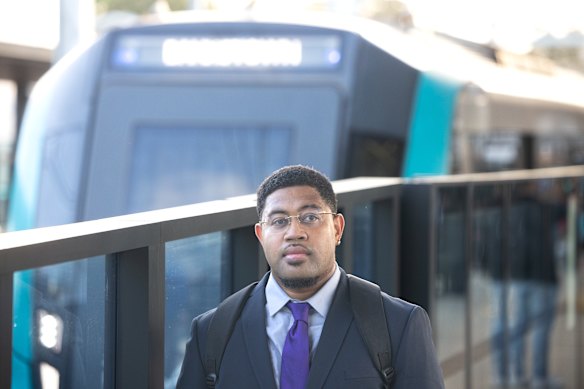

Pita Siganisucu could barely contain his relief on Friday.
The insurance worker from Greenacre was about to board the first-ever Metro service from Bankstown, after two years of commuting on replacement buses.
“I used to have an easy trip, train from Bankstown into Central. Then it became a bit of a nightmare; I had to take the buses and change over at Sydenham. And that nightmare consumed everything,” Siganisucu said.
“So I’ve been waiting for this for a while. We all have.”
At stations along the line there was excitement, joy and relief as the Sydenham to Bankstown metro extension finally opened after years of delays and construction woes.
Thousands of commuters who would once take a train on the T3 line from Bankstown, via the inner-west and into the city, have been forced to take buses that weaved their way through heavy traffic.
Some chose to abandon the route completely and found new ways to get to work. Natsumi Njuyen said she would drive from her home in Bankstown to Revesby then take a train to Central.
“It’s a stunning development,” Njuyen said of the opening.
“It’s probably going to take around the same amount of time, but there’ll be less chopping and changing, thankfully. And at least I don’t have to waste petrol any more.”
“Thank god,” was what truck driver Issa Abousleiman had to say about the opening. “I’m just happy I don’t have to catch those buses any more.”
Peak hour at Bankstown was a chaotic scene on Friday morning, with commuters navigating a media scrum to get onto the trains.
At other stations, locals were coming to grips with what the opening means for the region.
“It’s going to be massive for working mums and house prices,” said Jane Hajal as she got on a train from Punchbowl just after 8am.
“It’s going to save working mums so much time, especially between childcare pick-ups. It will make a huge difference.”
Hajal nodded outside the train window as Punchbowl flew past. “My aunty owns property along the train line, and she’s hoping her property prices will skyrocket.”
The line connects two distinct regions of Sydney to the rest of the metro line: the south-west and the inner west. Both are united by histories of working-class and migrant communities, still thriving in many of those areas.
Each stop along the newly extended line represents a different community – the Chinese and Lebanese communities in Bankstown, the Greek and Vietnamese communities in Marrickville, or the Bengali and Pakistani communities of Lakemba, with many crossovers across the region.
Despite the metro replacing an existing rail line, passengers said it would rejuvenate the connections between these suburbs and encourage people to explore the region.
“It’s a reminder to be tourists in our own city,” Karen Locke said, inspecting a map of the metro line at the Hurlstone Park station with her friend Kate Reid.
“When the line extended to Sydenham, you saw a lot of people from the north shore coming into Marrickville, particularly to do the brewery tours and to enjoy everything that Marrickville has to offer.
“I think it opens up the opportunity for those in the inner west to venture further into the south-west. Not that we didn’t have the opportunity with the old line, but because of the speed factor and the novelty factor, we’ll now make a point of going out to dinner in Bankstown.”
No suburb will be quite as impacted by the changes as Bankstown, which will become a transport hub, connecting bus routes, the old train line and future cycle routes to the metro.
The long shutdown has damaged the local economy, with shuttered businesses dotting the surrounding lanes and streets. An arcade across the road from the station appears to have withered from the lack of foot-traffic, leaving only a butcher and a perfumery open.
Adnan Nemme has owned and run Odette’s Perfumery for 35 years, and sitting among piles of his unmoved stock, he lamented the economic damage wrought by the rail line’s two-year closure.
“The closure ruined the area and ruined this arcade. They’ve ruined our lives and homes. It’s been a catastrophe,” he said.
“Now I can only pray and hope the people return.”
At Hurlstone Park, complaints trickled in about the volume of the loudspeaker at the new station.
One member of Facebook group, set up by residents to share their frustrations, said: “We are being tortured by the volume of the chimes and announcements.”
Resident Jamie Honan said the station “has been noisy for a while, even before the metro opened”.
“At the rate we’re going, and with the growth in people moving around the city, we have no other option than to improve the infrastructure,” he said.
Start the day with a summary of the day’s most important and interesting stories, analysis and insights. Sign up for our Morning Edition newsletter.
 Mostafa Rachwani is a Parramatta reporter at The Sydney Morning Herald. He was previously the Community Affairs reporter at Guardian Australia.Connect via email.
From our partners
Disclaimer : This story is auto aggregated by a computer programme and has not been created or edited by DOWNTHENEWS. Publisher: www.smh.com.au