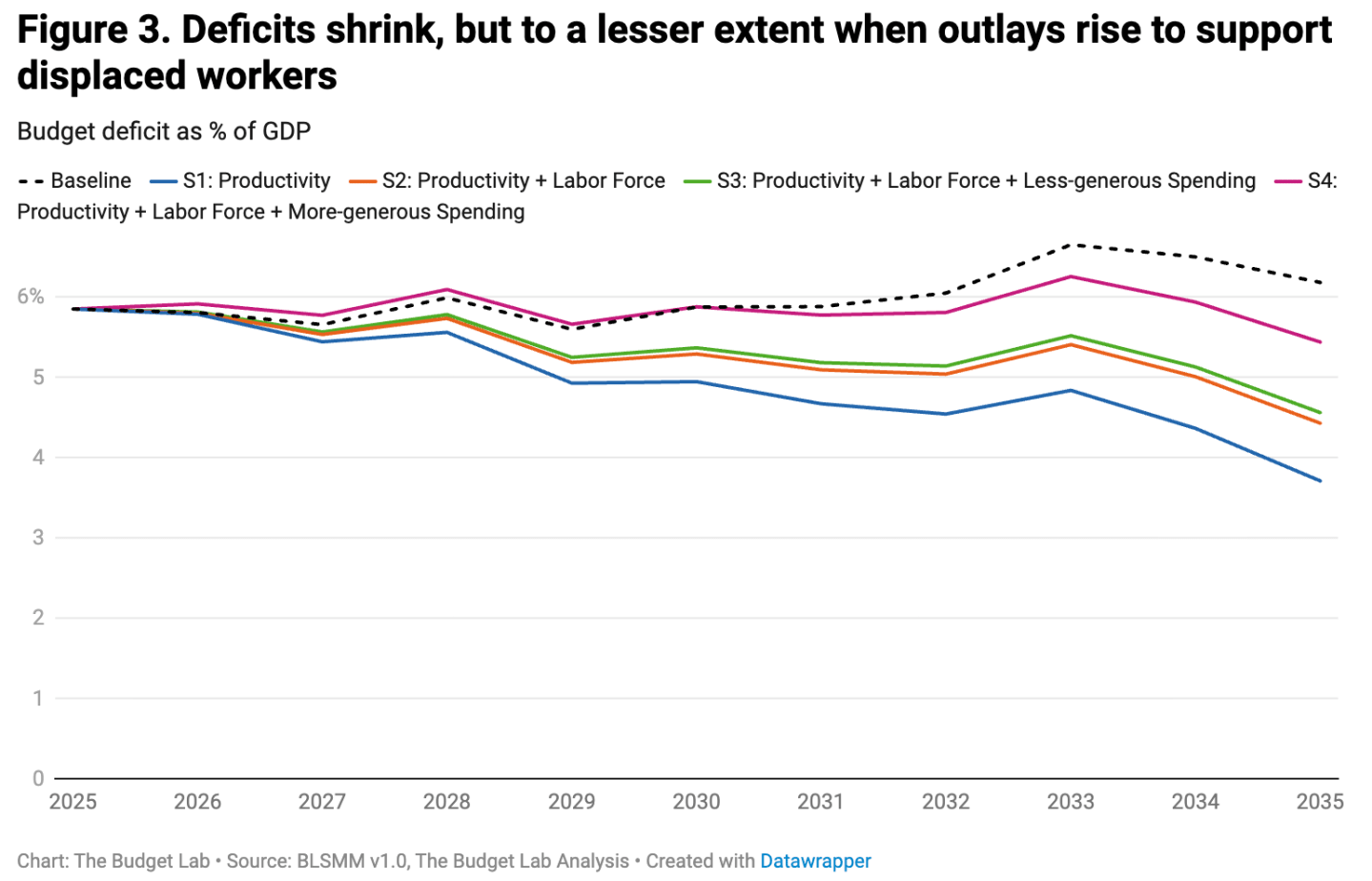
The big bet on AI—the near-trillion dollars that hyperscalers are spending to build out the technology’s infrastructure—is predicated on the belief that productivity will skyrocket.
If that bet pays off, a new report from policy research center Yale Budget Lab finds AI could help tackle one of the country’s most urgent crises: the $39 trillion national debt. The report offers a scenario on how AI could trim down the country’s piling debt, but comes with a significant caveat: to have AI productivity completely reverse the upward trajectory of the national debt, the government would have to forgo supporting the workers the technology displaces.
The study finds that moderate AI adoption could drive annual labor productivity growth of 2.5%—the median expectation among surveyed economists for 2025 to 2030—enough to slow, and eventually shrink, the debt-to-GDP ratio. However, increased federal spending to support displaced workers could hamper those plans. In a more-generous scenario, equivalent to the U.S.’s $42,400 retiree spending, and a less-generous one that matches the $5,500 spent per unemployed worker, productivity gains reduce the debt more than in a world where AI gains fail to materialize. But neither scenario is sufficient to keep the debt at its current level. That would require holding federal spending steady
“It seems unlikely that AI will be some kind of free, infinite money tree,” Martha Gimbel, executive director and co-founder of the Yale Budget Lab, told Fortune. “One, it depends on how big the productivity shock is and, two, how much you need to spend in response.”
The national debt just hit a sobering milestone last month, reaching 100% of GDP. Now, the U.S. is spending $88 billion a month on interest payments alone, a chunk of change roughly equivalent to defense and education spending combined. Getting the country back on a sustainable fiscal path within 30 years requires painful changes: large tax hikes, deep spending cuts, or some combination of the two, totaling $827 billion, in line with past defense budget proposals. Business leaders like Elon Musk have lauded AI productivity as a savvy fix to the country’s national debt.
While AI productivity gains may offer a simpler solution to the issue, the spending required to support the workers the technology threatens to displace—with spending proposals floated by everyone from Sen. Bernie Sanders (I-VT) to Sam Altman—is an added cost which Gimbel said policymakers must take into consideration when discussing AI productivity.
AI’s hidden fiscal costs
The report considers other revenue factors associated with an AI-induced productivity shock, mainly the consequences of shifting the burden of tax from labor to capital, as many business leaders and politicians have pointed out is a critical consideration given the threat of job displacement. Because capital is generally taxed more lightly than labor, the report warns AI productivity gains could inadvertently reduce federal revenues.
What’s more, another counterintuitive hurdle to debt reduction is the pressure on interest rates caused by rapid growth. Historically, faster productivity growth leads to higher rates, which will then increase the cost for the government to service its debt. The higher interest payments would partially offset the fiscal gains generated by AI.
To be sure, it’s not exactly clear to what extent AI will disrupt the labor market. While previously claiming AI will wipe out half of the entry-level white-collar workforce, Anthropic CEO Dario Amodei recently changed tune, saying the technology could actually transform and multiply roles rather than destroy them. And it’s not at all a guarantee AI will have the productivity gains the study assumes.
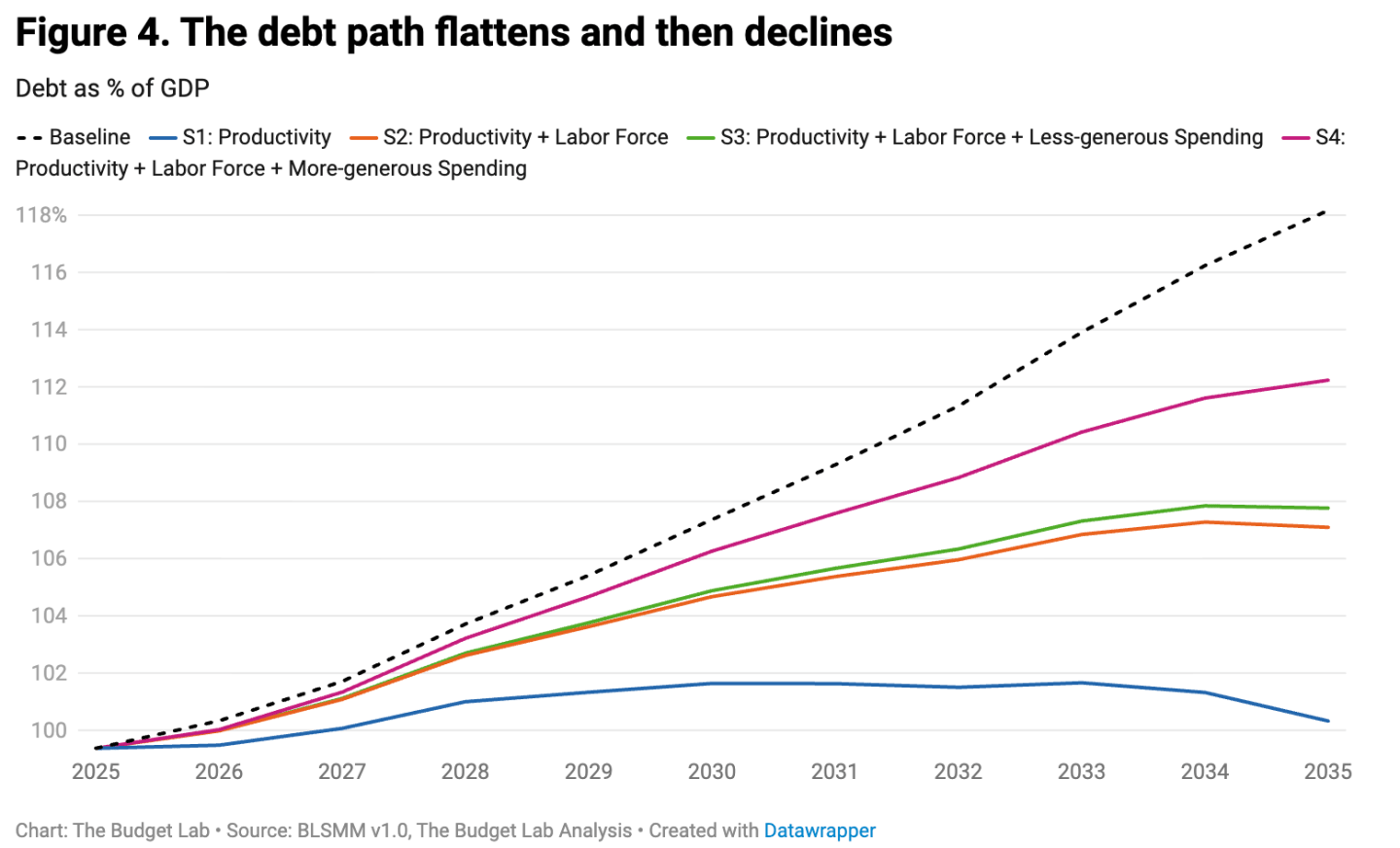
But the researchers emphasize that even if these productivity gains do materialize, they will not occur in a vacuum.
“I think it’s important to look at the industrial revolution — that obviously was a major productivity shock, but in that case there were substantial costs that the government didn’t manage,” Gimbel said. “It’s really important to keep in mind that productivity is not the only impact of AI.”
Disclaimer : This story is auto aggregated by a computer programme and has not been created or edited by DOWNTHENEWS. Publisher: fortune.com