
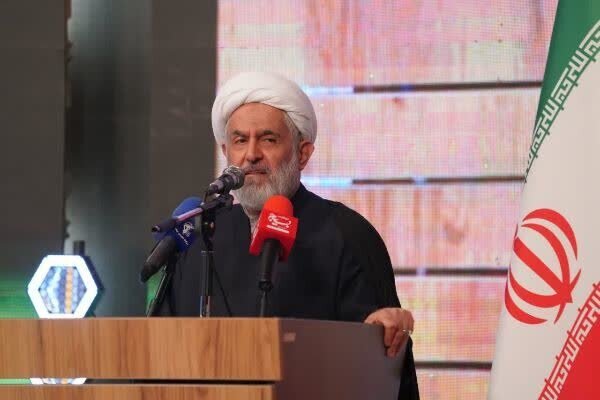
TEHRAN— Hossein Taeb, head of Iran’s Basij Organization, says the use of artificial intelligence in defense and intelligence operations has improved the accuracy of target identification and precision strikes, highlighting the technology’s growing role in Iran’s military capabilities.
Speaking on Thursday at the first Artificial Intelligence and Cybersecurity Conference in the southeastern city of Kerman, Taeb said AI had strengthened intelligence gathering and target assessment, adding that its applications had extended to the naval and aerospace divisions of Iran’s Islamic Revolution Guard Corps (IRGC) and other branches of the armed forces.
Taeb also discussed ‘the objectives of the US-Israeli war against Iran,’ arguing that attacks on military commanders, scientists and air-defense systems were intended to weaken the country’s defenses and undermine the scientific foundations of its development.
Protecting Iran’s scientific capabilities
Referring to the 12-day war, Taeb said the simultaneous targeting of military commanders and scientists was part of a strategy to weaken Iran’s security infrastructure and damage the scientific capabilities underpinning its technological progress.
He said the campaign against Iranian scientists had failed to eliminate the country’s nuclear expertise. According to Taeb, the scope of attacks expanded during the 40-day war, extending to other scientific fields and claiming the lives of researchers.
Taeb argued that the objective of such attacks went beyond military damage, encompassing efforts to undermine public security and weaken the country’s capacity for scientific and technological advancement.
“Targeting one scientist would not halt the country’s progress, as more specialists would emerge to continue the work,” he said.
AI and the changing landscape of military operations
Taeb described investment in artificial intelligence and cybersecurity as a strategic decision for Iran’s future, calling for these priorities to be translated into practical action by government institutions, policymakers and leading experts.
He said AI had already produced tangible results in the defense sector by improving intelligence assessment and the accuracy of target identification.
He further said AI-assisted systems had improved the detection of military vessels operating near the Strait of Hormuz and helped increase missile accuracy. Taeb argued that these capabilities had affected US military calculations and contributed to the relocation of American naval vessels farther from the area.
His remarks underscore the growing importance of AI-enabled intelligence, surveillance and targeting systems in contemporary military operations. Such technologies can help process large volumes of information, identify patterns and support faster operational decisions, although their effectiveness depends on data quality, system reliability and human oversight.
Taeb highlights disparity in military spending
Taeb also contrasted Iran’s defense resources with the much larger military budgets of the United States and Israel. He cited figures for US military spending and additional wartime funding requests, and said Israel had received $22 billion in additional US assistance for the conflict.
Despite Iran’s limited defense resources in foreign-currency terms, Taeb said the country had been able to withstand the military campaign. He argued that a comparable emphasis on scientific capability, technological innovation and strategic planning was necessary to sustain progress in the fields of AI and cybersecurity.
He called for artificial intelligence and cybersecurity to move beyond isolated technological initiatives and become part of a coordinated national strategy involving public institutions and the country’s scientific community.
The conference’s focus on young technology specialists, Taeb said, reflected Iran’s intention to expand its pool of skilled researchers and developers. In his view, strengthening domestic expertise in emerging technologies is essential not only to defense preparedness but also to the country’s broader scientific and technological development.
Disclaimer : This story is auto aggregated by a computer programme and has not been created or edited by DOWNTHENEWS. Publisher: tehrantimes.com






