
Labor is eyeing spending cuts to prove it is being more frugal to offset inflation and tackle internal unease about voter blowback, but influential party figures have claimed the RBA misdiagnosed the source of inflation and is arbitrarily hurting households.
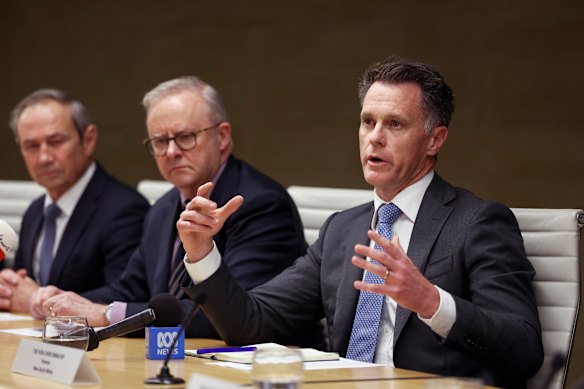
NSW Premier Chris Minns created a headache for Prime Minister Anthony Albanese when he declined to support Canberra’s fiscal approach. He claimed in a press conference on Wednesday he had long “heard the advice from the RBA over the last two years that we need to be careful with public funds”.
“I think every government has a responsibility to do what it can to take demand out of the economy,” Minns told reporters. “I’m not going to make a long commentary about other governments. It’s up to them and their decisions, obviously.”
Minns’ latest swipe at Canberra followed a press conference in which Treasurer Jim Chalmers played down the appearance of a split with RBA boss Michele Bullock. The governor said on Tuesday that inflation had been driven by “domestic capacity pressures” and that price pressures from the Middle East war were “in addition”.
Senior figures in federal Labor were surprised and frustrated by Bullock’s blunt assessment at her press conference, which challenged Labor’s key economic argument and was more direct than the bank’s earlier written statement. Bullock’s decision to be more explicit about domestic spending and productivity added to internal worries about Labor’s ability to turn around the economy.
The cabinet’s spending committee will examine options to lower outlays in its December budget update, according to a host of cabinet ministers, non-cabinet MPs and Labor figures who spoke on background to this masthead about an economic debate likely to be central to the next election.
“There’s a recognition that we will need to be seen to be more aggressive on spending,” said one MP, who asked to remain anonymous. “Hanson is making lots of claims about cutting spending, and we need to be seen to be conscious of the cost of living at the same time as reducing inflationary pressure.”
Chalmers was criticised by political opponents, the business lobby and economists after the bank hiked rates to a 15-year high.
He pushed back on a claim by economist Richard Holden that he was gaslighting voters when he claimed Donald Trump’s war was the primary driver of inflation. Chalmers pointed to Wednesday’s inflation data showing headline inflation growing to 4 per cent in August from 3.5 per cent in July. The underlying figure the RBA emphasises in its calculations was stagnant at 3.6 per cent, well over the 2.5 per cent midpoint target.
“The overwhelming reason why annual headline inflation has come up in August compared to July is because of the impact of higher global oil prices,” Chalmers said, arguing that the opposition had a huge unfunded agenda that would add even more to inflation.
But Deloitte Access Economics partner Stephen Smith said non-tradables inflation – goods and services not linked to international factors – remained high at 4.5 per cent.
“This means that the prices of goods and services that are not exposed to the whims of global price fluctuations are causing most of Australia’s inflation issue,” he said, saying the figure showed the RBA had been vindicated.
While Labor is likely to announce savings in December, some of its MPs are unconvinced by the calls of economists and conservatives seeking deep cuts. Former RBA boss Philip Lowe said on a podcast published by the Institute of Public Affairs that Labor should be running surpluses because revenues have been strong and unemployment has been low. Respected former officials Martin Parkinson and Ken Henry have made similar points.
Albanese said the Coalition would be tested on whether it supported Labor’s proposed cut to the private health rebate for older people, which will save $3 billion.
“You can’t say we want more savings and then oppose every saving,” Albanese told reporters in Melbourne, claiming Labor had saved $178 billion of hundreds of billions in unexpectedly high revenue.
This masthead revealed a fortnight ago that a growing minority of Labor MPs were critical of the government’s handling of inflation and productivity.
A cabinet minister said they were largely in the dark about Labor’s strategy on fiscal management and productivity, which was rarely discussed in weekly cabinet meetings. They noted Chalmers was often “grumpy and low”.
But the senior MP said Labor’s “wicked dilemma” was that the voters being hit by mortgage rises were often reliant on government services that would be cut if Labor slashed areas such as health or aged care.
A more junior MP agreed that it was not an easy task to find spending cuts and could not find major fault with Chalmers’ policy agenda. But, they argued, Chalmers should “be more honest” and tone down his political spin when explaining that both domestic and international factors were at play.
They suggested that other ministers such as Assistant Treasurer Daniel Mulino or digital economy junior minister Andrew Charlton should do more of Labor’s economic messaging.
Chair of parliament’s economics committee, Labor MP Ed Husic, told ABC the RBA’s call was unfair and Australia’s institutions needed to find new ways to repair wealth for middle Australia.
Emma Dawson, head of Labor’s Chifley Research Centre, said the bank’s call “whacks people already under extreme pressure”. She argued that the class of monetary policymakers and laissez-faire economists were relatively well-off and not in touch with a growing group of voters, especially those who had drifted to One Nation, who lost out from decades of deregulation.
Dawson pointed to the speech by UK Labour Prime Minister Andy Burnham this week calling for a transformational pivot to state intervention to help restore neglected communities. A politics which drastically lowered spending and relied on an “extractive” form of capitalism was “just not going to last”, Dawson said.
Former Victorian Labor minister Philip Dalidakis, who runs consulting firm Orizontas, said the RBA’s rate rise was an “absolutely ridiculous decision” that would hit demand when the war had created a supply problem by spiking the cost of production.
“The biggest spenders are state governments on infrastructure, and so state governments need to heed the warning far more than the federal government does,” Dalidakis said, pointing to the Victorian government and its Suburban Rail Loop that Albanese is partly funding.
Cut through the noise of federal politics with news, views and expert analysis. Subscribers can sign up to our weekly Inside Politics newsletter.
 Paul Sakkal is Chief Political Correspondent. He previously covered Victorian politics and won a Walkley award and the 2025 Press Gallery Journalist of the Year. Contact him securely on Signal @paulsakkal.14.Connect via X or email.
From our partners
Disclaimer : This story is auto aggregated by a computer programme and has not been created or edited by DOWNTHENEWS. Publisher: www.smh.com.au