
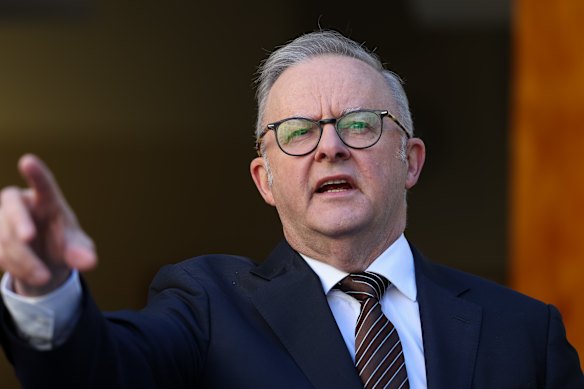

Whichever way you slice the data, the latest Resolve Political Monitor is bad news for Prime Minister Anthony Albanese.
The government’s primary vote is malingering at 28 per cent, still ahead of One Nation’s primary vote of 25 per cent and the Coalition’s even more paltry figure of 22 per cent.
But the voters are marking Albanese down hard on all sorts of metrics, from preferred prime minister to performance to likeability.
The most telling, and potentially the most damaging, long-term number is on trust. The awarding of a $6 million grant to the Marrickville Golf Club, in the prime minister’s electorate of Grayndler, has hurt him badly.
Just one in five voters now say they still trust the prime minister, while 22 per cent said they had lost trust in him over the issue, and 43 per cent of people – climbing 9 percentage points since September – stated they did not trust Albanese before the Marrickville grant saga surfaced.
Trust, once lost, can be just about impossible for a prime minister to win back from voters.
And it’s not like a quick change of prime minister or treasurer will fix things, either, despite the grumbling and, perhaps, hopes of some conservative critics.
One minister in the government posted a net positive likeability score. Health Minister Mark Butler recorded a result of plus 1 per cent – it might not sound like much, but it’s a heck of a lot better than Albanese (minus 19 percentage points) and Chalmers (minus 11 percentage points).
But Butler is one of Albanese’s closest political allies and is unlikely to ever challenge. There is really only one thing the government can do now.
The Labor caucus, full of first-termers with no idea what midterm blues look like, has little choice but to lock in behind Albanese and Chalmers and stop wetting the bed about the government being unpopular.
While the newbies in caucus figure that part out, they should also cross their fingers and toes that the government’s most senior figures have some idea what they are doing and that, starting with next month’s mid-year budget update, Labor finds real savings so pressure on the Reserve Bank to keep raising interest rates eases.
These poll numbers at the midway point of the term should hardly be a surprise after a budget that made hugely ambitious changes to negative gearing, capital gains, the tax treatment of trusts and the National Disability Insurance Scheme.
Albanese is at times likened to Labor’s legendary former prime minister Bob Hawke, but in many ways it is Liberal predecessor John Howard who makes a better comparison.
Howard saw his poll numbers crash more than once during the course of his four terms in office.
Six months before the November 2001 election, a leaked memo from then-Liberal Party president Shane Stone revealed that voters found Howard “mean and tricky”. It was a disaster and, in the minds of some, presaged the electoral thrashing voters were about to hand Howard.
Except it never happened. Over nearly 12 years in office, Howard’s standing with voters waxed and waned, much as it has for Albanese so far.
Albanese, like Howard, does not need to be liked by voters to win the next election. But there does need to be a residual level of trust – something Howard enjoyed – that the prime minister is doing what he thinks is best for the country.
Albanese needs to rebuild that trust with four out of every five voters, both by persuading them his government can manage the economy more effectively than his opponents and by showing that Labor is the best party to lead at a time of global turmoil.
The Reserve Bank expects inflation to stay higher for longer, so the government has little choice but to lock in and prepare for more economic pain.
The government is still ahead on primary vote (just) while Albanese remains ahead as preferred prime minister too (again, only just). The prime minister will be hoping that if this is not rock bottom for Labor, it is at least close, and that like Howard, enough voters will come to trust that he is governing in the national interest, even if they really don’t like him.
Cut through the noise of federal politics with news, views and expert analysis. Subscribers can sign up to our weekly Inside Politics newsletter.
 James Massola is Chief Political Commentator. He has previously been National Affairs
Editor and South-East Asia Correspondent, and has won Quill and Kennedy awards and is the 2026 Press Gallery Journalist of the Year. Connect securely on Signal @jamesmassola.01Connect via X or email.
From our partners
Disclaimer : This story is auto aggregated by a computer programme and has not been created or edited by DOWNTHENEWS. Publisher: www.smh.com.au



