Updated ,first published
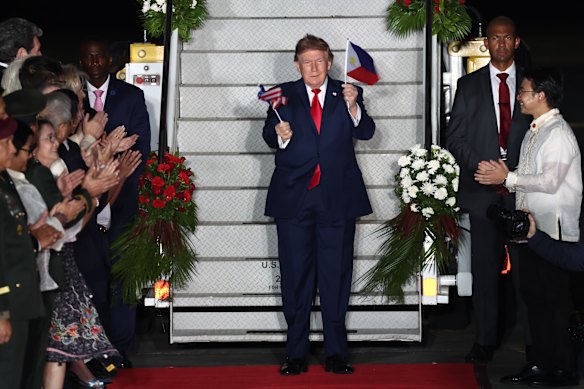
Manila, Philippines: United States President Donald Trump has landed in the Philippines and will meet Prime Minister Anthony Albanese for his first stop in a diplomatic blitz through Asia following the bruising midterm elections.
Trump and Albanese will on Tuesday evening sit down with Indian Prime Minister Narendra Modi and Japanese Prime Minister Sanae Takaichi for the first Quad meeting that the US president has attended in person.
The security partnership of Australia, the US, India and Japan has not held a leaders meeting since 2024, when Joe Biden was president, creating anticipation around Trump’s attendance in Manila on the sidelines of this year’s ASEAN summit.
The president waved two Philippines and US flags that were handed to him as he disembarked Air Force One, where he was greeted by dozens of school children on Tuesday night, as a band played his campaign favourite, YMCA.
He then embarked on a helicopter to fly to a hotel nearby where the Quad summit and an ASEAN closing night gala are being held.
But with just 55 minutes set aside in the president’s schedule for the Quad before he moves on to other engagements, there are low expectations the meeting will lead to comprehensive new initiatives.
In a speech at the East Asia summit earlier on Tuesday, Albanese pitched the Quad as an effective way for countries to work together “to respond to common threats better”, after he condemned aggressive actions in Myanmar, North Korea and, particularly, Russia.
“At this important moment we need to cooperate on the urgent challenges that confront each of our sovereign nations,” he said, adding “that’s why Australia is working with Quad partners to address the most pressing issues.″
The first Quad leaders’ meeting in two years will send a signal to Beijing. In an article previewing the meeting, the Australian Strategic Policy Institute’s Raji Rajagopalan and Justin Bassi said that was its most important function.
“Whether the summit produces a substantive new outcome is less of an issue than the political signal they send to the region and above all China by coming together,” they wrote.
“The location of this Quad meeting is yet another important signal. Manila was the city where the Quad made a comeback in November 2017… That the Quad’s initial demise had only incentivised China to step up malicious activity was a core reason for the group’s resurrection.”
Biden elevated the Quad to a leaders-level grouping in 2021 as a way to provide a democratic bulwark to China in the Indo-Pacific. But the grouping has faced persistent questions about its relevance and purpose while tensions between the US and India on trade have undermined its cohesiveness.
A planned Quad summit in Sydney in 2023 had to be scrapped when Biden could not travel because of debt ceiling negotiations, and plans for India to host the summit in 2024 were scrapped because of scheduling issues. The meetings were instead held in Japan and the US.
Trump has not participated in a Quad meeting since he returned to office in 2025 and his decision to impose sweeping tariffs on India damaged what had been a close relationship with Modi.
Rajagopalan and Bassi said Beijing would have hoped those political differences between the US and its partners would have killed off the Quad again.
“So this year’s summit will be more than a small disappointment to China,” they wrote. “Beijing fears the Quad because it makes China’s aggression visible and shows that the US and three regional powers will consistently back the region’s smaller powers.”
After Quad foreign ministers met this month in Atlanta, Georgia, they expressed “grave concerns” about economic coercion through export restrictions and nonmarket policies, in a clear critique of China.
They vowed to deepen co-operation on critical minerals, artificial intelligence, maritime security and energy security while working together to build a new port in Fiji, where geopolitical competition with China has been fierce.
While those issues should dominate the meeting, Albanese has previously said he would also advocate de-escalation of the war in the Middle East when he came face to face with Trump at this week’s ASEAN and APEC conferences.
“I have a good relationship with President Trump. He’s aware of Australia’s very strong views that we want to see a de-escalation, because it’s having an impact on the region… where the conflict is occurring,” he said on Sunday.
“But it’s also having an impact on supermarket shelves in the United States, in Australia, in the Philippines, right around the world.”
Trump is suffering record low approval ratings at home as the economic fallout caused by his war on Iran has become one of several factors turning public sentiment against him.
The US president will spend less than 24 hours in the Philippines before flying to the APEC summit in the tech hub of Shenzhen, China, on Wednesday. Trump will meet Chinese President Xi Jinping and Russian President Vladimir Putin for a historic trilateral meeting on Thursday.
The Quad meeting with Trump on Tuesday will allow the other leaders, including Albanese, to convey their coordinated message and priorities on Indo-Pacific security before the leaders of the three great powers come together.
Cut through the noise of federal politics with news, views and expert analysis. Subscribers can sign up to our weekly Inside Politics newsletter.
 Natassia Chrysanthos is Federal Political Correspondent. She has previously reported on immigration, health, social issues and the NDIS from Parliament House in Canberra.Connect via X or email.
 Matthew Knott is the foreign affairs and national security correspondent for The Sydney Morning Herald and The Age.Connect via X, Facebook or email.
From our partners
Disclaimer : This story is auto aggregated by a computer programme and has not been created or edited by DOWNTHENEWS. Publisher: www.smh.com.au