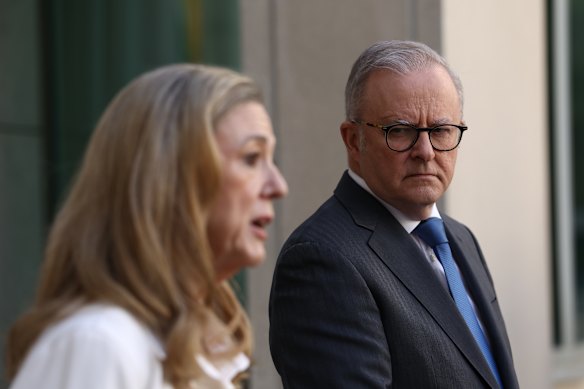

Prime Minister Anthony Albanese allowed Senator Tammy Tyrrell to keep additional well-paid staff typically assigned to those on higher duties when he drafted her to the Labor Party, after slashing the staffing allocations of his political opponents.
The former Jacqui Lambie Network senator now has the same additional staffing as 13 Labor colleagues who hold assistant minister or special envoy duties, prompting crossbench MPs and transparency experts to demand staffing decisions be stripped from Albanese and handed to an independent authority.
Backbenchers are allocated at least five electorate officers under the Member of Parliament (Staff) Act, currently paid between $75,000 and $100,000 per year. After Tyrrell left the crossbench in May to join Labor she retained two adviser-level staff. One is paid between $110,000 and $155,000, the other between $92,000 and $110,000.
The prime minister’s authority to make decisions on staffing levels is a longstanding feature of Australian law. However, Albanese’s use of the power has been frequently criticised. Immediately after Labor regained government at the 2022 election Albanese cut staffing levels to the expanded crossbench, and did the same to the Coalition following their wipeout at the 2025 election.
Both Tyrrell and the prime minister’s offices refused to answer questions on the advisers’ duties or whether their retention was part of negotiations to join Labor. Neither office responded to a question seeking justification for Tyrrell having more staff than her government backbench colleagues.
Three years ago, Tyrrell condemned the prime minister’s staffing powers as “a potential corruption risk” in an opinion piece for Guardian Australia in which she lamented the lack of appeal rights for opposition and crossbench MPs.
“It’s clear there’s a role for an independent body to determine what’s reasonable, to make sure it’s done at arm’s length, transparently and without prejudice,” Tyrrell wrote.
Her office did not respond to a question asking if this is still her position. Tyrrell was elected under Lambie’s banner in 2022, but quit the party in March 2024 and sat as an independent until May this year.
Labor colleagues speaking on condition of anonymity said Tyrrell’s workload did not justify the additional staff, who could have been reassigned to MPs serving as committee chairs with significantly more responsibilities.
The government does not view Tyrrell’s move to Labor as a reason to dismiss or transfer her two extra staffers, but the roles would be dissolved should the employees resign.
Senator Fatima Payman, who defected from Labor last term over the party’s stance on the Israel-Gaza war, has not been assigned additional staff unlike the majority of crossbench senators. Last week, in an unlikely press conference appearance alongside Pauline Hanson and independent Dai Le, she accused Albanese of demonstrating “anti-worker behaviour” by overburdening her staff.
“I know the prime minister wants to punish me, but he should not be allowed to play favouritism. There should be an independent process that guides resourcing when it comes to parliament, not the whims of a petty man,” Payman said.
Le, who won the Labor heartland seat of Fowler at the 2022 election, only has one additional staff member while teal independents such as Sophie Scamps and Monique Ryan have two. Le said Albanese had never provided justification for the discrepancy. Hanson said she was “begging” the prime minister to staff One Nation’s offices after they reached minor party status in May.
Earlier this year opposition housing spokesman Andrew Bragg said the Coalition under Sussan Ley was offered additional staff in exchange for their support of a seemingly doomed shakeup of the freedom of information system. The bill failed to find support in the Senate and was shelved.
Dr Catherine Williams, executive director of the Centre for Public Integrity, said adequate staffing was vital to hold governments to account, and repeated calls for an independent body to decide personal staffing allocations.
“Leaving staffing allocations to the discretion of the leader of the government – who may see their interests as at odds with scrutiny – creates a troubling conflict of interest and potential for abuse,” Williams said.
According to the most recent data, Jacqui Lambie has three personal staff, David Pocock and Lidia Thorpe each have two. United Australia Party’s sole senator Ralph Babet has one personal staff member.
Greens leader Larissa Waters employs 15 personal staff, while her colleague Sarah Hanson-Young employs one. By comparison, Hanson has two personal staff, while One Nation senators Malcolm Roberts and Sean Bell are entitled one staff member each.
In the House of Representatives, numbers are similarly arbitrary. All teal independents have two personal staff, except for newest addition Nicolette Boele who has just one.
Regional independents Bob Katter and Andrew Gee each have two personal staff, but Greens MP Elizabeth Watson-Brown and One Nation MP Barnaby Joyce have one. Joyce’s newest colleague David Farley says he has no additional staff. Joyce and Farley both represent electorates bigger than Tasmania by area.
Cut through the noise of federal politics with news, views and expert analysis. Subscribers can sign up to our weekly Inside Politics newsletter.
 Nick Newling is a federal politics reporter for The Sydney Morning Herald and The Age.Connect via X or email.
From our partners
Disclaimer : This story is auto aggregated by a computer programme and has not been created or edited by DOWNTHENEWS. Publisher: www.smh.com.au