Elon Musk has called director Alex Gibney a “bitter old man,” a “horrible human” and less deserving of respect than dog excrement. He has accused the Oscar-winning filmmaker, whose documentaries have tackled Scientology, Enron, Lance Armstrong and Elizabeth Holmes, of having “zero integrity” and dismissed his movies as “boring af.” And to his hundreds of millions of followers on X, Musk reposted an image of Gibney with a poop emoji on his head. “It’s an improvement,” he wrote.
The occasion for all this abuse is “Musk,” Gibney’s damning, nearly four-hour documentary about the trillionaire, which hits theaters in Los Angeles and New York Friday after causing a stir on the festival circuit. Yet the 72-year-old Gibney seems unbothered by the barrage as he logs on to Zoom in a black hoodie from his home in Brooklyn, fresh from a Sunday game of tennis.
“Do I get a lot of angry tweets from Elon and his pals? Yes, and I’m sure that will ramp up once the film is out,” Gibney says.
Still, he admits, “I don’t want to have him inside my head all the time. It’s punishing.” Hence the tennis.
“He’s the richest man on Earth but he’s also sort of a stubborn adolescent at the same time,” Gibney says. “He’s both a guy with real power and a sort of human meme.”
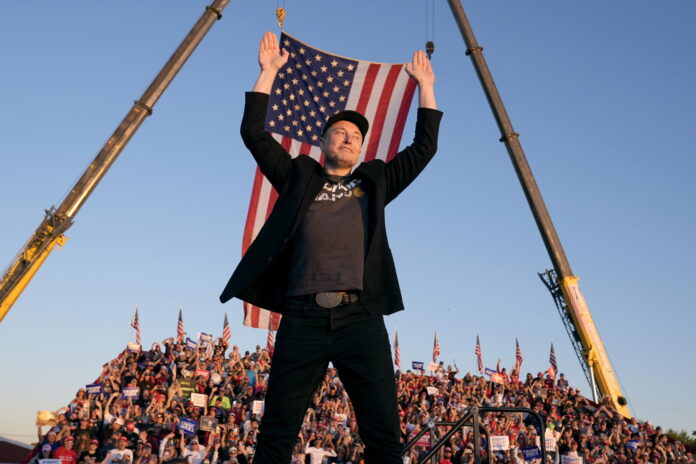
Elon Musk in Alex Gibney’s documentary “Musk.”
(Alex Brandon / AP)
Drawing on interviews with Musk’s family, former friends and employees, journalists and business associates — though not Musk himself — Gibney traces the tech entrepreneur’s epic rise and the mythology that grew with it: a real-life Tony Stark who would conquer space and help save humanity. As Musk’s personal life becomes more chaotic and his public behavior more erratic, his power only expands, from self-driving cars and rockets to his takeover of Twitter and rechristening of it as X, artificial intelligence and, with his embrace of President Trump, the machinery of American democracy itself.
In one of the documentary’s more chilling moments, Ashley St. Clair, the former conservative influencer who has a child with Musk, offers a stark assessment of all that concentrated power: “Elon is a nuke.”
Musk has called the movie a hit piece and a “psy op,” portraying those who appear in it as disgruntled former associates with axes to grind. His lawyer, Alex Spiro, has threatened to sue Gibney, accusing the film of falsely implying Musk used Starlink to sway the 2024 election and claiming his team was rebuffed when it tried to provide information during fact-checking. Jigsaw Productions, Gibney’s production company, defended the film as a fact-based examination of a powerful public figure protected by the 1st Amendment.
Gibney doubts Musk has even seen the film.
“I don’t really hope for a lawsuit, but if he does, so be it,” he says. “Discovery should be interesting.”
Gibney didn’t initially come to the project as a Musk skeptic. When he first began work on “Musk” four years ago, he had Tesla solar panels on his house and admired not only Musk’s clean-energy ventures but what he calls his “fumbly charisma” and the way he engaged with ordinary people online.
The filmmaker’s first move was to try to speak to Musk himself. Producer Jessie Deeter, who had previously worked with Musk, had his cellphone number and email address and repeatedly tried to persuade him to participate. Musk’s only response, Gibney says, was a public post on X calling him a “douche.”
“Which I took as a no,” he says, dryly.
With Musk unwilling to sit for an interview, Gibney and his team came up with a work-around. Inspired by Musk’s fascination with the idea that reality itself may be a simulation, the filmmakers created a CG avatar in his likeness — realistically rendered but clearly artificial — dressed in a black leather jacket and seated in a gamer chair. The avatar recurs throughout the film, speaking words drawn from Musk’s interviews and public appearances.
“I think Elon should be happy with the presentation,” Gibney says. “I want my main character to look good.”
Musk was hardly the only person reluctant to talk. Gibney says even potential sources worth hundreds of millions of dollars feared being sued — an irony, he notes, given Musk’s self-description as a “free speech absolutist.” Others became more willing to speak as Musk moved further to the right, Gibney says.
Among those who agreed to talk was Musk’s first wife, Justine, who met him when they were students at Queen’s University in Canada. She told Gibney she was drawn to Musk’s almost preternatural confidence — the sense that whatever he said he was going to do, he would somehow make happen.
“The more I thought about him as a ‘confidence man’ in all of the meanings of that term, what Justine said really resonated with me,” Gibney says.
Meanwhile, Musk kept outrunning the movie with his controversial behavior.
By the spring of 2024, Gibney had a nearly finished two-hour cut he hoped to take to the fall festivals. But after Trump survived an assassination attempt and Musk endorsed him, executives at HBO, which had already acquired the film’s TV and streaming rights, urged Gibney to keep going. “They said, ‘You’re not done. You should keep following the story, and follow it where it leads,’ ” Gibney says. “And so I did.” The film eventually ballooned to six hours before Gibney began whittling it back.
For all its length, the film leaves some threads only partly explored. One is Musk’s reported drug use. In 2024, the Wall Street Journal reported that he had used LSD, cocaine, ecstasy and psychedelic mushrooms. Musk, who has said he takes prescribed ketamine for depression, denied it, citing years of random drug tests that found “not even trace quantities” of drugs or alcohol.
“I went as far as I felt I could on the record,” Gibney says, adding he sees drugs as just one part of a “pretty toxic stew,” alongside Musk’s childhood trauma, his Twitter use and the destabilizing effect of so much power.
And while “Musk” shows its subject’s much-debated arm-extended gesture — widely condemned as a Nazi salute — at a 2025 Trump inauguration event, it moves past it quickly. Given how closely the film examines Musk’s ties to the far right, why not explore that incident further?
Gibney answers without much hesitation. “I think that’s a classic Elon moment,” he says. “On the one hand, you can say, ‘Whoa, it’s clearly a nod to the far right.’ Or is he having us all on? Is it just LOL? Is it a meme? It’s hard to know.”
Musk’s increasingly right-wing politics are clear, Gibney says, but he is less certain what beliefs actually underpin them. He points to Musk’s argument that because Nazis were called National Socialists, all socialists are Nazis. “That’s the dumbest thing ever — it’s just trolling,” Gibney says. “I think the more dangerous thing about Elon is that it may be that he no longer has a coherent philosophy.”
“I think he deeply needs to be loved,” Gibney continues. “Part of that is surrounding yourself with yes-men — in this case, a harder and harder right group — and casting out and hating the others who are not part of that group.”
Digging into the incident, Gibney says, would have meant “playing Elon’s game” — trying “to put the pieces together like a conspiracy theorist would do to make sense of the chaos.” Asked for his own read, he says, “I think he wanted to have it both ways.”

Elon Musk at the White House in 2025 during his time as an advisor to President Trump.
(Kevin Dietsch / Getty Images)
Some of the film’s most provocative material concerns the 2024 election. St. Clair shares private texts from the run-up to the election in which Musk refers cryptically to an “anomaly in the matrix” and “10,000 lasers in space,” a reference, she believes, to Starlink, SpaceX’s satellite internet network. On election night, Musk appears to know unusually early that Trump has won, telling her, “We have the best real-time data.”
Gibney says he doesn’t believe Musk manipulated votes, but the sequence leaves open what, if anything, lay behind his apparent early certainty. Later in the film, Nobel Prize-winning computer scientist Geoffrey Hinton warns that the government data gathered by Musk’s so-called Department of Government Efficiency could be exploited with AI to interfere in future elections.
Gibney acknowledges that he doesn’t know what Musk meant. “It could be that he was just bulls— his lover and wanting to impress her,” he says. “But if I were to hazard a guess — and it’s just a guess — one of the things he may be contemplating in the 2026 midterms is casting doubt on results that may go the wrong way, as far as he’s concerned.”
The election sequence raises the question of whether the film risks encouraging the same kind of conspiratorial thinking it finds troubling in Musk.
“I purposefully don’t go to the place where I say, ‘This is exactly what happened,’ ” Gibney contends. “I’m laying out a fact pattern that I think should concern us.”
For all the apocalyptic overtones in the film, Gibney doesn’t want audiences to come away feeling hopeless.
“It’s a very dark comedy that turns to a horror film at the end,” he says. “What I want them to take away is that we need to find a way to hold this guy to account, to take back some of the power we’ve given him.”
The problem with finishing a movie about Elon Musk, of course, is that Elon Musk keeps going. Last week, the Pentagon announced that Musk would help lead a new project examining the future of warfare.
“I find it terrifying,” Gibney says. “It’s like putting the Joker in charge of the Manhattan Project.” He suspects the arrangement amounts to a bailout of xAI, Musk’s artificial intelligence company and the maker of the Grok chatbot. “Elon is extraordinarily good at reward hacking from the government.”
After four years, does he know what Musk ultimately wants? “I don’t think he knows,” Gibney says. “And I think that’s the scariest thing of all.”
Musk is only 55. As exhausted as Gibney may be with the subject, he can’t entirely rule out “Musk 2.”
“It’s not a sequel I’m looking forward to,” he says. “But if called upon, I will serve.”
In the meantime, he has one last piece of Musk-related business, once the PR push for “Musk” is over: He plans to cancel his X account.
More to Read
Disclaimer : This story is auto aggregated by a computer programme and has not been created or edited by DOWNTHENEWS. Publisher: latimes.com