
Campaign finance experts have urged the Victorian government to recall parliament and introduce emergency legislation to prevent the flow of dark money to political candidates ahead of this year’s state election.
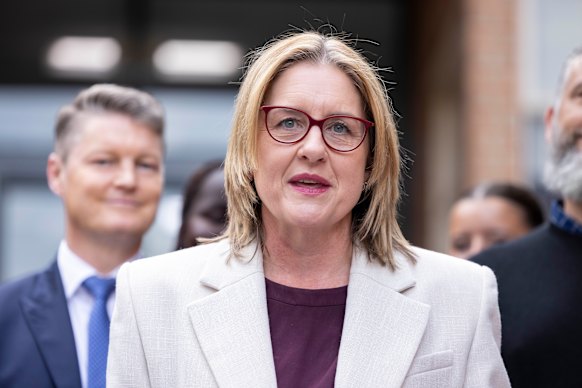
Premier Jacinta Allan said the High Court’s shock decision to strike out all regulation of campaign finance from Victoria’s electoral law had blinded the state to how much money is being pumped into the election or where it is coming from.
She vowed to “move quickly and immediately to bring back transparency … to bring back a strong framework of election integrity”.
“This is very important to me. Victorians deserve to have a system where they can see where the money is coming, who it is flowing to,” Allan said.
However, the premier added that she had no plans to recall parliament ahead of its next scheduled sitting in three weeks’ time for the state budget, saying that whatever regime the government introduced would retrospectively apply from the date of Wednesday’s High Court judgment.
The premier’s timeline means that the Nepean byelection, where One Nation is mounting a serious challenge to the Liberal-held seat, will be decided while there are no campaign finance rules in place.
Integrity experts urged the government to act with greater haste, saying there is no reason why uncontroversial elements from the old law – such as disclosure requirements for donations and public funding for candidates – could not be reinstated at a special parliamentary session.
The government could then take more time to design a fuller campaign finance system including caps on donations and, potentially, expenditure.
“They could do that tomorrow if they wanted to,” said Centre for Public Integrity executive director Catherine Williams.
“Recall parliament and get it done at the very start of next week. There is not even drafting to be done. Just get the thing passed and then worry about what else we do.”
Dr Yee-Fui Ng, an associate professor of law at Monash University and one of Australia’s leading researchers on campaign finance, said the government should model its new regime on NSW, which has strict disclosure requirements and caps on both political donations and expenditure, and has withstood legal challenges.
Kiera Peacock, the Sydney-based solicitor who ran the High Court challenge against Victoria’s laws, also agreed there were “immediate” actions the Allan government could take.
“The government can legislate the transparency measures and some of the good and uncontroversial aspects of the regime. There is nothing in the court’s decision to say they can’t do that tomorrow.”
She said a more considered response was also needed. “What has been missing in any legislative reform to date is genuine, multi-party consultation. I don’t feel like we necessarily have the answers because no one person can have the answers.”
The previous laws in Victoria capped political donations but set no limit on what candidates could spend campaigning for a seat, or parties across the state. The High Court struck out the laws after finding that special carve-out from the donation caps gave the major parties a “significant advantage” over minor parties and independent candidates.
University of Sydney constitutional expert Anne Twomey, in a submission to a 2024 review of Victoria’s campaign finance laws, said that caps on donations and expenditure needed to operate together to be effective.
“If donation caps reduce the size of donations, but expenditure is unlimited, it creates an environment that encourages corruption and the avoidance of legal constraints to maintain high levels of expenditure,” she wrote.
“It also has the benefit of freeing up party structures from the high administrative and time burdens of perpetual fund-raising. Parties might even be able to focus more on policy development and nurturing high-quality candidates.”
Twomey, Williams, Yee-Fui and the Greens in their submissions to the review all called for the introduction of expenditure caps, which were introduced to NSW in 2010 and are also in place in Queensland, Western Australia and the ACT. The new federal campaign finance laws, which include caps on expenditure, are due to come into force on July 1.
The Victorian government’s in-house lawyers were on Wednesday absorbing the implications of the High Court decision, which went beyond what any parties to the case had anticipated. Although the case was a challenge to rules introduced by the Andrews government in 2018, the court put a red line through other provisions which had been in place for nearly a quarter of a century.
The Victorian opposition has offered to work constructively with the government to help fix the problem, but is not calling for parliament to be recalled.
The two independent candidates who successfully took on the state’s electoral law, Paul Hopper and Melissa Lowe, on Wednesday said “urgent action” by the government was required and that the priority was the restoration of disclosure rules.
“That can be resolved right now,” they said.
Start the day with a summary of the day’s most important and interesting stories, analysis and insights. Sign up for our Morning Edition newsletter.
 Chip Le Grand leads our state politics reporting team. He previously served as the paper’s chief reporter and is a journalist of 30 years’ experience.Connect via email.
From our partners
Disclaimer : This story is auto aggregated by a computer programme and has not been created or edited by DOWNTHENEWS. Publisher: www.smh.com.au