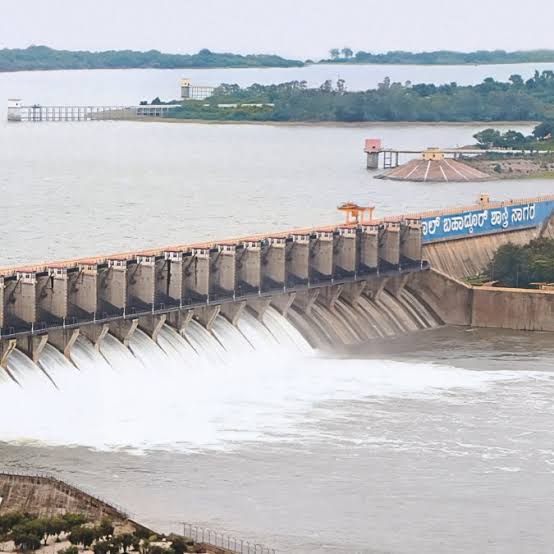
Koppal: A week ago, uncertainty over water availability dominated discussions among farmers across north Karnataka. With storage in Almatti and Tungabhadra reservoirs remaining low, authorities had stated that the available water would be reserved only for drinking purposes. A week of widespread rain across the Western Ghats of Karnataka and the upper Krishna catchment in Maharashtra has now brightened the outlook, raising hopes that irrigation releases may still be possible for the kharif season if the monsoon continues to remain active.
The rain has brought a welcome rise in water levels across the major reservoirs in the Krishna basin, particularly Almatti and Tungabhadra, easing concerns that had gripped farmers over the past few weeks.
According to data released by the Karnataka State Natural Disaster Monitoring Centre (KSNDMC), the combined gross storage in the six major Krishna basin reservoirs—Bhadra, Tungabhadra, Ghataprabha, Malaprabha, Almatti and Narayanapura—increased from 92.62 TMC on July 5 to 154.62 TMC on July 10. The Krishna basin as a whole received 19.8 TMC of inflows on July 10, compared with 1.2 TMC on July 5.
The biggest gain has been at Almatti, the state’s largest reservoir in the Krishna basin. Its storage rose from 20.61 TMC to 57.07 TMC in five days as heavy rain in the upper catchment swelled inflows. The sharp increase has revived hopes that the reservoir will soon be in a position to support irrigation in addition to meeting drinking water requirements.
There was similar relief at the Tungabhadra reservoir, the lifeline for lakhs of farmers in Ballari, Koppal, Raichur and parts of Andhra Pradesh and Telangana. Gross storage nearly doubled during the five-day period, increasing from 9.26 TMC to 17.51 TMC. Even so, the reservoir remains well below the 75.93 TMC it held on the same day last year, underlining the need for continued rainfall in the catchment.
Other reservoirs too have shown good gains. Bhadra added more than 5 TMC of storage during the period, while Ghataprabha more than doubled its storage from 7.82 TMC to 17.47 TMC. Malaprabha also registered a steady increase, with storage improving from 8.71 TMC to 11.59 TMC.
“The recent rain has brought hope to farmers. The Tungabhadra reservoir reached around 20 TMC on Saturday, and we are optimistic that, if the rains continue, irrigation water will be released in the coming days,” Rajya Raitha Sangha president Madhava Reddy told Deccan Chronicle.
He said around 65 TMC of storage was required to release water for one irrigation cycle, which would be sufficient for about 110 to 120 days.
Drawing a parallel with 2019, Reddy said the situation then had been similar, with poor rainfall during the early part of the monsoon.
“That year too, the reservoir reached around 65 TMC only in August. We urged the authorities to release water for irrigation. Though officials wanted another 20 TMC for drinking water and release after the dam reached 85 TMC, we argued that the reservoir would receive the needed water as the monsoon progressed. Eventually, water was released in late August and early September. We hope this year also turns out the same way. A farmer always lives with hope—that is what keeps us going,” he added.
Disclaimer : This story is auto aggregated by a computer programme and has not been created or edited by DOWNTHENEWS. Publisher: deccanchronicle.com