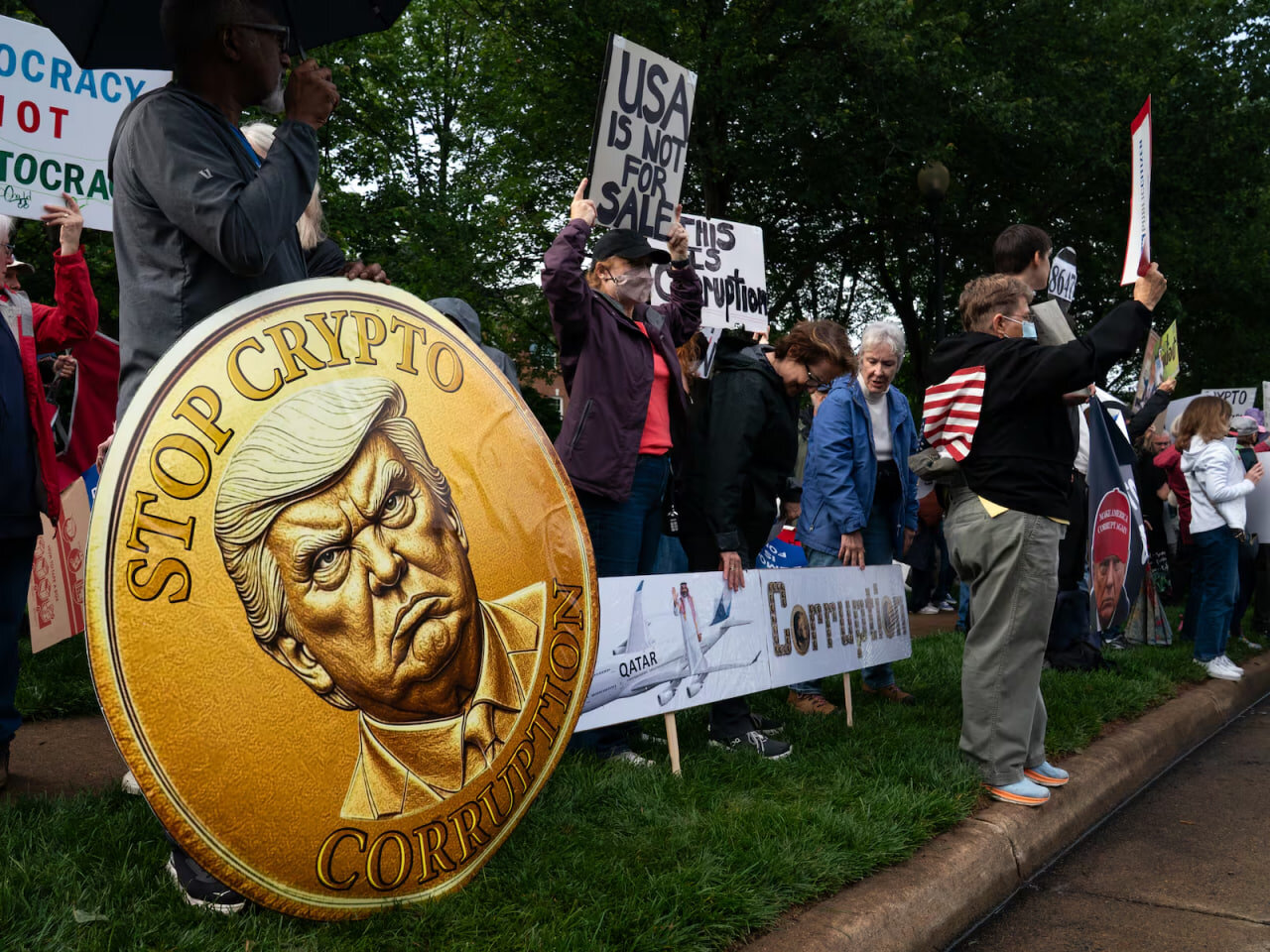
TEHRAN — Donald Trump won the White House promising to “Make America Great Again,” then promised Americans a short, cheap war on Iran. They got a closed Strait of Hormuz, Brent crude above $116 a barrel, and gasoline past $5 a gallon in several states. He and his family got a windfall.
Nine days before the November 3 midterms, the distance between those two experiences has become the central fact of American politics.
In CNBC’s final pre-election survey, 36 percent of registered voters named government corruption among their top issues, ahead of food prices at 34 percent and gasoline at 23 percent.
Fox News found 60 percent of voters extremely concerned. People are reading their grocery receipts and the headlines as one story.
A war with a customer list
The campaign of aggression against Iran has already cost tens of billions of dollars, paid from the public purse. Some of it is landing with companies the president’s sons own or advise.
Powerus, which Eric Trump and Donald Trump Jr. are backing toward a stock listing, holds an Air Force contract worth up to $90 million for interceptors meant to counter Iranian drones.
Skeptics doubt the systems can stop Iran’s one-way attack drones, which have proved themselves in large numbers. Powerus is pitching them to Arab governments in the Persian Gulf anyway, the same clients Washington claims to be defending.
Trump Jr. also holds roughly $4 million in Unusual Machines, where he serves as an adviser. The “War” Department bought 3,500 drone motors and related parts from the company, and the Army has floated a follow-on order of 20,000.
Its shares jumped when his link became public. Rep. Jason Crow says firms tied to the sons have drawn about $3.7 billion in federal money this term.
The youngest Trump son, Barron, joined 1789 Capital days after the 2024 election. Among its holdings is Anduril, approved for a possible $2 billion interceptor sale to Kuwait.
Trump’s own portfolio includes Palantir, Lockheed Martin, General Dynamics and Northrop Grumman, whose revenues have swelled with U.S. military warmongering.
Richard Painter, who served as ethics lawyer in George W. Bush’s White House, told the Wall Street Journal that he sees no modern precedent. That is a notable benchmark, given the Bush administration’s own notorious record of foreign aggression and corporate enrichment.
Persian Gulf states, he says, are “under immense pressure to buy from Trump’s sons,” so the president will deliver what they want. It may be the first time, he adds, that a president’s family has made vast sums from a war launched without congressional authorization.
Arab monarchy money and a crypto pipeline
The Persian Gulf runs through the family’s earlier business too. In his upcoming book Princes and Thieves, Matthew Cole reports that Jared Kushner had access to at least two accounts tied to the UAE and Israel, together receiving about $2 billion, part of it Saudi-backed and moved through banks in Baku.
Dutch intelligence, which had penetrated his phone, helped trace the transfers. A third account, the report says, paid for an Israeli pledge to defend the Emirates against Iranian strikes.
Then came crypto. Days before the 2025 inauguration, an entity backed by Tahnoon bin Zayed, the UAE’s national security adviser, agreed to buy 49 percent of World Liberty Financial for $500 million.
An Abu Dhabi fund he chairs later bought $2 billion of the firm’s USD1 stablecoin. Months on, the administration eased AI chip exports to Emirati firms, including G42, which Tahnoon controls.
Trump also pardoned Binance founder Changpeng Zhao, whose company had paid $4.3 billion in fines, and accepted a $400 million jet from Qatar.
On October 22, a Circle shareholder sued in federal court, alleging violations of the Foreign Emoluments Clause.
Trump’s disclosures show $2.2 billion in earnings for his first year back, $1.4 billion of it from crypto, including about $636 million from a memecoin whose promoters advertised a dinner with him for its 185 biggest holders.
‘Slime, not crime’
Smaller scandals keep piling up. Ambassador to Greece Kimberly Guilfoyle resigned after the Wall Street Journal reported she asked a donor to cover a $100,000 credit card bill.
Adviser Corey Lewandowski faces a Justice Department inquiry. The New York Times says Alina Habba, Trump’s former lawyer, agreed to a $50 million deal with the family of a Venezuelan billionaire who later received a pardon.
Trump’s answer was to warn that dishonest allies “have to be prosecuted,” while his Justice Department charged a Virginia Democrat, state Sen. L. Louise Lucas.
Expect few convictions. Experts point to the Supreme Court: McDonnell in 2016 narrowed “official acts,” Snyder in 2024 excused gratuities paid after the fact, and Trump v. United States granted presidents sweeping immunity.
The Justice Department’s Public Integrity Section was effectively shut down in February 2025. What remains, some prosecutors say, is “slime, not crime,” despite overwhelming evidence of corruption that Americans across party lines can no longer ignore.
Nine days to judgment
Voters have noticed anyway. A Washington Post/ABC News/Ipsos poll found nearly two in three Americans think Trump is using the presidency to enrich himself, with most of the rise coming from Republicans and their leaners.
His approval sits at a record low of 33 percent, and Democrats have spent $182 million on corruption ads, more than the last four cycles combined, according to data from the firm AdImpact.
Vice President JD Vance calls the charge “laughable.” Trump’s pollster argues undecided voters will still choose on pocketbook issues. Perhaps. But $5 gasoline and a president’s sons selling drones are hard to pull apart.
The deeper question is what the money buys. In Matthew Cole’s account, Kushner held signing rights on an Emirati account while Abu Dhabi wanted the 2015 Iran nuclear deal (JCPOA) dead.
Trump quit the agreement in May 2018. Months after he left office, Saudi Arabia’s sovereign fund gave his firm $2 billion, despite a screening panel finding its due diligence “unsatisfactory in all aspects.”
Today, at least some of the transactions happen in plain sight: Emirati stablecoin purchases, chip exports, drone contracts, and more.
Disclaimer : This story is auto aggregated by a computer programme and has not been created or edited by DOWNTHENEWS. Publisher: tehrantimes.com