TEHRAN – The lessons drawn from the history of U.S. relations, whether with governments or non-state actors across the world and the region, point to a dramatic and painful end to such alliances.
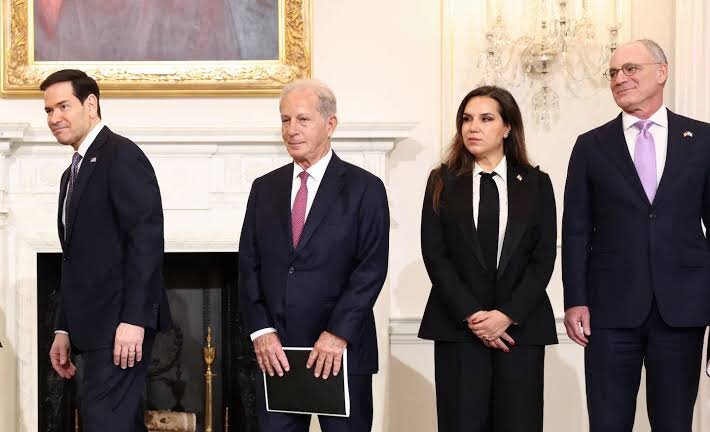
The speed of the American response to Hezbollah Secretary-General Sheikh Naim Qassem’s recent speech marking Resistance and Liberation Day was striking. Despite his busy schedule, U.S. Secretary of State Marco Rubio did not hesitate to issue a lengthy statement on Lebanon, reaffirming Washington’s support for Nawaf Salam’s government.
What Sheikh Qassem said is a position repeated daily in many countries considered democratic. He stated: “People have the right to take to the streets to bring down the government.”
This statement reflects a principle at the core of democratic systems, where the people are considered the source of authority and therefore have the natural right to protest against governments. He did not call for an armed coup and nor did he call for violence.
As for Lebanon’s current government, which has failed to achieve anything meaningful, all the conditions for a popular uprising appear to exist. The government has failed to solve the disaster of stolen depositors’ funds, has not improved the electricity supply, and has not introduced any serious plan to address the waste crisis.
At the top of a long list of unresolved crises that have seen no governmental response is its inability to defend Lebanon against the Israeli regime’s aggression, which is carpet bombing towns and villages, liberate occupied parts, or even properly address any of these national security interests.
So why was Rubio so quick to support the Lebanese government despite its failures?
The United States usually supports governments that meet certain conditions, most being submissive to Washington, aligned with its broader project, and willing to perform roles that serve American interests. Many governments around the world that enjoy U.S. backing fit this description.
In West Asia, however, another essential condition is added: the supported government must protect and preserve the Zionist regime’s interests, even at the expense of its own national interests. It is also expected to accept and accommodate the Israeli regime.
Nawaf Salam’s government fulfills these conditions to the fullest extent.
Lebanon’s leadership has entered direct negotiations with an occupying regime without any conditions or limitations, in ways that serve American and Israeli interests while openly sacrificing national interests. This includes abandoning all sources of strength, foremost among them Hezbollah’s weapons, which the government has officially declared illegitimate, thereby achieving a key Israeli objective.
For this reason, Rubio’s statement falls perfectly within the normal framework of American policy.
What should not be overlooked, however, is that American support offers no guarantees. Lessons drawn from the history of U.S. relations highlight this. Washington quickly abandons its allies, no matter how many concessions they make. The moment its interests change or the cost of support outweighs the political or military benefit, it does not hesitate to change policy.
This pattern was repeated with leaders such as Ngo Dinh Diem in Vietnam, Augusto Pinochet in Chile, the Somoza dynasty in Nicaragua, Ferdinand Marcos in the Philippines, Mohammad Reza Pahlavi in Iran, and later Hamid Karzai and Ashraf Ghani in Afghanistan.
All of them were left to face their fate without warning and without even the minimum effort to preserve their dignity.
The same pattern exists in the Arab world. The Kurdish-led Syrian Democratic Forces (SDF) provides one of the latest and clearest examples after years of American backing. The United States used the SDF to keep Syria politically unstable and supported it as a force controlling strategic resources in eastern and northeastern Syria, serving as a proxy that secured American influence there.
Yet the SDF found itself outside American priorities once the former Syrian government fell. Before that, Washington abandoned Tunisian President Zine El Abidine Ben Ali and his Egyptian counterpart Hosni Mubarak.
Perhaps the experience of Lebanese Christians and their relationship with the United States is among the clearest examples. Lebanese people often recall the proposal allegedly made by Kissinger to former Lebanese President Suleiman Frangieh in the 1970s to transport Christians out of Lebanon on American warships. It showed how little value the U.S. placed on the Christian presence in Lebanon and how prepared it was to abandon them.
This became even more evident during Lebanon’s Mountain War in 1983 and later at the end of the civil war, which led to the Taif Agreement. The agreement included provisions that reduced Christian political powers within Lebanon’s system, while Christian leaders at the time were also abandoned, most notably Michel Aoun, whose exile to Paris, which America did not prevent, and Samir Geagea, whose imprisonment it also did not stop.
This happened even though many Lebanese Christians, at critical moments, believed that Washington held all the leverage, and they based their expectations on that assumption.
Yet the Americans did not hesitate to leave them to their fate. Washington became one of the main architects of the post-Taif era, during which Christians were excluded from key positions of power in Lebanon for many years.
Today, this same mistaken reliance on the United States is being repeated by Lebanon’s ruling authorities, who have placed all their cards in American hands without learning the lessons of recent history.
For this reason, Rubio’s remarks defending the Lebanese government after Hezbollah’s secretary-general criticized it may not be worth the ink used to write them. The real danger lies in trusting the deadly friendship of the United States.
Disclaimer : This story is auto aggregated by a computer programme and has not been created or edited by DOWNTHENEWS. Publisher: tehrantimes.com