

Henry Ouseley Blake Lane, known as Harry, was just 18 when he helped stop Confederate forces burning Washington to the ground in 1864.
That same year, he fought at the bloody Battle of Opequon in Virginia – a turning point in the Civil War for his side, the victorious Union Army.
Despite his role in America’s history, by the time he died almost 50 years later, Lane was living halfway around the world, estranged from his family and buried in an unmarked grave at Brighton General Cemetery in Melbourne.
But last week, 113 years after his death, Lane was honoured by US Consul General Colin Crosby at a ceremony recognising him as a hero.
Barry Crompton, a researcher with the American Civil War Round Table of Australia, who described Lane’s story as “incredible”, said more than 300 US veterans migrated to Australia after the war’s end in 1865.
Born in Ireland to a Protestant minister, Lane was an educated man.
After immigrating to Australia, he worked as an attorney and managed a mine in Western Australia.
In Melbourne, he worked for the Department of Education, married Blanche Crisp and they had two children. The family lived in Brighton and owned land, but like many, were hit hard by the 1890s depression.
When he died in 1913, Lane was living alone in the Prince of Wales Hotel in St Kilda.
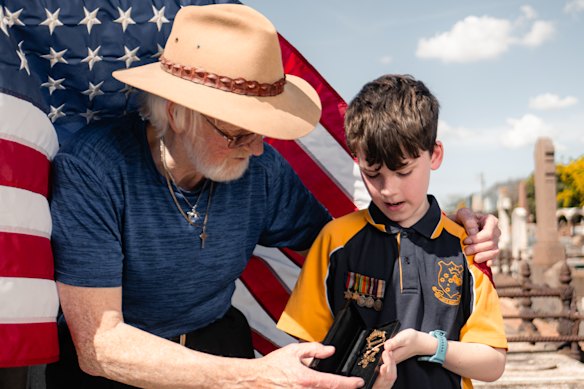
At Tuesday’s ceremony were Crosby, members of the Brighton Cemetorians (a friends group of the cemetery) and Australian researchers of the Civil War, and Roger Blake-Lane, who was gifted three of his great-grandfather’s relics.
The first two items were medals; one from the Civil War, engraved with his regiment – the 25th New York Cavalry – and the surnames of Union leaders he served under, Daniel Sickles and George Custer, and another from the Royal Humane Society of Australasia awarded to Lane in 1888 for his bravery in saving a friend from drowning in Port Phillip Bay.
The third item was a pocketbook New Testament, with a dedication from Lane to his mother, and the note scrawled sideways in pencil: “Don’t be fretting”.
It was a notice in The Age from 1913 that noted the probate of Lane’s will was granted to his executor and solicitor, George Douglas Lawrence, that started the reunification trail for the Civil War round table and the Brighton Cemetorians.
Upon contacting Lawrence’s grandson, Frankston man Mark Lawrence, researchers from the two groups learnt Lane’s belongings were passed down to him.
A former journalist at The Age, Lawrence said he was “delighted” to return the items to Lane’s family, particularly as they were inherited with no information about whom the man honoured by the medals was.
“They’re not mine,” Lawrence said of giving the objects to the Blake-Lane family.
“It’s a load off my shoulder that they’re going home.”
At Tuesday’s ceremony, Roger Blake-Lane said he hadn’t known of the medals or his great-grandfather’s New Testament until this year, when Isaac Hermann from the Cemetorians contacted Blake-Lane’s daughter on LinkedIn.
The consul general told The Age he was “honoured” to commemorate Lane’s service to his country.
“Harry had a remarkable life, full of adventure, bravery and demonstrations of true mateship,” Crosby said.
“He was a hero of the American Civil War, and a hero here in Australia, where he made his home after the war, when he put himself in danger to save his friend’s life.”
Blake-Lane attended with relatives including his grandson, 11-year-old William, who accepted the Civil War medal from the consul general. Blake-Lane thanked the researchers for effecting the reunion with the relics.
Blake-Lane thanked Lawrence and his grandfather for being “custodians of these precious historical items, preserving them with care and respect”.
“We’re grateful to Mark for his generosity, and his willingness to now entrust these items to the Blake-Lane family,” he said. “It’s a wonderful gesture, and one that means a great deal to us.”
He said for his family, the ceremony to honour Harry Lane was about “remembering a remarkable ancestor, honouring his service and his achievements, and ensuing that his story is preserved for future generations”.
Start the day with a summary of the day’s most important and interesting stories, analysis and insights. Sign up for our Morning Edition newsletter.
From our partners
Disclaimer : This story is auto aggregated by a computer programme and has not been created or edited by DOWNTHENEWS. Publisher: www.smh.com.au



