Alexandra Sangster
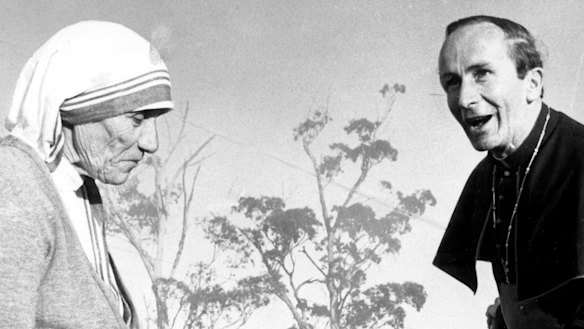
In 1970, Mother Teresa arrived in Melbourne with six sisters and established the House of Compassion in Fitzroy. On the cobbled stone backstreets, with rising tower blocks looming overhead, the sisters lived and worked among the very, very poor.
At the end of The Lord of the Rings trilogy, the elves sail away from Middle-earth, leaving the humans to fend for themselves. All the visible and invisible work they have been doing will cease, and we, the readers, fear for those left behind.
As a Uniting Church minister who grew up in the north, I had no idea the sisters were still with us. I thought they had faded away, or left in boats for another shore.
I was wrong.
Recently, I worked with a mother – tall and graceful, like a waterbird – who needed help attending court with her two tiny girls.
We arrived at the Magistrates’ Court early and ready, and were told, twice, to go to the wrong place: wrong building, wrong floor. Finally, we ended up back where we began and went up in the lift to the court.
The twins were restless, their little heads bouncing from side to side like curly-mopped meerkats, unable to sit still. We arrived in an octagon-shaped space, with arm-like corridors extending from a central circle. A shafted light well opened in the butter-beige ceiling, and indistinct announcements called names and court numbers.
Everyone who worked there wore a suit. Everyone who was there because they had to be, looked as if they had made an effort. Everyone looked stressed.
A blonde woman, flying fleet on her feet, bee-lined towards us.
“I am your lawyer. I can’t be with you; I’m on Family Violence today. Wait in Court 15. No children allowed.”
My parishioner looked at me in panic, but I told her the little ones and I would be just fine.
Two nearly three-year-old twins and I – what could possibly go wrong?
As soon as their mama disappeared, they began to wail, both at once, both wanting out of the pram and onto my hips. I pressed lift buttons, pushed the pram with my elbows, and was just struggling through a door when Mama came back.
“There was no one there,” she said. “They told me to wait with you.”
We were there to get court recognition of paternity, so that this mama – couch-surfing, not a citizen, and all alone – could receive child support and, also, some justice.
Hours passed. Then, all of a sudden, like a bird flashing down into a river, the lawyer was back.
“Quick,” she said. “Now. Court 22.”
This time, when Mama left, the girls did not protest. They were exhausted now, drifting toward sleep.
I began to sing old Scottish folk songs – songs of drowning sailors and mine explosions, of girls left holding babies and spinning wheels while the men fought the war. All the while I rocked the pram and closed my eyes. Time stopped. There were only these babies, this song, this octagon-shaped waiting room.
I was woken from my dream state by the lawyer.
“Quick. The magistrate wants to see the girls.”
I wheeled them in, trailing Textas and teddies. We were a little coracle, pulled along in the wake of the lawyer’s urgent stride.
In the courtroom – deeply quiet, almost empty except for the magistrate, the court clerk, and us – the magnitude of an idea settled over us all. The idea being, explicitly: justice.
The magistrate read through the documents. She tutted and frowned. What was this? she asked, about an intervention order. What was that? How dare he? Why was this allowed?
She looked up, straight at my parishioner.
“You are just a mother trying to do what’s right for your babies,” she said. “This is about justice. This is about responsibility. The father will acknowledge these girls. And you” – she looked at me – “who are you?”
At that moment, I was on the floor with a blanket and the girls.
“I am her minister,” I said. “I am Reverend Alexandra Sangster.”
“Yes,” she said. “Yes, you are. Good on you.”
Suddenly, she softened, looking at the twins and then back to Mama.
“These are the hardest times,” she said. “But there is so much joy. I remember, with my boys.”
“Stop recording,” she said to the court clerk.
And then she told us stories – of women who had been wronged, just like in the songs I had been singing moments before. But this time it was 2026, and she was the magistrate, and I was the priest, and the mama was being honoured, her pain acknowledged, her courage applauded.
The twins began to run, sweep-sparrows of joy, looping around us. A mini murmuration. A ribbon of rebellion. Running in court.
I tried to gather them back to the blanket, but the magistrate smiled.
“Let them run,” she said. “Let them run.”
And so we did.
Later, the mother – who was about to be homeless – messaged me.
“I’ve been offered a room, Rev,” she wrote. “A room with some nuns in Fitzroy. A whole room all to ourselves. And there are other women there, and children. Should I take it?”
I thought about the elves sailing away, and of how maybe they haven’t all left us. At least, not yet.
“Yes,” I said. “Yes, do.”
Alexandra Sangster is a Uniting Church minister, facilitator and Darebin councillor.
Start the day with a summary of the day’s most important and interesting stories, analysis and insights. Sign up for our Morning Edition newsletter.
From our partners
Disclaimer : This story is auto aggregated by a computer programme and has not been created or edited by DOWNTHENEWS. Publisher: www.smh.com.au