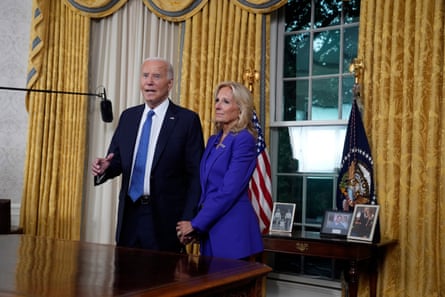
Burnham confirms that he will set up a No 10 North in Manchester.
The change will be the biggest change in our lifetimes to the way the country is run, and it is consistent with the 2024 manifesto.
We will create a more streamlined state with a clearer purpose to power up all parts of the country and put a laser-like focus on growth and regeneration, good growth.
The change will be driven through the prime minister’s office in an extended operation based here in Manchester.
But here’s the important thing; it will only be based here. The job of No 10 North will be to make power flow into the Midlands, into the South West, into the East of England and yes, into London.
The Local Government Association has welcomed Andy Burnham’s speech. Its chair, Louise Gittins, a Labour councillor, said:
Successive devolution agreements have demonstrated that devolving powers to local communities is the best way of unlocking the potential of people and their places, while boosting inclusive economic growth.
It is now vital that the government steps up its ambition to deliver genuine devolution right across England, giving councils who know their communities the power to tackle long-standing local and national challenges, including driving infrastructure investment, plugging skills gaps, building more affordable housing and boosting productivity.
A close aide to the former prime minister Rishi Sunak has pleaded guilty to cheating at gambling with bets on the date of the 2024 general election.
The Labour MP Luke Charters reckons the most significant thing about Andy Burnham’s speech is how it was covered on the Guardian’s busines live blog. He says:
The biggest political story today hasn’t been covered yet.
During Andy’s speech, borrowing costs dipped, the pound rose and gilts settled.
Having worked in the City, I know markets respond well to credible growth plans.
Andy’s record as Mayor speaks for itself.
And he has posted this screenshot.
Here is some comment from journalists and commentators on Andy Burnham’s speech.
From Patrick Maguire from the Times
Slipped almost imperceptibly into Burnham’s case for devolution and a cultural revolution in Westminster – including the loosening of the whip – was this: “The political direction I set will not be up for negotiation.” Bet is that the PLP can be led if they don’t feel coerced.
From Steve Richards, the broadcaster and writer
Andy Burnham speech: Finally a coherent accessible counter to failed 1980s’ orthodoxies.. wise not to take questions from political editors who use the platform to perform a turn for their viewers/ editors …and also smart not to announce chancellor before rest of cabinet.
From Lewis Goodall from the News Agents podcast
There are plenty of details to be ironed out and contradictions to be gone through (do devolution and equality always go together?) But Burnham’s team will be v happy with that. Everything in it was designed to maintain his sense of insurgency- and for now, at least, he is.
From Fraser Nelson from the Times
The idea that devolution seriously improves public services has been robustly tested in Scotland and Wales.
Perhaps why 9 out of 11 English cities rejected the idea of mayors in the 2012 referendums.
To double down on this model is a risk…
From the author and Comment is Freed Substacker Sam Freedman
I’ve really struggled to understand why people keep saying it’s not clear what Burnham wants to do given few incoming PM’s have ever been clearer about it. Whether it will work, or survive the trade-offs in government, is a different question.
I am genuinely excited about a PM who will be serious about devolution. If done right it could give people more sense of control about their locality; free up Whitehall to focus on big strategic issues; and make it harder for a future national govt to burn everything down.
The biggest argument against devolution is that some regions/authorities will screw up. Which they will. But you still free up capacity in the centre and you still give people more control over what happens where they live.
From Simon Jack, the BBC’s business editor
Andy Burnham has promised major reform of business rates to revive high streets – as they are a barometer for the success and happiness of UK regions. Business rates currently raise around £27 billion – half of which goes to local authorities – half to central government. A cut to rates bills would mean less money for either central government, local government, or both. But listening to the rest of the speech you’d have to bet that local authorities would not be the ones to take a hit
From the Spectator’s James Heale
Today’s speech underlines how important Burnham’s Chancellor will be. His appointee will effectively be signing up to a massive loss of power and status on day one. Echoes of George Brown and the DEA.
These are from Jeremy Corbyn, the former Labour leader who is now parliamentary leader of Your Party, on the Andy Burnham speech.
Devolution is welcome, but it is not enough to fix the crises facing us all.
We will never bring about real change without a mass redistribution of wealth, ownership & power.
Public ownership. Wealth taxes. Rent controls. That must be the basis for a real alternative. [1/3]
Starmer went after the sick and disabled to fund his thirst for war. Repeating this strategy would be a catastrophic mistake.
Instead of wasting billions on weapons, we should invest in schools, renewable energy and our NHS.
That is what real security means. [2/3]
Palestine is the litmus test.
Britain must end all arms sales to Israel, impose real sanctions, and establish an independent inquiry into Britain’s participation in genocide.
Anything less will be a continuation of Britain’s complicity in the greatest crime of our time. [3/3]
Here is the Guardian’s Owen Jones on Andy Burnham’s speech.
And this is his conclusion.
Starmerism did not implode because of vibes, but because of its failure to address a broken economic model. We still do not know who Burnham will appoint as his chancellor. Only Ed Miliband would offer a hope of overcoming the suffocating Treasury orthodoxy that has condemned Britain to stagnation and decline. That’s without even dealing with a parliamentary Labour party stuffed full of rightwingers by Starmer’s allies. A change in vibes, alas, will not overcome the crises that have fuelled Britain’s age of discontent.
Plaid Cymru has challenged Andy Burnham to ensure that his commitment to devolution extends to Wales, and not just England.
Responding to Burnham’s speech, Liz Saville Roberts, Plaid’s leader at Westminster, said:
While there were fine words by Andy Burnham today about empowering communities to deliver good growth in every postcode, his focus was very much on ‘the regions’, which means England. For too long, successive UK governments have failed to give Wales the tools we need to thrive and so the ‘King of the North’ must be clear that Wales is a nation, not a region, and work with the Senedd to enable growth in Welsh postcode areas.
While Burnham seemed open to extending powers to the devolved nations, this must match the ambition that the people of Wales voted for less than two months ago. Plaid Cymru was given a mandate to secure powers over rail, the Crown Estate, justice and policing to unlock investment, strengthen our infrastructure and allow policies to be shaped around the needs of our communities. In the past, Burnham has laid great emphasis on public transport as a symbol of a fair society. Now’s the time for him to talk about how he will come up with the goods.
British foreign correspondents could be at risk of prosecution if they use sources within state-backed groups in countries such as Iran under national security legislation being rushed through parliament this week, Pippa Crerar reports.
Lucy Powell, the deputy Labour leader and a friend of Andy Burnham, told Radio 4’s the World at One today that she did not expected Burnham to get rid of the entire Westminster whipping system for Labour MPs. He has implied this in the past. (See 9.30am.)
But, referring to what Burnham said about whipping today (see 11.56am), she said:
I think what he was talking about was the ability for MPs who represent their own constituents, if they have a different point of view, if they want to raise amendments, or they want to shape things differently … that will not be deemed to be something that is disloyal.
Andy Burnham spoke a lot about his experience as mayor of Greater Manchester in his speech this morning. The Institute for Government has published a paper today exploring whether being a regional mayor is good preparation for being PM. Only to a limited degree, it suggests.
Here is an extract.
No role represents a perfect proving ground for the unique post of prime minister. New prime ministers typically make this step either from another cabinet role or (after an election) from the opposition benches. The former equips would-be premiers with experience of executive leadership and policy delivery, albeit within a departmental silo; leaders of the opposition have no executive control but, in their role ‘shadowing’ the prime minister must be across all policy areas and set out a broad vision for government.
In some ways a mayoralty might be considered to offer better preparation for Downing Street than either route. As head of an executive, mayors lead an organisation and set a broad vision for its political direction. Mayors also exercise responsibility across a range of policy areas, each of which has its own department at the national level. And they are the most visible face of the whole administration in the media and public eye.
Yet in terms of the scale of the role, the style of leadership required, and the nature of the decisions they take, they simply cannot compare.
Kemi Badenoch and the Conservatives are suggesting that an Andy Burnham government would just be a more leftwing version of Keir Starmer’s. (See 10.32am.) But they don’t seem to have persuaded the CBI, which has issued a broadly positive response to the Burnham speech.
This is from Rain Newton-Smith, the CBI chief executive.
Business will welcome Andy Burnham’s clear focus on growth and delivery. Taking the positive, dynamic and collaborative approach that has helped public and private sectors drive growth in Manchester and applying it at UK level would give industry a practical agenda it can get behind.
Business will welcome the commitments to sound public finances, upholding fiscal rules and maintaining investor confidence. Backing innovation and scale-ups, boosting international trade and tackling youth unemployment by strengthening apprenticeships are practical steps that can help unlock growth.
Business leaders will be encouraged by efforts to use the levers of devolution to spread prosperity across the country. While London must remain vital to UK growth and investment, helping other regions attract greater investment and make decisions that reflect local priorities is essential to taking the economy forward.
While firms support many of the ambitions, they will need a clear delivery plan – particularly on business rates. Proposals for greater intervention in markets such as transport and utilities must avoid deterring investment. Public-private partnerships remain the most effective and affordable route to upgrading critical infrastructure, crowd-in vital private capital and deliver long-term growth.
As Graeme Wearden reports on his business live blog, the City seemed comfortable with the speech too. The pound was up very slightly after Burnham finished, and government borrowing costs down a fraction.
Shelter, the housing charity, says Andy Burnham’s call for the biggest council housebuilding programme in the postwar period (see 12.48pm) could “utterly transform” Britain. Sarah Elliott, its chief executive, said:
Andy Burnham is right on the money here. Any government that is serious about fixing life’s foundations must start by delivering a new generation of social rent homes and strengthening the arm of councils to get building.
Council-built social homes once provided a stable basis for millions of people across the country to get on in life and succeed. Politicians have ignored this fact for far too long, while people’s hope dwindled away and our supply of genuinely affordable social rent homes fell through the floor.
Delivering the biggest council housebuilding programme since postwar period has the potential to utterly transform our country and restore the building blocks of people’s lives. To make this vision a reality, the government must set councils up to build by removing unsustainable debt and delivering a big boost to investment.
Here are four thinktanks responding to Andy Burnham’s speech.
The Fabian Society, the Labour party thinktank, agrees with Burnham about the importance of devolution. This is from Luke Raikes, its deputy general secretary.
The UK’s local economic investment rate is half that of France, Germany and the OECD average. That’s because in the UK, the Treasury hoards 95% of our taxes and then fails to invest in the infrastructure people need …
Ultimately, centralisation is the root cause of the growth failures in the north and the housing failures in the south. The answer to both problems is devolution.
And the left-leaning IPPR takes a similar view. This is from its executive director, Harry Quilter-Pinner.
Andy Burnham is right to put rebalancing Britain at the heart of his agenda. The UK’s concentration of power and opportunity in Westminster has held back growth, productivity and living standards for too long. This is a problem for London – blighted by overcrowding and house price inflation – as much as it is for the north and Midlands.
Labour is also right to reassure the markets by sticking to the fiscal rules. But fiscal discipline should not be confused with a lack of ambition. The government can still pursue a radical agenda by increasing investment, reforming the state and devolving real power over areas like skills, transport and local finances.
The LGIU (Local Government Information Unit) also wants to see more devolution to local government but (like Zack Polanski – see 1.32pm) is not sure councils have the resources to take advantage of new powers. This is from its chief executive, Jonathan Carr-West.
Andy Burnham’s speech today was the most ambitious statement on devolution we have seen from a senior politician in a generation.
At LGIU, we have always argued that national success has local foundations, and that democratic control, economic growth and excellence in public services cannot be achieved by working from the top down, only nurtured from the bottom up. Burnham appears to understand this based on his remarks this morning …
But vision requires a vehicle. We have seen ambitious visions before, and we have seen many governments come unstuck because of their failure to empower councils sufficiently.
Local government is the operational frontline of the state, and right now it is hollowed out and close to collapse. Number 10 North, reindustrialisation, housebuilding: none of this works without councils that have the capacity to deliver it.
And the Joseph Rowntree Foundation says people need more help with the cost of living. This is from Chris Belfield, its chief economist.
Strong communities help us to feel connected, confident and in control and Andy Burnham is right to focus on devolving more power to where people live. But strong communities can only flourish when they’re resilient to shocks. And there can only be hope in every heart when people expect their living standards to improve.
Household incomes are expected to fall between now and the end of the parliament. People can’t wait 10 years to see an improvement. This is why we need a plan for living standards that includes bold action on rent costs, energy prices, social security and employment protections
Today, JRF sets out a policy package which would return incomes to growth for the majority of households while lowering inflation. Devolution is vital, but it cannot thrive without wholesale economic reform that fundamentally rethinks how we build household economic security.
UDPATE: And this is from Danny Sriskandarajah, chief executive of the New Economics Foundation, a leftwing economic thinktank.
This morning’s speech sets out a hopeful vision for people-powered success. Three things stood out as particularly welcome: calling time on trickle-down economics, upping the need for public intervention when markets fail and shifting power to people and communities.
At a time of rising inequality it is good to hear Andy Burnham go beyond aggregate growth being a defining mission and instead focus on good quality, equitable growth. His ambition to set out a 10-year plan for bringing essential services like water, housing, energy and transport back under public control is much needed. And the promise to modernise an insufficiently accountable state and nurture a more collaborative politics will be welcome at a time of falling trust and growing division. None of this will be easy and the proof will be in the policy, but it has the makings of the economic and political reset the UK needs.
Here is video from Andy Burnham’s speech.
Disclaimer : This story is auto aggregated by a computer programme and has not been created or edited by DOWNTHENEWS. Publisher: theguardian.com