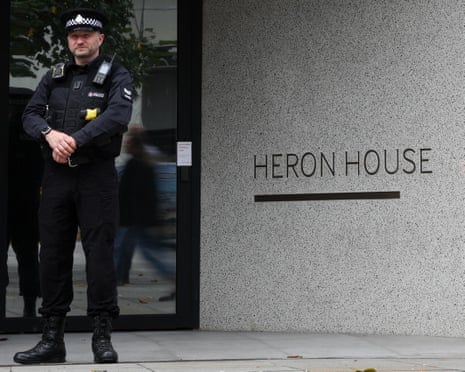
Andy Burnham will hold his first meeting in No 10 North in Manchester today, the new branch of Downing Street in the north-west that the prime minister has described as “the biggest rebalancing of power our country has seen”.
He will chair the inaugural meeting of the national economic council [NEC], a cabinet committee first launched in 2008 by Gordon Brown in response to the financial crash. It will bring together senior ministers and regional mayors to shift economic decision-making away from London.
Writing for the Guardian, Burnham said: “It is about taking power down and placing it in the hands of people who can use it best.”
He added:
No 10 North will be responsible for accelerating devolution. It will drive reindustrialisation and growth across every postcode of the UK. It will remove barriers to regeneration, from council housebuilding to public transport infrastructure. Crucially, No 10 North will bring the whole of Whitehall together behind places rather than standing in their way. Our long-term ambition is clear: to achieve equivalent living standards across all the regions and nations of the UK.”
Based in Heron House in central Manchester, in the same building which houses GCHQ in the north-west, Burnham is expected to work from No 10 North once a week, bringing him closer to his Makerfield constituents and to the community where he grew up. Other ministers including Angela Rayner and Lucy Powell, who hail from the north-west, will also regularly use the office, the government said.
Conservative leader Kemi Badenoch accused the prime minister of governing “like he’s still the mayor of Manchester”, saying he needed to focus on broader national challenges.
Read the full report here:
The housing secretary, Angela Rayner, has said the new Andy Burnham administration is on “borrowed time” to turn the country around.
Appearing on BBC Radio 4’s Today programme, Rayner said the flurry of announcements made by the new prime minister – cap on bus fares, VAT cut on electricity bills and support for pubs and clubs – showed he understood the frustration over the cost of living.
“We’re on borrowed time if we don’t get a move on and I think Andy acknowledged that,” she said. “As prime minister he stood on the streets of Downing Street without notes and spoke directly to the public and said ‘we get it, I get the frustration’.”
Turning to housing policy, Rayner said the Government’s goal to build 1.5m homes in this parliament is “a really difficult stretched target” but insisted she is not dropping it.
She said: “It certainly got more challenging, and we’ve seen things like construction costs go up etc, which has had a real negative impact on that.
“But I’m not dropping it. I’m just saying that it is a really difficult stretched target.”
Earlier on BBC Breakfast, Rayner said she is not looking at bringing in rent controls.
She said changes made through renters’ rights legislation brought in under Labour so far “are already having a significant impact on the market”.
Speaking to BBC Breakfast, she said: “We won’t be looking at rent controls if that’s what you’re getting at at the moment.
“That is not something that we’re looking to do because we’ve seen what’s happened in areas like Scotland. It hasn’t necessarily brought rents down.”
On Monday, while the cameras were fixed on that famous black door in Downing Street, something important was happening 165 miles away. A small team of officials and advisers were walking into an office building in Manchester to set about the remaking of the British state.
This was the beginning of No 10 North: the first major act of this government and what I hope will be seen as its most defining.
Over the course of the past 40 years, Britain has taken a series of wrong turns. In the 1980s, political power was centralised, economic power was privatised and communities were deindustrialised. Many of the places most affected have not recovered since and are still in decline. They have been unable to turn things around because they simply do not have the necessary power to do so. This feeling of neglect has lain underneath the increasingly fractious politics that has bedevilled Britain in recent times.
Solving this problem is crucial for the cohesion of our country. It is something with which it has wrestled for a long time but never got right. We have seen gimmicks, such as levelling up. We have seen the shifting of bits of the British state around the map to no great effect.
Why has none of it worked? It is partly because, even though Whitehall departments have set up outposts, decision-making power has remained in London. It is also because, in the very centre of government itself, Nos 10 and 11 have not been sufficiently aligned – particularly on growth.
This is what No 10 North is seeking to correct and, if we succeed, it could bring the much-needed sea change in the way Britain is run.
Read more:
Andy Burnham will hold his first meeting in No 10 North in Manchester today, the new branch of Downing Street in the north-west that the prime minister has described as “the biggest rebalancing of power our country has seen”.
He will chair the inaugural meeting of the national economic council [NEC], a cabinet committee first launched in 2008 by Gordon Brown in response to the financial crash. It will bring together senior ministers and regional mayors to shift economic decision-making away from London.
Writing for the Guardian, Burnham said: “It is about taking power down and placing it in the hands of people who can use it best.”
He added:
No 10 North will be responsible for accelerating devolution. It will drive reindustrialisation and growth across every postcode of the UK. It will remove barriers to regeneration, from council housebuilding to public transport infrastructure. Crucially, No 10 North will bring the whole of Whitehall together behind places rather than standing in their way. Our long-term ambition is clear: to achieve equivalent living standards across all the regions and nations of the UK.”
Based in Heron House in central Manchester, in the same building which houses GCHQ in the north-west, Burnham is expected to work from No 10 North once a week, bringing him closer to his Makerfield constituents and to the community where he grew up. Other ministers including Angela Rayner and Lucy Powell, who hail from the north-west, will also regularly use the office, the government said.
Conservative leader Kemi Badenoch accused the prime minister of governing “like he’s still the mayor of Manchester”, saying he needed to focus on broader national challenges.
Read the full report here:
Disclaimer : This story is auto aggregated by a computer programme and has not been created or edited by DOWNTHENEWS. Publisher: theguardian.com