On the day after last year’s budget, Treasurer Jim Chalmers was interviewed for satirical website The Betoota Advocate. It is a remarkable interview, because of how relaxed Chalmers is. Politicians’ talk about their hobbies and history tends to sound naff, confected – but on this particular occasion, when Chalmers talks about basketball and listening to rap on community radio growing up, it actually crosses the line into personal and interesting.
Early on, the interviewers say of Angus Taylor, “on paper he should be a fantastic treasurer”. Chalmers interrupts, saying, “Yeah, it’s hard to explain why he’s so shit”. He’s smiling, but soon decides he’s made a mistake. A little penitent, he acknowledges having taken “a shot” at Taylor, saying, “I understand that there’s elements of his CV – going to Oxford and the like – that’s pretty good”. And yet, he can’t quite leave the theme alone, returning to lament “this assumption against all the available evidence that [Taylor] is some kind of credible figure”, saying “we all know people who get promoted kind of beyond their station”.
You can take this with a grain of salt, given Chalmers’ obvious interest in undermining his then-opposite number – though his analysis aligns interestingly with Malcolm Turnbull’s line that people describe Taylor as the “best-qualified idiot they’ve ever met”. Notably, Chalmers presents it as a puzzle – something he has tried but failed to understand. It is hard to shake the sense that he is genuinely baffled by Taylor’s failure to live up to his billing.
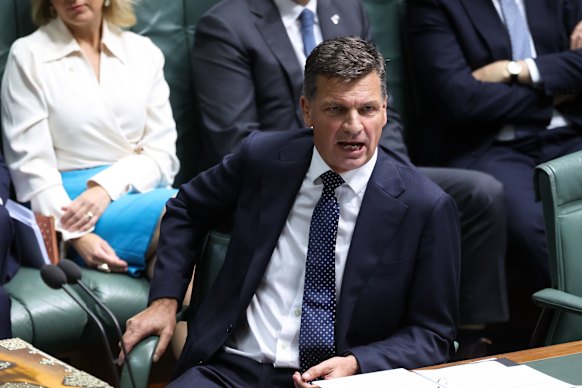
Last month, Taylor delivered his reply to Chalmers’ budget. Since replacing Sussan Ley, Taylor has failed to shift the polls much. So the speech was widely seen as an important test of his abilities as leader: personally, politically and on policy.
How did he do? On delivery, Taylor – often publicly unconvincing – surprised. He was confident but not cocky. More importantly, there was a lot of policy. And some of it was interesting. His proposal to index income tax brackets is certainly debatable, but has support from some prominent economists.
This could have felt whiz-bang, like a generational explosion of policy ideas. Instead, it felt like conventional-Liberal-policy-by-the-numbers. Cut migration: tick. More defence spending: tick. Cut taxes: tick. Oppose Labor’s tax rises: tick. In a perverse way, all this policy felt not so different from having no policy at all. That is a little unfair – but only just, and it’s worth asking why.
Political leaders need to walk a difficult line. They need to represent their party at the same time as representing themselves. They need to fulfil their role – and also act outside of it. Another way to think about this is to say they need to be predictable – but also surprising.
That may sound like an unfair ask – until you remember that this is what all humans are like. We are always both fulfilling expectations and dodging them – displaying what the critic James Wood has described as the “little riot of freedom in otherwise orderly souls”. Taylor’s speech didn’t have that human element. It felt, instead, like an algorithm. But voters want to be led by humans: they want to feel the person behind the role.
Taylor is coming from a difficult spot, of course: the impossible place in which the opposition finds itself. Desperate times call for desperate measures. The trouble is that desperate measures always risk feeling desperate – with the risk that voters ignore the measures and only notice desperation. Interestingly, polls since budget week suggest One Nation has so far gained more than the Coalition.
Still, the Coalition reportedly felt buoyed by Labor’s budget and the chance it offered to oppose something. This reaction may eventually turn out to be justified. But a warning to keep in mind: the last time the Coalition felt like this was the Voice referendum. It won that battle, but Peter Dutton also missed his best chance to publicly reinvent himself. He could have supported the change, demonstrating an ability to rise above base politics and presenting another side of himself to voters. Instead, his image was cemented.
It is possible this budget is similar. What if Taylor had supported the government’s housing changes? He could still have opposed Labor’s changes to trusts and other assets; still have attacked Labor for abandoning aspiration. He would have kept within the bounds of Liberal philosophy – but, crucially, he also would have surprised people, signalling the ways in which he was both new and old, predictable and not.
One Labor veteran remarked last week that the largest problem the party had in the early 2000s was accepting that John Howard had voters’ respect. The suggestion was that the Liberals are making a similar mistake. This was vividly illustrated by Taylor’s irritated response to Anthony Albanese in parliament last week, reportedly calling him an “arrogant prick”.
The next day, Taylor chose to back himself in, admitting what he had said was unparliamentary, but saying, “what I am hearing everywhere I go is far worse than that”. There is a certainty here – which brings us to another one of those contradictory demands voters have. Yes, they want confidence from their leaders. But absolute certainty can set off alarm bells.
Chalmers’ backtracking on his initial criticism of Taylor last year, his recognition he had been too sharp, offers instructive contrast. Perhaps he realised that voters don’t respond well to complete dismissal of opponents. Scorn can indicate a closed mind: a failure to remember that other people don’t automatically see things the way you do. They may even like your opponents – they may even have good reason to do so.
A simpler way to put this is that Taylor’s remark itself risked sounding arrogant – neatly matching that well-known psychological habit of accusing others of what we fear is our own worst trait. The irony is that Taylor may finally have given voters the impression he was showing something of himself – just not something that will help him.
Sean Kelly is an author and regular columnist. He’s a former adviser to Julia Gillard and Kevin Rudd.
Get a weekly wrap of views that will challenge, champion and inform your own. Sign up for our Opinion newsletter.
 Sean Kelly is author of The Game: A Portrait of Scott Morrison, a regular columnist and a former adviser to Julia Gillard and Kevin Rudd.Connect via X.
From our partners
Disclaimer : This story is auto aggregated by a computer programme and has not been created or edited by DOWNTHENEWS. Publisher: www.smh.com.au