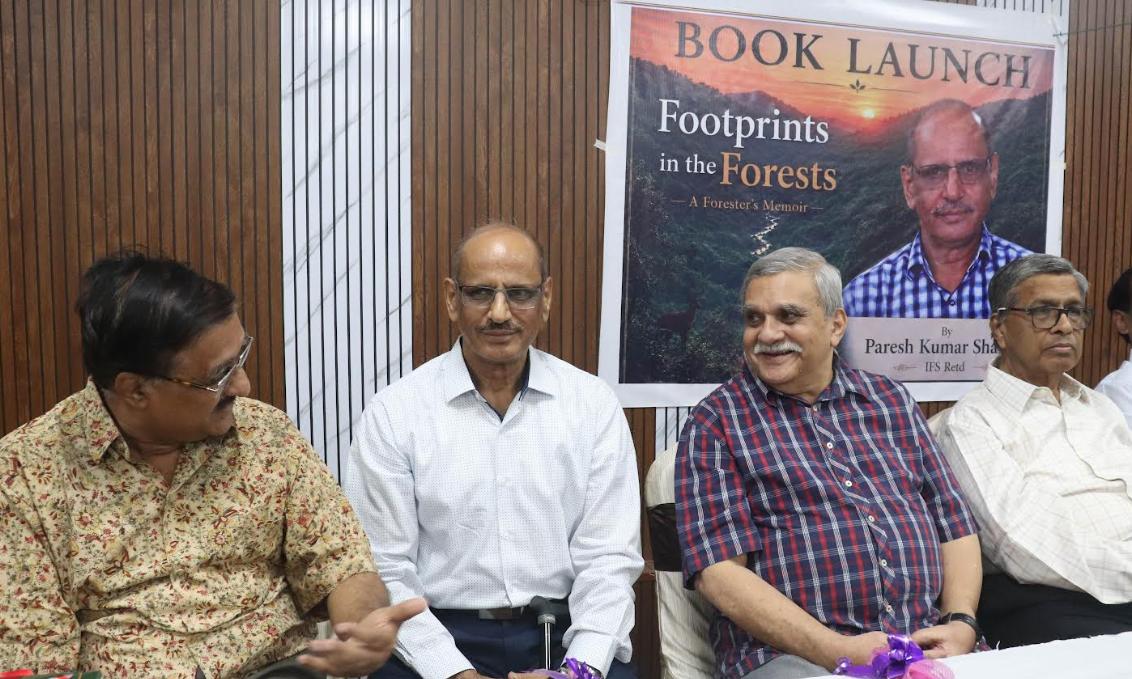
Hyderabad: Development is considered more important than forest protection because forests and wildlife have no electoral value, said retired Indian Forest Service (IFoS) officer Paresh Kumar Sharma, explaining the failure he saw between forest policy and field practice during his 36-year-long career.
His memoir, Footprints in the Forests: Memoirs of a Forester, was launched in Hyderabad on Wednesday, and his account relates to weak enforcement, political priorities, field postings, and the realities that remain hidden from people who encounter environmental loss mainly in cities.
“There is no political will, though it is there in the Constitution. There are so many Acts, rules and regulations, but they are not being implemented,” said Paresh Kumar Sharma. “Unfortunately, development is considered more important than the environment because trees, tigers, panthers and monkeys are not voters.”
Sharma said he entered the service to protect natural forests and contribute to the national goal of increasing forest cover to 33 per cent. While laws, rules and constitutional provisions existed, the field system lacked the means to enforce them. “Imagine a single person being expected to protect 25 square km of forest, without arms or additional support. The Forest Department does not receive adequate financial, manpower or legal support.”
The memoir grew out of accounts Sharma wrote during his later career and retirement for departmental publications and for Vana Premi, a monthly magazine published by retired forest officers. “I started writing around 2008 and continued until 2024. The book is not a compilation as it is. I used those articles, refined them, revisited the events, checked the facts and figures, and brought them into the form of a memoir.”
That process of revisiting his experiences also inspired the book’s title of leaving “Footprints”, an idea that he keeps coming back to. “When a forest officer goes into the forest, he leaves his footprints. Those footprints give direction to the lower staff about what should and should not be done. If you do not go into the forest, there will be no footprints,” he explained as he recounted episodes from such field presence, including accounts of working in districts dominated by Left-wing extremism.
“People will be afraid of anyone who carries arms. During one interaction, they asked me how I perceived their movement. I told them, ‘Your ideology is very good, but your methods are not.’ They became angry, but that was what I felt. If you want to do something good for people, you cannot intimidate them.”
Sharma also writes about clashes within the administrative system. He said certain people had tried to damage him professionally, but he identified them by their designations rather than their names. “I wanted to bring out the facts so that people know this is not the way officers or subordinates should be treated.”
The invitation to the book launch presented the memoir as relevant to forest officers, civil service aspirants, environmentalists and readers interested in principled public service. Sharma named serving and retired officers, officials from other departments, politicians, non-governmental organisations and young people as the audience he wanted to reach.
“Forest protection gets lip sympathy but no real support. If the younger generation asks what is being done to save forests and improve the environment, things may improve. Then my task is fulfilled,” he said. “Fifty years ago, people did not buy water. Today, everybody buys it. If this destruction continues, you may have to buy oxygen. Our survival depends on forests and the environment.”
He said public concern often focused on visible tree felling in cities while far greater destruction in forests went unnoticed. “If ten trees are cut, people make noise and newspapers write about it. But when lakhs of trees are cut in forests, you do not even know. This book exposes gaps in forest governance and suggests what needs to be done.”
And the principle he returned to was in line with the title of his memoir, that an officer must leave the office, enter the forest. “Go to the forest, see for yourself and act,” he concluded.
Disclaimer : This story is auto aggregated by a computer programme and has not been created or edited by DOWNTHENEWS. Publisher: deccanchronicle.com