- Anne Carson blends ancient Greek literature with contemporary human experiences.
- Her unique literary career combines rigorous scholarship with experimental forms.
- Carson’s works explore love, grief, identity, making classics relevant.
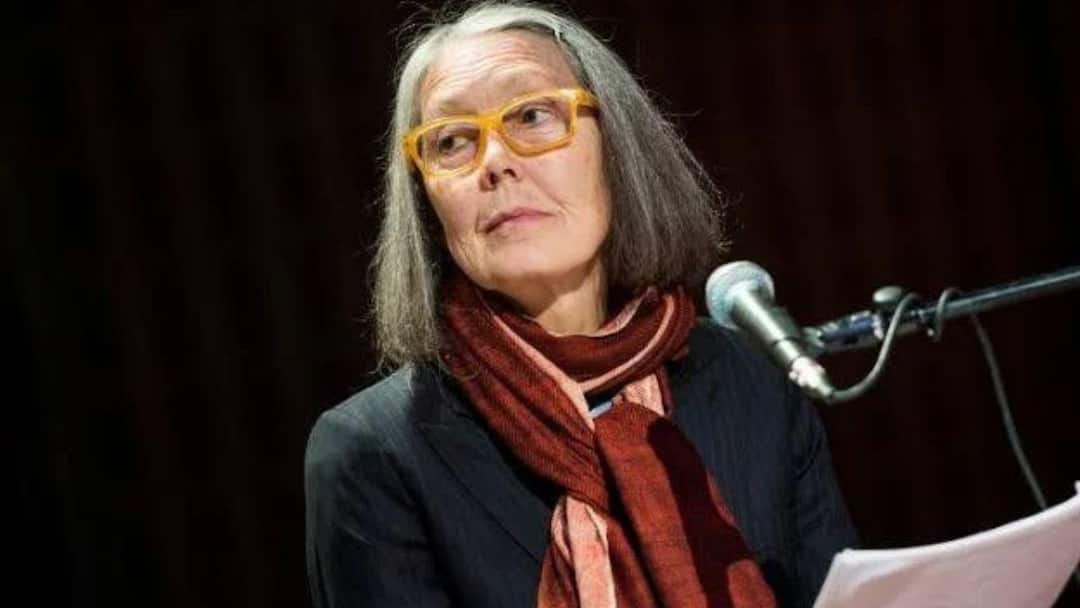
Anne Carson’s literary career has challenged conventional boundaries between poetry, prose, translation and classical scholarship. Drawing on ancient Greek literature while exploring contemporary experiences of love, grief, memory and identity, Carson has developed a distinctive body of work that brings classical ideas into conversation with modern life.
From her early academic research to experimental books that rethink the physical form of literature, her work reflects a sustained interest in language, human relationships and the possibilities of literary expression.
How Did Anne Carson’s Intellectual Journey Begin?
Born in Toronto in 1950, Carson spent her early years in small Canadian towns, where her father worked as a banker. Her introduction to ancient Greek in high school proved to be a turning point, eventually shaping both her academic pursuits and literary career.
She earned a BA in 1974, an MA in 1975 and a PhD in Classics in 1981, all from the University of Toronto. She also undertook extensive studies in Greek prosody, or poetic metre, at the University of St Andrews in Scotland.
Carson’s intellectual approach combines rigorous classical scholarship with a willingness to experiment. While teaching at institutions including Princeton, McGill, the University of California, Berkeley, and the University of Michigan, she developed an approach that connected ancient texts with contemporary experiences rather than treating classical literature as a relic of the past.
Personal loss and emotional attachment have also played a significant role in her writing. The disappearance and subsequent death of her brother Michael, followed by the deaths of her parents, informed some of her most poignant explorations of grief. Her work frequently operates at the intersection of ancient and modern languages, personal experience and historical narratives, as well as speech and silence.
Anne Carson’s Major Works
Carson’s writing spans verse novels, lyric essays, translations, hybrid artist-books and performance texts. Her works frequently blur the boundaries between literary genres, combining academic inquiry with experimentation in form and language.
Early Critical And Experimental Works
Eros the Bittersweet (1986)
In this work, Carson examines desire through three elements: the person who desires, the object of desire and the distance between them. The book brings together classical scholarship and poetic expression to explore the complexities of love and longing.
Short Talks (1992)
This collection of brief prose poems explores a range of subjects, including rain, the painter Rembrandt, fish and translation. Its concise form and unconventional observations reflect Carson’s growing interest in literary experimentation.
Plainwater (1995)
Combining travel writing, personal reflections and translations of ancient poetry, Plainwater demonstrates Carson’s ability to move between autobiographical material and classical narratives.
Poetry, Fiction And Hybrid Literature
Glass, Irony and God (1995)
The collection includes The Glass Essay, a poem that brings together the pain of a failed relationship, an encounter with the speaker’s mother and reflections on the life and work of Emily Brontë. Personal heartbreak and literary engagement become intertwined in the work.
Autobiography of Red (1998)
One of Carson’s best-known books, Autobiography of Red reimagines Geryon, a figure from ancient Greek mythology, as a contemporary red-winged boy. The narrative follows his experience of love, heartbreak and artistic expression through photography. Often described as a novel in verse, the book combines classical mythology with modern themes of identity and desire.
ALSO READ: Anne Carson: Exploring Desire, Memory And Myth Through The Nobel Laureate’s Works
Economy of the Unlost (1999)
This work places an ancient Greek poet alongside a modern poet to explore questions of value, memory and language, examining how poetry and its meaning are understood and valued.
Men in the Off Hours (2000)
Bringing together historical and literary figures, including Virginia Woolf and Tolstoy, the collection also includes an elegy for Carson’s father. The book won the Griffin Poetry Prize and was followed by recognition through a MacArthur “genius” fellowship.
The Beauty of the Husband (2001)
Structured in 29 sections likened to tango steps, this work examines marital breakdown, betrayal and the complexities of love. Carson won the T. S. Eliot Prize for the book, becoming the first woman to receive the award.
Experimental Forms And Later Works
Decreation (2005)
Combining essays, poems and plays, Decreation explores the idea of moving beyond or diminishing the ego in the pursuit of spiritual understanding. The work examines the relationship between devotion, God and art.
Nox (2010)
Presented as a long, foldable book housed in a box, Nox brings together photographs, letters and memories relating to Carson’s estranged brother. Its unconventional physical form makes the book itself part of the expression of grief and remembrance.
Red Doc> (2013)
A continuation of Autobiography of Red, this work revisits its central characters as they grow older and confront illness and loss, including the death of Ma. Its distinctive presentation, with text arranged in thin lines, contributes to its experimental character.
Float (2016)
This collection comprises 22 small books presented in a plastic box. The individual books can be read in any order, without a prescribed beginning or ending, challenging conventional assumptions about how a literary work should be approached.
Norma Jeane Baker of Troy (2019)
This play and performance text draws parallels between Hollywood icon Marilyn Monroe and Helen of Troy, bringing together modern celebrity culture and ancient Greek mythology.
Wrong Norma (2024)
A collection of 25 short pieces and reflections, Wrong Norma moves across subjects such as snow, poverty, fathers and writers. Its varied forms resist classification within a single literary genre.
Anne Carson’s Translations Of Ancient Greek Literature
Alongside her original writing, Carson has translated ancient Greek poetry and drama into contemporary English. Her translations seek to make classical works accessible while preserving their literary complexity and distinctive qualities.
If Not, Winter (2002)
This translation of the surviving fragments of the ancient Greek poet Sappho preserves the gaps left by missing words, making absence and incompleteness visible on the page.
Grief Lessons (2006)
The collection features translations of four plays by Euripides, exploring suffering, grief and the emotional conflicts at the centre of human experience.
An Oresteia (2009)
This work brings together translations of three major Greek tragedies, presenting classical dramatic literature through Carson’s distinctive approach to language.
Antigonick (2012)
An adaptation of Sophocles’ Antigone, this work combines Carson’s translation with illustrations, creating an unconventional interpretation of the classical play.
Bakkhai (2015)
Carson’s translation of Euripides’ tragedy explores madness, religious traditions and the conflict between human authority and divine power.
How Anne Carson Changed The Way Readers Approach Classical Literature
Carson’s work challenges the idea that classical literature belongs exclusively to the past. By placing ancient Greek texts alongside contemporary experiences, she treats the classical tradition as a continuing source of questions, ideas and artistic possibilities.
Her willingness to move between poetry, scholarship, translation, performance and experimental book design has expanded the boundaries of literary form. Across her work, questions of love, grief, memory, identity and spirituality emerge through an approach that is both intellectually rigorous and formally unconventional.
Carson’s career demonstrates how engagement with ancient literature can generate new ways of writing and reading, allowing classical narratives to remain relevant to the complexities of modern life.
ALSO READ: Two Latvian Men Arrested For Breaking Into UK RAF Base Used By US
Disclaimer : This story is auto aggregated by a computer programme and has not been created or edited by DOWNTHENEWS. Publisher: abplive.com