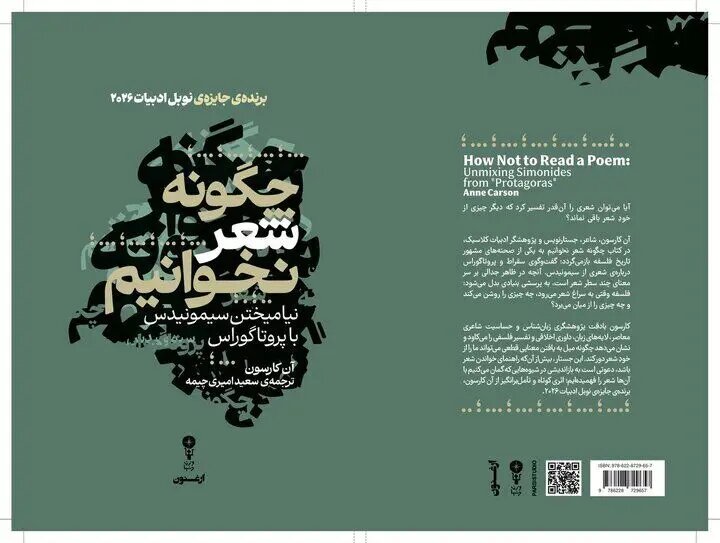
TEHRAN- “How Not to Read a Poem,” an essay by Canadian poet and 2026 Nobel laureate Anne Carson, has been published in Persian in a translation by Saeed Amiri Chimeh.
The 56-page book has been released in the Arghanoon collection by Vazn-e Donya Publications in Tehran.
Originally published in 1992 in the academic journal “Classical Philology”, the essay examines a philosophical exchange between Socrates and Protagoras in Plato’s dialogue “Protagoras.” Their discussion centers on a poem by Simonides of Ceos, an ancient Greek lyric poet, and the ways in which its meaning can be interpreted.
In Plato’s dialogue, Socrates and Protagoras attempt to analyze Simonides’ poem through philosophical argument, examining its language and the apparent contradictions in its statements. Carson revisits this exchange to explore the complicated relationship between poetry and philosophical interpretation.
Rather than treating the poem as a text with a single, easily identifiable meaning, Carson examines how the philosophers’ efforts to explain it can lead them away from the poetry itself. Their discussion, she suggests, exposes the limitations of imposing a rigid philosophical framework on poetic language.
Drawing on her background in classical languages and literature, Carson approaches the subject with both the precision of a scholar and the sensitivity of a poet. She investigates how meaning is produced through language and how attempts to establish a definitive interpretation may obscure the complexity and ambiguity that make poetry distinctive.
The essay offers a broader reflection on the act of reading itself, questioning whether analytical approaches always bring readers closer to a literary work or sometimes distance them from its essential qualities.
Born in Toronto, Canada, in 1950, Anne Carson is a poet, essayist, translator and classicist whose work has established her as one of the most distinctive figures in contemporary literature. She studied classical languages and literature at the University of Toronto, where she received her bachelor’s degree in 1974, master’s degree in 1975 and PhD in Classics in 1981.
Her academic background, particularly her extensive engagement with ancient Greek literature, has had a profound influence on her writing. Carson frequently brings classical mythology, philosophy and poetry into conversation with contemporary literary forms, combining scholarly research with personal reflection, experimentation and unconventional narrative structures.
Her first major book, “Eros the Bittersweet,” published in 1986, explores the nature of desire and the paradoxes of love through ancient Greek literature, particularly the works of Sappho and Plato. The book established her reputation for combining classical scholarship with original literary criticism.
Among her best-known works is “Autobiography of Red” (1998), a novel in verse that reimagines the ancient Greek myth of Geryon, a red-winged monster defeated by Heracles. Carson transforms the myth into an unconventional coming-of-age story exploring love, identity and emotional vulnerability.
Other notable publications include “The Beauty of the Husband: A Fictional Essay in 29 Tangos” (2001), “Nox” (2010), “Red Doc” (2013) and “Float” (2016). Her work frequently moves between poetry, prose, drama, translation and visual art, challenging conventional distinctions between literary genres.
Carson is also widely recognized for her translations of classical Greek literature, including works by Sappho, Sophocles and Euripides. Her translation of Sappho’s surviving fragments, published as “If Not, Winter: Fragments of Sappho” in 2002, is among her significant contributions to the modern reception of ancient Greek poetry.
On October 8, 2026, Carson was awarded the Nobel Prize in Literature. The Swedish Academy recognized her for her “bold and inventive oeuvre that, in playful dialogue with the classical tradition, has created new forms for contemporary literature.”
Her selection highlighted the distinctive way she brings ancient literary and philosophical traditions into contemporary writing, making classical themes relevant to modern readers while continually experimenting with language and form.
Carson’s work has received numerous other honors, including the T. S. Eliot Prize, two Griffin Poetry Prizes, a MacArthur Fellowship, a Guggenheim Fellowship and the Princess of Asturias Award for Literature in 2020.
Through her poetry, essays and translations, she continues to explore the possibilities of language and the enduring relationship between ancient thought and contemporary literary expression.
SAB/
Disclaimer : This story is auto aggregated by a computer programme and has not been created or edited by DOWNTHENEWS. Publisher: tehrantimes.com