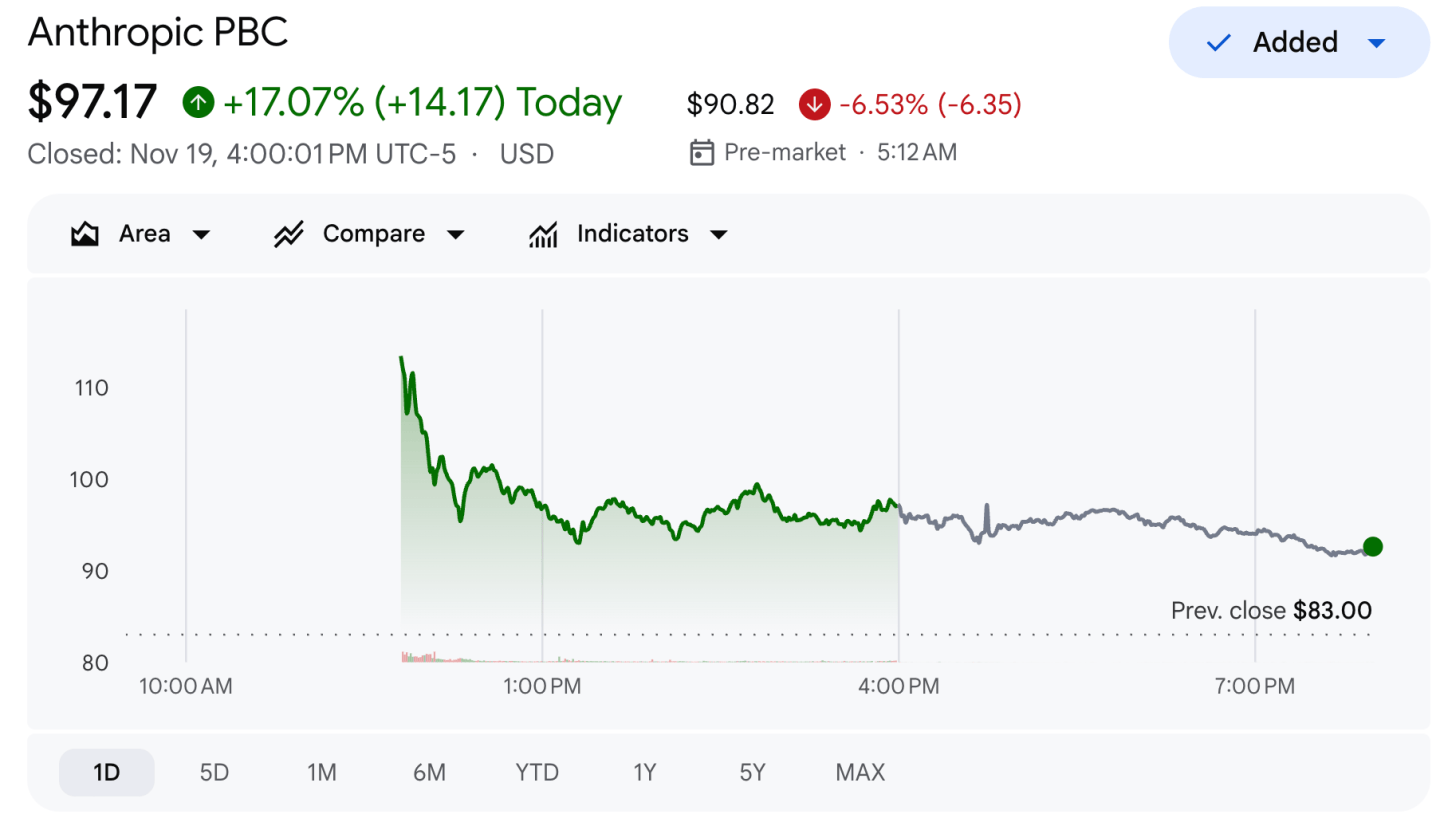
Anthropic stock closed up 17.07% in its first day of trading yesterday—and that is where the good news ends. It declined 6.5% in overnight trading, foreshadowing a wider global selloff and prompting Wall Street to ask how deep the correction will go.
S&P 500 futures were down this morning before the opening bell in New York after falling more than 2% yesterday—a huge move for the massive index. Markets in Asia and Europe largely fell.
“The US S&P 500 index is now 8.5% off its highs of the year,” ING’s Chris Turner told clients. “The extent of this correction is not far from that seen in March this year (9.5%) and way off the ‘Liberation Day’ rout of 21% seen in March/April 2025. The cause of the current correction has been the threat of a faster Federal Reserve tightening cycle, put on the table by the Fed’s Christopher Waller last week.”
“The volatility in tech stocks may also be owing to this week’s Anthropic IPO, where investors have probably been shuffling portfolios to participate in a $100 billion IPO. The fact that the Fed wants to tighten faster because of a demand shock should not necessarily be bad news for equities and, barring some major earnings misses, the case for another 10% correction in equities is a weak one,” he said in a note.
Yesterday, the S&P had the most decliners so far in 2026, Jim Reid and his folks at Deutsche Bank noticed. “It also fell for a 6th consecutive session, which also marked its longest losing streak since April 2024. And if we get a 7th fall today, that would make it the longest run of declines since the pandemic slump began in February 2020.”
Part of this volatility is due to investors selling parts of their existing portfolio to buy Anthropic’s new shares, according to Gaurav Mallik, chief investment officer at Modera Wealth Management ($17.5 billion AUM). “This is the first pure-play LLM stock, and investors are rotating money out of the semiconductor space in favor of this new entrant into the AI complex. This is a notable new chapter in the AI story and may take some time to play out. … We are in the midst of a garden-variety correction,” he told Fortune.
At UBS, Paul Donovan was less fussed. “Equity markets continued to exhibit volatility, but not to a degree that signals broad economic concerns or is likely to have economic consequences. The volatility was not triggered by growth or policy worries—it is more narrowly focused,” he said in a note.
Read more:
Anthropic just set an IPO record nobody’s bragging about: $20 billion left on the table – Shawn Tully
Anthropic’s IPO nets Goldman Sachs and Morgan Stanley $113 million apiece in fees, eclipsing their SpaceX paydays – Morgan Chittum
- S&P 500 futures were down 0.67% this morning. The index fell 2.02% yesterday.
- In Europe, the Stoxx 600 was down 1.42% in early trading, and the U.K.’s FTSE 100 fell 0.91% before lunch.
- Asia: South Korea’s KOSPI was down 5.21%. Japan’s Nikkei 225 was down 5.06%. India’s Nifty 50 was up 1.06%. China’s CSI 300 was down 0.76%.
- Brent crude declined to $90 per barrel.
- Bitcoin declined to $61,664.
Asian chip companies are recycling their profits into U.S. stocks, creating “a new form of circularity and potential instability,” Deutsche Bank worries
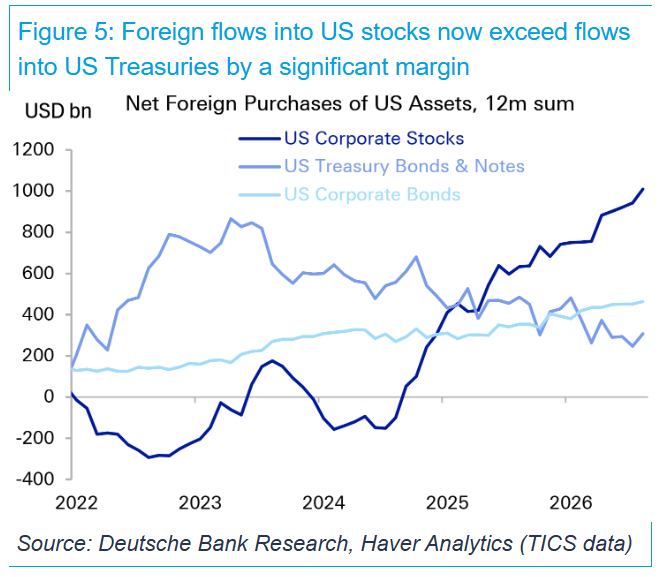
Don’t worry too much about all the money U.S. tech companies are sending to Asia to acquire semiconductors, because the profits from those Asian companies are being reinvested in U.S. stocks, according to Mallika Sachdeva of Deutsche Bank.
Profits from Asian companies used to be recycled into U.S. Treasuries, but that has changed, and the money is now more likely to end up in American stocks, she wrote recently.
“Helped by ‘chipdollars,’ foreign inflows into U.S. equities have crossed $1 trillion a year and become the mainstay of U.S. deficit funding. The biggest source of increase over the past year has come from Asia,” she said.
Seems like a virtuous circle? Er, no.
“This introduces a new form of circularity and potential instability to global imbalances. Moreover, equities are a much riskier asset class than bonds – U.S. stocks are three times as volatile as Treasuries, with tech stocks up to ten times as much. Growing dollar dependence on inherently riskier capital should spill into higher U.S. dollar volatility over time,” she says.
MORE FROM FORTUNE
Trump is one step closer to his ‘Golden Dome’ in Greenland, and it will be ‘absolutely devastating’ for U.S.-European relations – Sasha Rogelberg
Grocers sell bananas at 66 cents a pound to lure you in. What could be the strongest El Niño on record is testing that – Mia Osmonbekov
Disney’s sports profit jumped 53% as it bets on live games. It also wants $3 billion in cost cuts – Fernanda Tronco
As attention spans move on from Iran and oil, the world is forever changed and the conflict is escalating again – Jordan Blum
The world got used to endless Saudi cash. The Iran war ushered in a new reality – Vivienne Walt
‘Half philanthropy and half protest’: Noah Wyle and FIGS pair up to erase $200 million in real patients’ medical debt – Sydney Lake
Warby Parker is betting its next chapter on smart glasses people actually want to wear – Phil Wahba
GIBBON’S WASHINGTON
Internet outages make the U.S. look like the Roman Empire in decline, Macquarie says
The U.S. is halfway to collapsing like the Roman Empire, according to a bleak, paranoid note from Thierry Wizman and Gareth Berry at Macquarie.
“Edward Gibbon famously attributed the decline and fall of the late Roman Empire to (1) the loss of civic and martial virtue, (2) too much luxury enjoyed by the ruling classes, (3) the barbarians at the gates, and (4) the ‘new religion’ and Christianization of Rome,” the pair wrote. “The U.S. likely shares the late Empire’s first two traits already. We’ll leave it to the reader to judge who the barbarians might be today.”
Wizman and Berry are in this dystopian mood because of all “the ‘funny’ things going on” in terms of multiple tech system failures: “All of these failures follow a singular script, with reassurances from the managers of the failing systems that the problem was not caused by a deliberate cyberattack. That’s been the script so far for Microsoft products going offline, the FAA’s grounding of all flights (due to ‘a faulty router’), the downtime of Amtrak’s booking system, the service interruptions at the largest banks (‘a software bug’), United Airlines’ halting of US flights (‘no indication of a cybersecurity issue’), etc., etc.,” they said.
They are worried that if the breakdowns are the result of cyberattacks or “a conspiracy,” then it will further fuel the public’s “new religion,” which is being anti-AI and anti-tech. That’s a problem because Macquarie views each as the last remaining pillar of American global dominance.
CHART OF THE DAY
AI costs are driving inflation through the roof
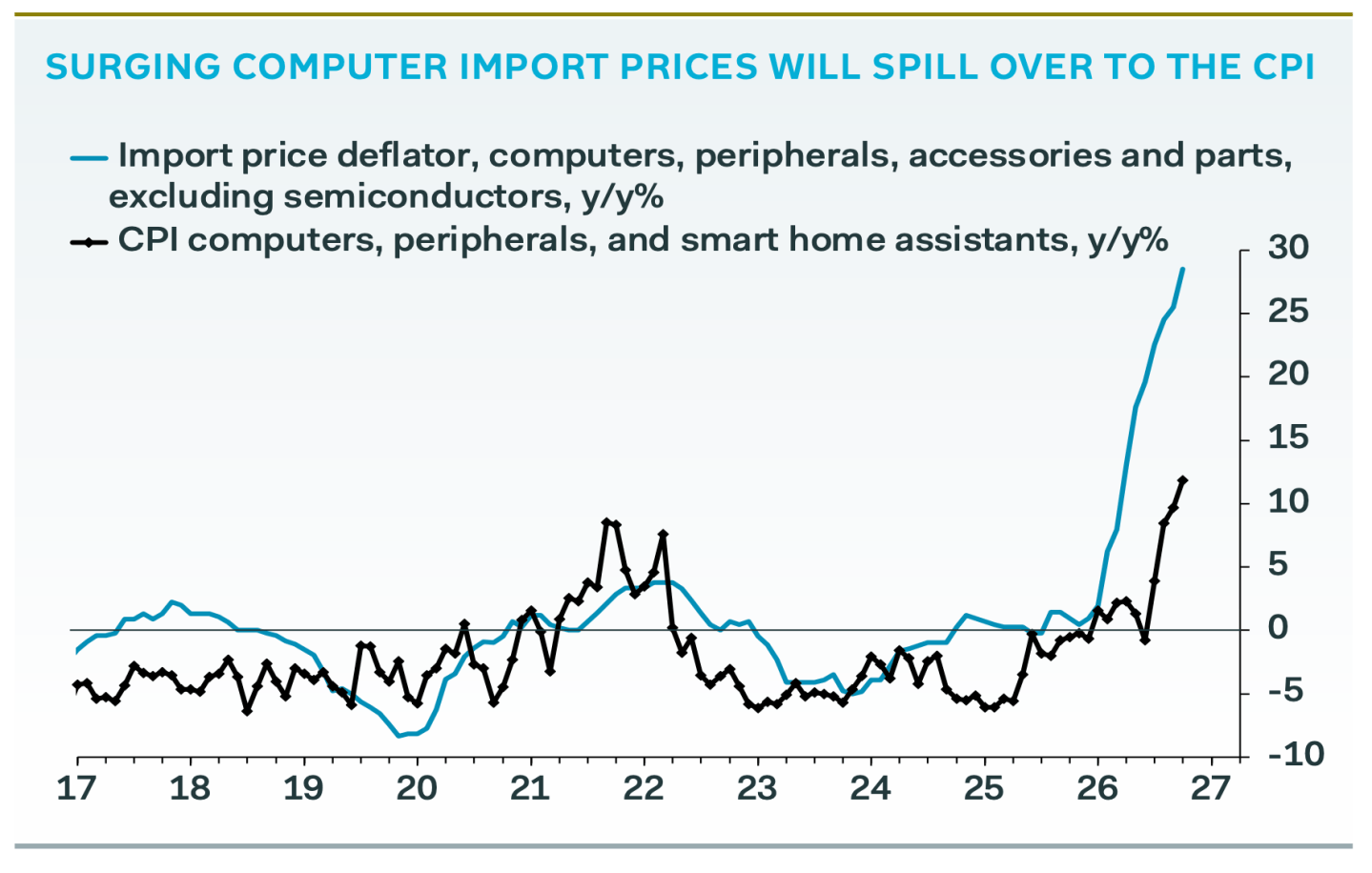
In the minutes of the Fed’s October meeting, this quote stood out for many: “Many participants viewed the AI buildout as a material source of inflation risk.” That’s counterintuitive for folks in Silicon Valley (and Fed chair Kevin Warsh) who have been promising that AI will reduce costs as it makes everything more efficient.
But the opposite has happened, as this chart of tech product import prices from Pantheon Macroeconomics’ Samuel Tombs and Olivia Cross shows. The demand for equipment from AI companies has pushed up prices for almost any kind of tech product.
“Import prices for computers, peripherals, accessories and parts, excluding semiconductors, jumped 2.7% in October, taking their cumulative increase since December to 28%,” they wrote in a note. “We expect the [consumer price inflation] for computers, peripherals and smart home assistants to accelerate over the coming months as higher acquisition costs feed through to retail prices.”
THE FRONT PAGES TODAY
UK-EU summit live: Andy Burnham to agree Brexit ‘reset’ deal in Brussels – FT
SoftBank suffers worst day in over two years as AI sell-off hits Asian tech stocks – CNBC
Trump tells skeptical Europeans: “Putin wants to end the war” – Axios
U.S. Has Floated NATO Membership for Ukraine in Recent Meetings – WSJ
The Anthropic IPO Is Adding to a Real Estate Frenzy in Major Tech Hubs – Bloomberg
Nvidia Asked to Sell Chips to Companies Tied to Chinese Military and Megaspeed – NYT
ONE MORE THING
This bank is paying old people to go away
Thailand’s Kasikornbank has a voluntary buyout scheme that, at first glance, seems insulting to anyone in middle age (and would probably be illegal in the U.S. or U.K.). Its early retirement scheme is named “45 is the new 60,” and any employee aged 45 to 59 can apply and receive both standard retirement compensation and additional severance of up to a year’s salary.
“Those who know that technology is coming in and feel that they are unable to reskill, or feel uncomfortable, they can take this package out,” CEO Kattiya Indaravijaya told Fortune. “We rolled this out last year, and many people took it up… so this year our [bank’s] personnel expenses are down by quite a lot.”
- ➡️ Would you like to sponsor this newsletter? Contact advertising@fortune.com for details.
- ➡️ If you would like to receive this information in your inbox every morning before the markets open in New York, sign up here.
Disclaimer : This story is auto aggregated by a computer programme and has not been created or edited by DOWNTHENEWS. Publisher: fortune.com