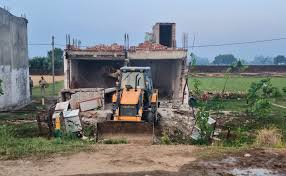
SRINAGAR: A major political controversy has erupted in Jammu and Kashmir after authorities on Tuesday conducted an anti‑encroachment operation on the Jammu city’s outskirts, demolishing more than two dozen hutments and temporary structures to reclaim what officials said was nearly 60 kanals (7.5 acres) of prime forest land. The demolished dwellings belonged largely to members of the nomadic Gujjar community, who have accused the Forest Department and police of selective targeting and bias against Muslims.
The drive, carried out jointly by the Forest Department, Forest Protection Force, Revenue Department and police, lasted nearly four hours in the Mahamaya–Raika Bandi forest belt of the lower Shivalik range. Officials stated that the area had witnessed a rapid rise in illegal structures over the past five to six years, transforming what was once a sparsely inhabited forest zone into a cluster of makeshift settlements. They maintained that the operation was part of a broader effort to curb encroachments and protect ecologically fragile forest land.
However, the action triggered widespread protests, with affected families alleging that the demolition was carried out without prior notice and amounted to an unjust eviction. Many claimed long‑standing residence in the area, with some asserting that their families had lived there for generations and even appeared in voter lists dating back to the 1950s. Community members also argued that the administration had used the pretext of controlling drug‑related activity (“Chitta menace”) to justify a blanket demolition of an entire settlement.
Amid mounting public anger, Minister for Forest, Ecology and Environment Javed Ahmed Rana visited the site and met the displaced families. Calling the action “absolutely illegal and unjust,” he announced an official inquiry into what he described as an “illegal eviction drive” and vowed strict action against all officials involved. Rana accused the administration of high‑handedness and selective harassment, asserting that the demolition had been carried out without consulting the elected government or even his own ministry. He further stated that he would take up the matter with Chief Minister Omar Abdullah, demanding an immediate halt to such operations and an institutional probe.
The controversy comes at a time when Jammu district has emerged as the largest contributor to land encroachments in the Union Territory. Official data shows that Jammu alone accounts for 1,45,487 kanals and six marlas (approximately 7,350 hectares) of encroached land—over ten times the figure recorded in Srinagar. Across J&K, more than 17 lakh kanals (approximately 85,996 hectares) of state land have been encroached upon, with the Jammu division accounting for over 14 lakh kanals, more than triple the encroachment recorded in the Kashmir Valley. Authorities have recently expunged 17,27,247 kanals of encroached state land from revenue records as part of ongoing anti‑encroachment efforts.
In response to the latest controversy, forest officials have announced plans to map all tribal settlements and habitations in forest areas across Jammu. They intend to photograph and videograph these locations, verify documents, and upload records to official portals to prevent further encroachments. Officials reiterated that no illegal occupation of forest land would be tolerated and that all such structures would be removed in future drives.
However, the Sidhra–Raika Bandi demolition has become a flashpoint—raising questions about tribal rights, environmental protection, administrative transparency, and political accountability. With an inquiry now ordered and protests continuing, the episode has intensified the debate over how J&K balances ecological conservation with the rights and livelihoods of its nomadic and marginalized communities.
Environmental experts, meanwhile, warn that unchecked encroachments in the hills and forests surrounding Jammu are contributing to rising temperatures, ecological degradation, and flash floods in the city. They argue that the loss of forest cover has weakened natural drainage systems and increased the vulnerability of urban areas to extreme weather events.
Disclaimer : This story is auto aggregated by a computer programme and has not been created or edited by DOWNTHENEWS. Publisher: deccanchronicle.com