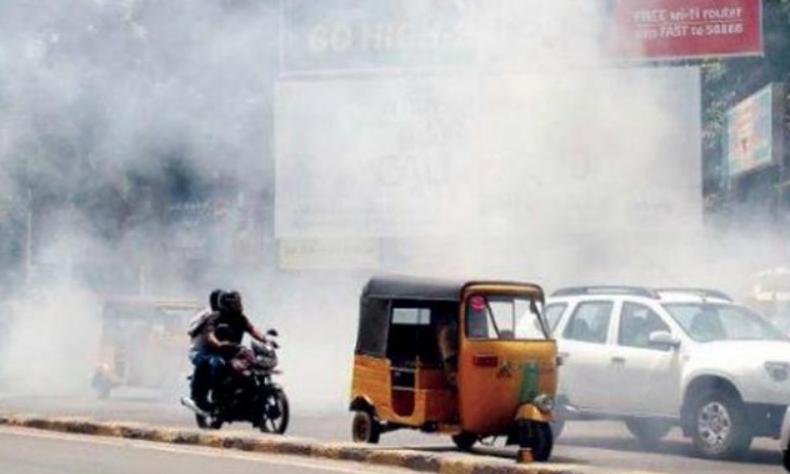
Visakhapatnam: The air quality in Andhra Pradesh has steadily declined over the past three years, according to new data from Respirer Living Sciences. Visakhapatnam has been listed as the state’s most critical pollution hotspot.
Founded in 2017, Respirer Living Sciences has deployed over 3,500 air-monitoring devices across 35 cities in India and abroad, collaborating with governments, industries and researchers to promote clean air initiatives.
Their data indicate that coarse particulate matter (PM10) has consistently exceeded national standards each year since 2024. The report tracked five pollutants across the state from January 2024 to April 2026 and highlights a concerning increase in fine particulate matter (PM2.5) and nitrogen dioxide (NO2), posing significant public health risks for millions of residents.
PM10 levels rose from an annual average of 67 µg/m³ (micrograms per cubic meter) in 2024 to 84 µg/m³ in 2026, significantly above India’s permissible limit of 60 µg/m³.
During the same period, PM2.5, which can penetrate deep into the lungs and bloodstream, increased by 33 per cent, exceeding the 40 µg/m³ threshold in both 2025 and 2026.
The number of days classified as unsafe for PM2.5 more than doubled from 2024 to 2025. NO2, associated with traffic and industrial combustion, surged by nearly 44 per cent, while ammonia and carbon monoxide levels remained within national limits.
Seasonal patterns were evident, with the worst readings consistently occurring during the winter months. PM2.5 peaked at 67.9 µg/m³ in December 2025, while PM10 exceeded 100 µg/m³ in both December 2025 and January 2026. Additional spikes during morning and evening rush hours further indicated that traffic and industrial activities are significant contributors to this pollution.
“Andhra Pradesh is at a tipping point. PM10 has exceeded national standards for three consecutive years; PM2.5 has now exceeded the safe threshold; and NO2 has increased by nearly 44 per cent. These are serious numbers that represent millions of people breathing unsafe air every day,” said Ronak Sutaria, founder and CEO of Respirer Living Sciences.
Meanwhile, Visakhapatnam has emerged as the state’s most critical pollution hotspot. The GVMC monitoring station consistently ranked among the top five for PM2.5, PM10, and NO2 over all three years. PM10 levels were above safe limits on 55 per cent of days in 2024, 62 per cent in 2025, and 70 per cent in the first four months of 2026.
The city’s combination of port operations, heavy industries, including steel, zinc, fertilisers, and petroleum, and increasing traffic has compounded the pollution burden. “When you have a port, a steel plant, fertiliser units, a refinery, and growing urban traffic all in the same airshed, the pollution is not going to resolve itself,” said Capt N Vishwanathan, secretary of the Greater Visakhapatnam citizens’ forum.
He urged source-apportionment studies, binding industrial emission targets, and a denser monitoring network to hold polluters accountable.
The report also noted that ammonia pollution in Andhra Pradesh does not follow the sharp winter peaks observed in northern India; instead, it remains elevated year-round due to continuous agricultural and industrial sources.
However, there are significant data gaps, with several monitoring stations showing inconsistent coverage over months and years. Ronak Sutaria noted the need for expanded monitoring, particularly in smaller cities, to gain a complete understanding of the state’s air quality crisis.
Respirer Living Sciences recommended several interventions, including hyperlocal emissions inventories, binding industrial emission management plans, expanded monitoring in Visakhapatnam, and daily hotspot reporting to facilitate targeted pollution mitigation.
Disclaimer : This story is auto aggregated by a computer programme and has not been created or edited by DOWNTHENEWS. Publisher: deccanchronicle.com