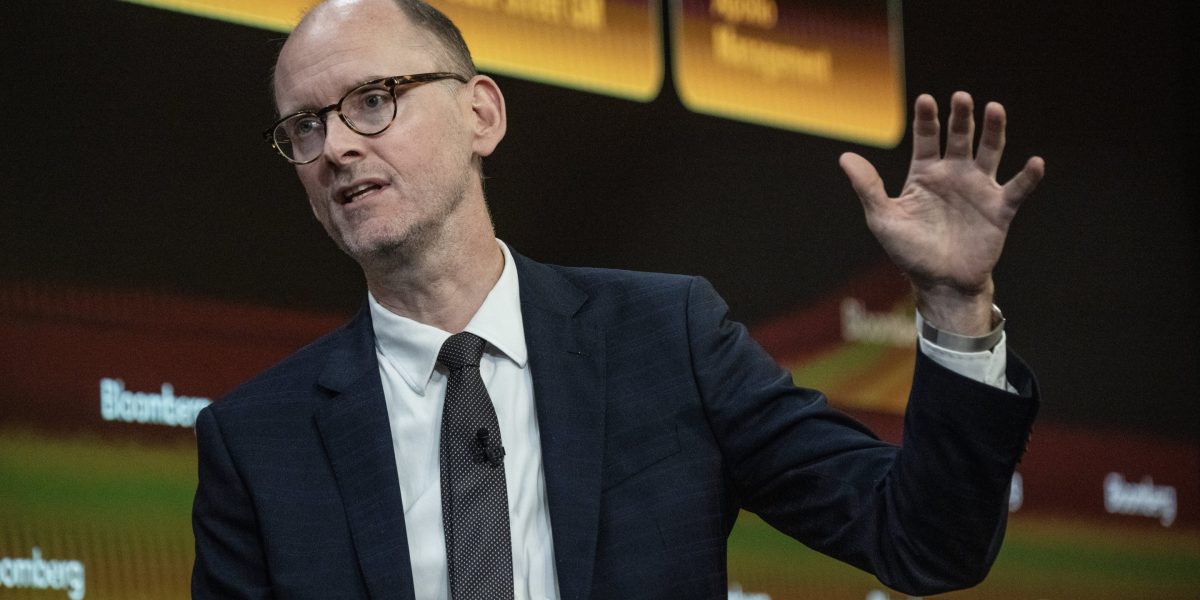
Sløk pointed to ADP employment data as evidence, concluding that the AI spending frenzy is “stoking both employment and inflation.” And thanks to the tech boom, he even believes that nonfarm payrolls in May—accounting for all U.S. workers excluding agriculture laborers, private household staffers, non-profit employees, and government professionals—could come in higher than the 95,000 jobs that are generally predicted.
The economist says this is the Jevons paradox taking shape: cheaper technology generates more demand and work for humans. This idea contrasts with the notion that AI could be a money-saver as opposed to employing a legion of human staffers, who come with costly salaries, benefits, and PTO. Instead, Sløk believes this tech revolution only increases demand for human beings—albiet, ones with AI skills who can help drive the business into the future.
“Instead, many firms are hiring AI implementation experts,” Sløk said in a recent blog post. “And the data center buildout is putting upward pressure on salaries for AI experts and on prices of semiconductors, equipment and energy.”
Companies are cutting jobs in the name of AI
Ever since ChatGPT stepped onto the scene in 2022, workers have been hand-wringing over the fate of their careers—all while leaders have stoked fears with alarming predictions.
In 2025, Anthropic CEO Dario Amodei claimed that AI could eliminate 50% of white-collar jobs; and last summer, OpenAI chief Sam Altman said that entry-level work was threatened by automation. Leaders have reinforced that narrative by whittling their workforces in the name of AI.
Earlier this year, the cofounder of payments firm Block announced that the company would lay off nearly half of its workforce, impacting about 4,000 staffers. Jack Dorsey explained in an X post that the cuts are directly tied to the company’s AI implementation: thanks to efficiency gains from the tools, the $45 billion business will employ “smaller and flatter teams” moving forward.
And this trend has been picking up steam for years; in late 2023, Klarna also decided to halt hiring as AI brought newfound productivity. At the time, the fintech company boasted around 4,500 staffers—and after letting natural attrition run its course at a rate of 20% of workers leaving each year—the workforce was whittled down to 3,500 by 2024. Klarna said it has saved about $10 million annually using AI for its marketing needs, cut back on in-house lawyer time, and optimized its communications roles. And the company’s CEO, Sebastian Siemiatkowski, has doubled-down on this broader workforce shift—even if his peers won’t be honest about it.
“I feel a lot of my tech bros are being slightly not to the point on this topic,” Siemiatkowski told Bloomberg in 2025. “I think there is a massive shift coming to knowledge work. And it’s not just in banking, it’s in society at large.”
Even one of America’s largest employers, Amazon, has been leveraging AI at the behest of office jobs. CEO Andy Jassy expects the company’s workforce to shrink in the coming years as tech automates more tasks; he says that generative AI and AI agents “should change the way our work is done,” and sees the biggest unlock with the retail giant’s corporate team.
“We will need fewer people doing some of the jobs that are being done today, and more people doing other types of jobs,” Jassy wrote in an email to Amazon employees last year. “It’s hard to know exactly where this nets out over time, but in the next few years, we expect that this will reduce our total corporate workforce as we get efficiency gains from using AI extensively across the company.”
Are companies being honest, or ‘AI-washing’ their layoffs?
As employers slash headcounts and point their fingers at AI, there is growing question over whether or not the tools are truly causing a jobs armageddon. Amodei and Altman have even backtracked on their doomsday predictions; the Anthropic leader now says AI will expand the work people do, and the OpenAI chief said he was “delighted to be wrong” about the tech’s impact on jobs. Altman even senses that some employers are hiding behind AI when reasoning their workforce layoffs.
“I don’t know what the exact percentage is, but there’s some AI washing where people are blaming AI for layoffs that they would otherwise do, and then there’s some real displacement by AI of different kinds of jobs,” the OpenAI cofounder told CNBC-TV18 earlier this year.
Market research firm Forrester said that job loss fears are overstated in the midst of “AI washing,” as businesses reference AI as the justification behind their headcount reduction in lieu of other reasoning, or cut staffers in the lead-up to reaping the tech’s efficiency gains. Another 2026 report from Yale Budget Lab found that the concept of an AI jobs wipeout to be “largely speculative.” Instead, experts speculate that companies are shedding employees due to pandemic-era overhiring, or are attempting to position themselves as frontrunners in the AI era.
In reality, these tech-related layoffs are climbing, but still represent a sliver of the cuts happening behind the scenes. During 2025 an estimated 55,000 roles were slashed in connection to the technology, according to the National Bureau of Economic Research—a number that has been ticking up, but still encapsulates a small portion (4.5%) of the overall 1.2 million U.S. workforce layoffs that year. And many AI-related layoffs could actually be a diversion from less attractive business explanations, according to experts.
“You’ll hear companies in these cases say they want to streamline, or remove layers of bureaucracy or management, or trim bloat,” Chris Martin, lead researcher on Glassdoor’s economic research team, told Fortune this year. “It’s companies that are doing well, but they’re deciding to boost profitability by removing some headcount.”
Disclaimer : This story is auto aggregated by a computer programme and has not been created or edited by DOWNTHENEWS. Publisher: fortune.com