
Quick note: Subscribe to the forthcoming Fortune Gulf Brief. Every Tuesday, this new newsletter will deliver clear-eyed, authoritative intelligence on the deals, decisions, policies, and power shifts shaping one of the world’s most consequential regions, written for the people who need to act on it. Sign up here.
THE MARKETS
A new record high in the U.S.
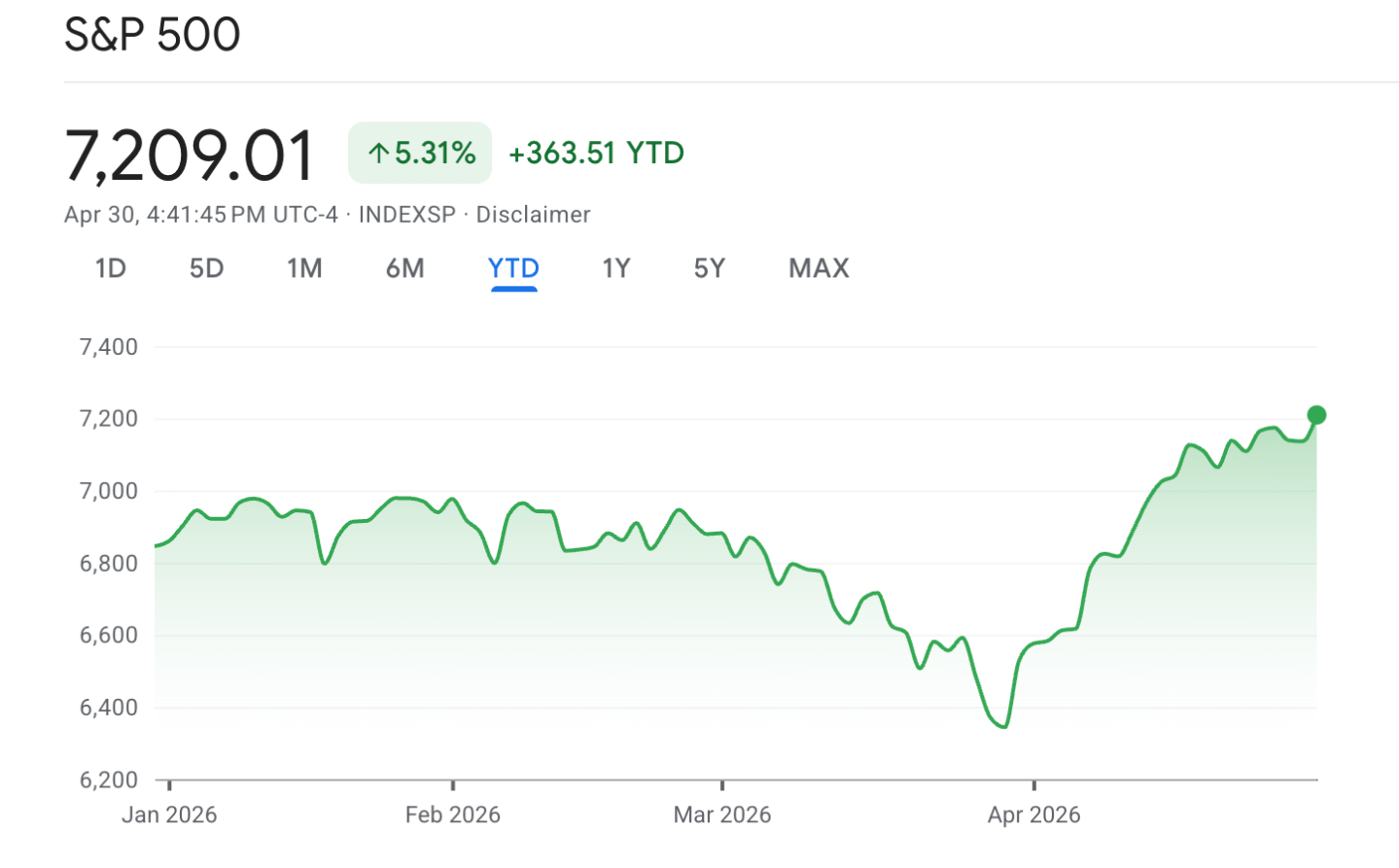
- S&P 500 futures were flat prior to the open in New York. The index rose 1.02% yesterday to hit a new record high at 7,209.
- In Europe, the Stoxx 600 was up 1.21% in early trading, but the U.K.’s FTSE 100 was down 0.66% before lunch.
- Asia: Japan’s Nikkei 225 was up 0.38%. Markets in South Korea, India, and China were closed today.
- Brent crude was at $111 per barrel this morning.
- Bitcoin was at $77.3K.
ONE BIG THING
Apple’s new CEO said nothing—and Wall Street loved it
It was Tim Cook’s 89th earnings call last night. Apple stock was up 2.8% in overnight trading after ending up 0.44% at the close of yesterday’s daytime session as investors digested yet another beat on quarterly revenue ($111.2 billion), and the company raised its guidance for future sales. CEO Cook also introduced his replacement, John Ternus, who will succeed him in September.
As is tradition, Ternus overtly insisted on saying nothing about Apple’s new product pipeline. Fortune’s Alexei Oreskovic noted that this is the time-honored way that Cook and Apple have maintained a mystique around their business: By insisting on secrecy—loudly and publicly.
Ternus said: “We have an incredible roadmap ahead. And while you are not going to get me to talk about the details of that roadmap, suffice it to say, this is the most exciting time in my 25-year career at Apple Inc. to be building products and services.” Full transcript here.
THE CAPEX PROBLEM
The economy seems fine — until you look under the hood
U.S. Q1 GDP growth came in at 2% annually, and initial jobless claims fell sharply to 189,000 (the expectation was 212,000). So why is Mohamed El-Erian worrying about a recession possibly being mere weeks away?
Because corporate spending has been negative for six straight quarters, according to ING’s James Knightley. Capex overall is growing, but pretty much only because of spending on AI data centers, as this chart shows. Software and computing investment rose 24% year-on-year, ING says. Absent AI, U.S. capex is shrinking:
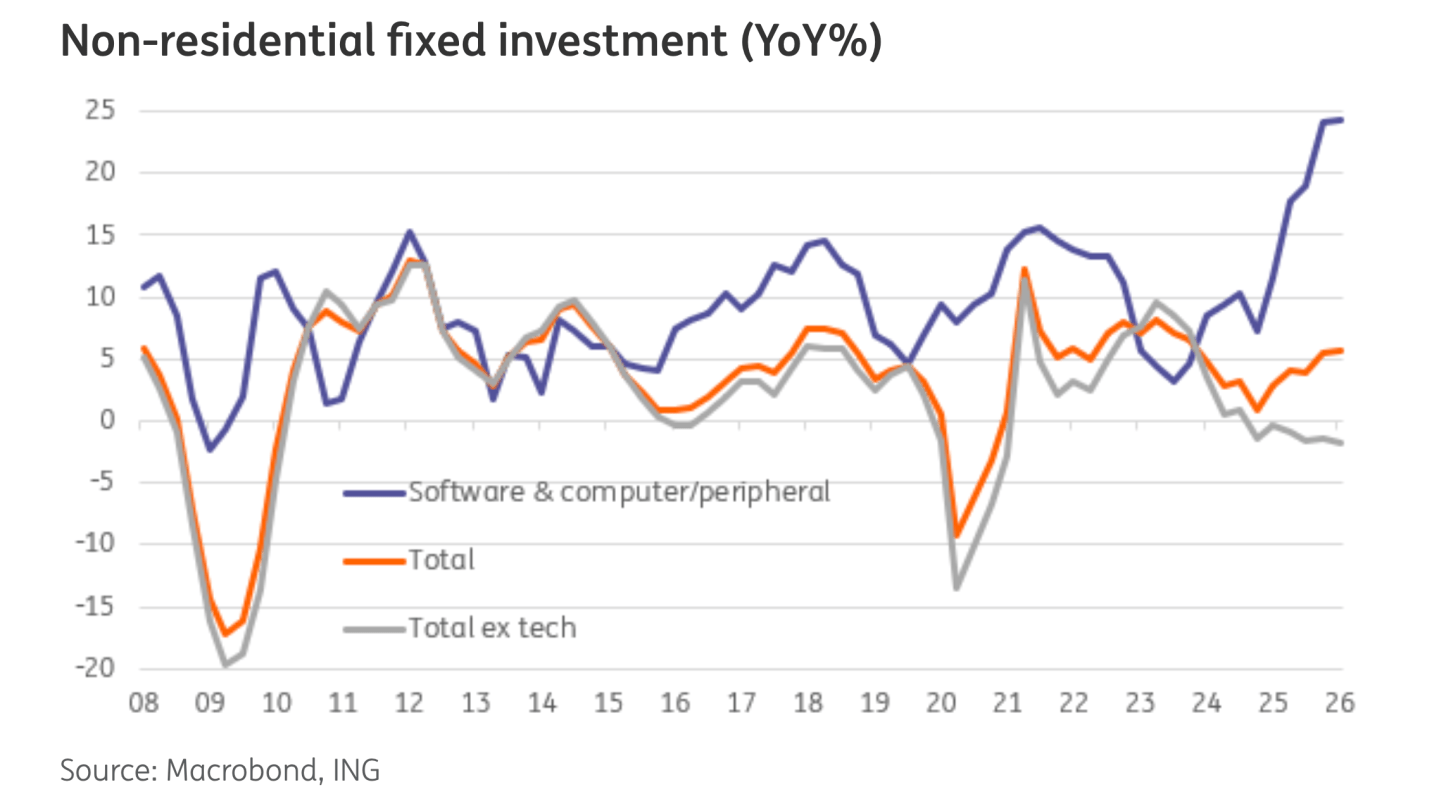
$1 trillion on the horizon. But AI capex won’t be shrinking anytime soon. Tech hyperscalers Alphabet, Amazon, Meta, and Microsoft are planning $800 billion in data center capex this year (up 67%), according to Bank of America’s Vivek Arya. It could reach $1 trillion (up 25%) in 2027.
The Fed considers the “h” word
Although U.S. Fed chair Jay Powell left interest rates at the 3.5% level on Wednesday, his remarks were the most hawkish-sounding in months. Wall Street is adjusting its predictions for the Fed’s rate-setting schedule and, as usual, their guesses are all over the place. Some even think the Fed may be forced to hike rates.
Here is a sampling of opinions in order of hikey-ness:
- Macquarie’s David Doyle and Chinara Azizova: “The next Fed rate change will be a hike (in 1H27) with broadening evidence of labor market improvement a key reason.”
- Bank of America’s Yuri Seliger: “Following the marginally hawkish [Fed meeting], and more importantly, oil prices reaching new highs, markets are now pricing in about 10bps of Fed hikes over the next 12 months.”
- Goldman Sachs’ David Mericle: “We see the risks around our Fed forecast as tilted toward a longer pause, though we remain very skeptical of rate hikes.”
- PIMCO’s Tiffany Wilding: “Our view remains that the next move will be a rate cut, but the timing is far from clear.”
- Natixis’s Christopher Hodge and Selin Aker: “We believe cuts will be forthcoming in September and December.”
Bond vigilantes sighted
Ed Yardeni of Yardeni Research is starting to worry about bond vigilantes—investors who dislike inflation and who will dump government debt if they see it, making the cost of borrowing higher.
- “The bond market is starting to signal concerns that the energy shock might cause a more persistent, rather than transitory, inflation problem. The 10-year Treasury bond yield is up from 3.95% on Feb. 27 (a day before the war started) to 4.25% this evening. … The Bond Vigilantes are starting to mutter: ‘No more Mr. Nice Guys,’” he said in a note on Thursday.
IRAN
Congress could stop the war. It won’t.
Defense Secretary Pete Hegseth told Congress that the current ceasefire between the U.S. and Iran puts the 60-day “war powers” clock on hold. Under the War Powers Resolution of 1973, the White House must seek Congress’s permission to continue hostilities against a foreign nation within the first 60 days of the conflict. The Iran war started on Feb. 28 and the 60-day period passed a couple of days ago.
Don’t get excited: Congress has hardly ever exercised its authority to end a conflict under War Powers Resolution, and the courts have shied away from judging whether it is even constitutional, according to Natixis chief U.S. economist Christopher Hodge. The act is thus unlikely to force an end to the war, he said in a recent note: “The operative question is not legal authority, but political constraint—specifically, whether Congress is willing to impose one. Thus far, Republicans have largely had the luxury of offering tacit support for an increasingly unpopular conflict without taking a recorded vote.”
MORE FROM FORTUNE
China dominates the world’s lithium supply. The U.S. just found 328 years’ worth in its own backyard – Jake Angelo
Former Fed economist raises alarm on Warsh after historically partisan vote: ‘this is not normal is going to be a theme’ – Eva Roytburg
A ‘no-brainer’: Senate unanimously bans members and staff from using prediction markets – The AP
Wind energy CEO says company ‘must adapt’ as Trump offers $2 billion to kill offshore wind projects – Marco Quiroz-Gutierrez
CHART OF THE DAY
AI didn’t kill the radiology stars*
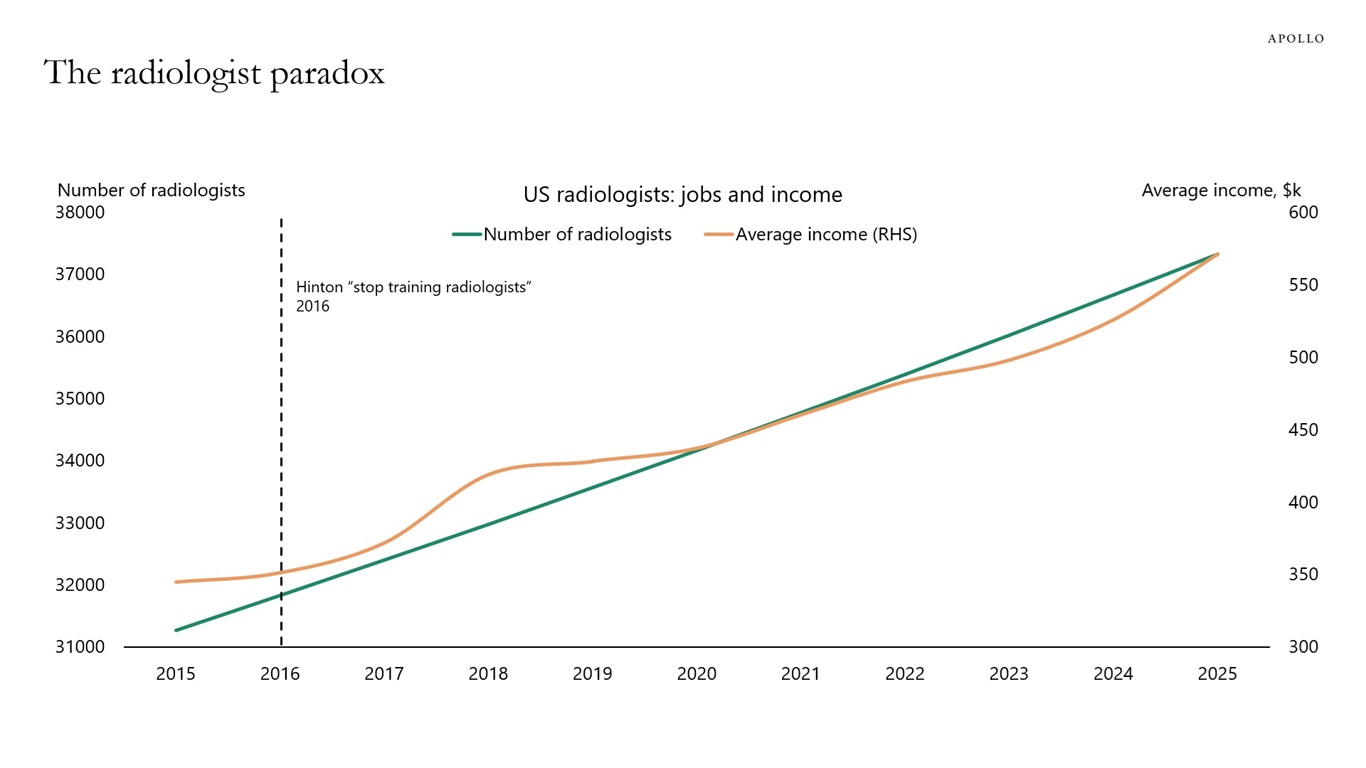
New tech, like AI, creates more jobs than it destroys, according to Apollo Global Management’s Torsten Sløk. “A decade ago, AI was supposed to replace radiologists. Today, radiologists make more than $500,000 per year, and their employment continues to grow … Reading scans is a task, not a job, and when the task gets cheaper, demand for the job grows,” he wrote recently.
*My apologies. Click here if you don’t get it.
NUMBER OF THE DAY
One million
The cost, in Iranian rials, of a single fried egg in downtown Tehran. Minimum wage in Iran is 200 million rials per month. The USD exchange rate is $1 = IRR1.3 million.
THE FRONT PAGES TODAY
Jeffrey Epstein’s Possible Suicide Note Hidden From Public View – NYT
Trump vs Kimmel: inside Disney chief Josh D’Amaro’s baptism of fire – FT
First driverless truck delivery takes place in Texas – Axios
Lululemon’s New CEO Is Already in the Hot Seat—and She Hasn’t Even Started – WSJ
Elon Musk’s Tesla Compensation Totals $158 Billion for 2025 – Bloomberg
ONE MORE THING
The “gas tax” is eating Americans’ tax returns
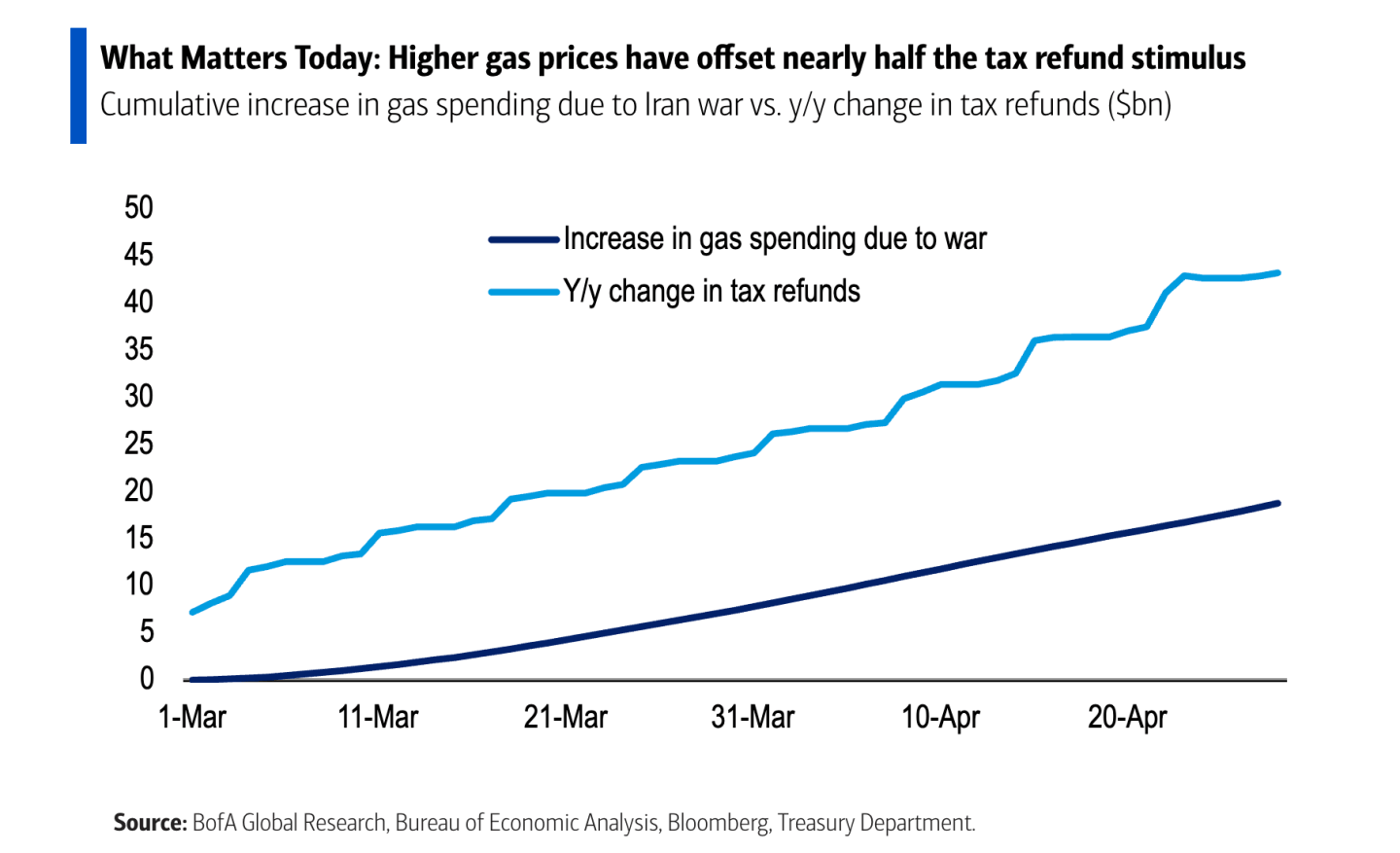
Tax refunds in the U.S. are up $43 billion year on year, according to Bank of America’s Matthew Yep and Aditya Bhave. But rising oil prices have cost consumers an extra $19 billion, they estimate. “Unless there is relief at the pump, the ‘gas tax’ should start to weigh increasingly on the consumer in coming months,” they said in a recent note.
Disclaimer : This story is auto aggregated by a computer programme and has not been created or edited by DOWNTHENEWS. Publisher: fortune.com



