
MICHAEL DYSART
April 18, 1934 – May 28, 2026
You might expect the creator of the often-reviled UTS Tower to disappear into obscurity after its completion. But that was far from reality for its architect, Michael Dysart. It was just one building, albeit controversial, in a long career of inventive, innovative and influential architecture.
Dysart possessed three interwoven talents: a creative desire to explore new ideas, an architect’s eye for making forms for his ideas, and wit and charm, to overcome the forces against different ideas.
With those skills, he originated new ways of designing schools, homes, churches, medium-density housing and hotels. It was the way he challenged the possibilities in each environment which saw him vaulted into the pantheon of Australia’s most significant architects. He died late last month.
Born in 1934 in Brighton, UK, Dysart migrated to Australia with his family when he was 15. He attended Katoomba High School, and commenced architecture at The University of Sydney in 1953. By 1955 he had won a traineeship at the NSW Government Architect (NSWGA). He joined “the Design Room”, a hothouse of creativity set up by Harry Rembert within the NSWGA’s office. Other alumni included Peter Hall (who completed the Sydney Opera House), Ken Woolley and Peter Webber. Even before graduation in 1958, Dysart was entrusted with the design of Robb College at the University of New England, a striking scheme of basalt and concrete vaults.
In 1958, while working for the NSWGA, Dysart and colleague Woolley won the Australian Women’s Weekly Family Home competition. Fortuitously, the government was supportive of their extracurricular work, where Dysart designed innovations for Pettit+Sevitt, Aspect, Habitat, and Program homes.
His designs were driven by two key ideas: a better fit in the Sydney topography, and interiors reflecting new-found domestic freedoms. Whereas traditional homes had level floors in “boxes”, these “designer” homes had open plans, with spaces defined over split levels, and indoor-outdoor relationships for views and interactions with the bushland.
External walls were highly textured in “clinker” bricks or bagged and painted in Grecian-inspired white. Skillion roofs with sloping ceilings and dark-stained exposed timber beams gave vaulted spaces, for a more natural fit in the bush settings. Dubbed “the Sydney School”, the design movement forever influenced suburban houses.
In 1964 Dysart displayed his versatility designing the Polish War Memorial Chapel at Maraylya in Sydney, with the “clever and memorable” building formed from a series of triangles narrowing and rising towards the steeple at the back.
Rapidly rising population in the 1960s, as well as the progressive “Wyndham Scheme” curriculum, required more and bigger schools. Dysart asked for the work, wanting to change “double-loaded corridors” of closed-up rooms into natural cross-ventilated spaces (since air-conditioning was banned).
Two radically different approaches resulted: the “doughnut design”, single-sided rooms accessed from external corridors around an internal courtyard, for privacy and security, and shaded indoor-outdoor connections; and the “chimney” design, which exhausted summer heat through towers, not for winter smoke, but ventilation.
The Department of Education opposed both ideas. Dysart sought out the bureaucrats for Friday beers in a bid to overcome their resistance, eventually getting the “doughnuts” approved and under budget, to everyone except Dysart’s surprise.
He developed 43 new high schools in three years. Some won architectural awards – Taree Technical College won the Blackett in 1965, and Ryde High School was highly commended in the Sulman in 1967. Natural cross-ventilation became a vital component in designing for sustainability in schools.
In these seminal years, Dysart, with his Design Room colleagues, were influential tutors at the University of NSW.
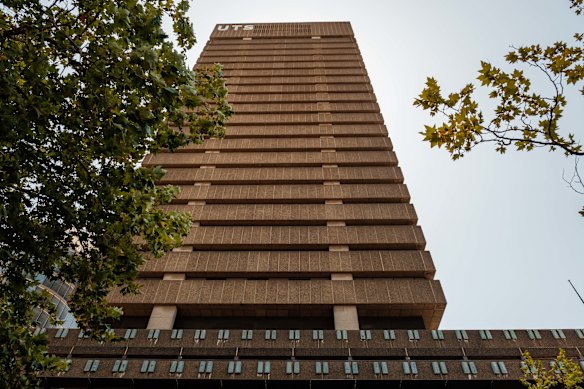
Dysart is best known for the University of Technology, Sydney (UTS) tower, designed in 1968, and taking almost 10 years to build. Close to the CBD, the tower, with its heavy brutalist structure, was often criticised, but was highly radical for its time, being the first “town and gown” project in a high-rise building.
Large column-free spaces for foyers and halls were created using a new technology of post-tensioning, using cables within concrete slabs, with end cappings expressed externally to break up the solid surfaces. The exposed aggregate concrete, or “concrete skin”, as Dysart called it, reflected the colouring of Sydney sandstone, weathering better than other brutalist buildings.
Now seen as a “brutalist icon” – it is surrounded by buildings of differing styles by four “star” architects – its simple engineering aesthetics can be perceived as a strong statement of its time.
Dysart left the NSWGA’s office to form his own studio in 1969, to expand his ideas from project homes into grouped housing. Searching for a different way to build mass housing, he formed the Baranbali co-operative to fund a communally minded project of 40 units in a 10-storey building near
Moore Park.
The scheme had a commercial laundry for income, communal areas, a kitchen and “gathering areas”. Dysart’s energy and skills were vital in overcoming the obstacles of finding finance for an unusual project, and finishing construction when the builder went broke.
The most famous of his co-operative projects were two “ahead of their time” projects in Canberra, designed and built between 1974 and 1977. Kambah’s Urambi Village consists of 72 houses with views of the Brindabella ranges, and Wybalena Grove, established by the Cook-Aranda Co-operative Housing Society, included 105 houses. Both had bush settings, with conjoined courtyards and townhouse plans drawn from his project homes work.
The houses “grew out of the ground”, stepping down steep sites, while retaining outlooks into existing trees. They were grouped around shared communal facilities, meeting rooms with fireplaces and outdoor gathering areas, in a highly developed landscape designed by Dysart that included communal gardens for food.
Again, Dysart’s force of will was required to overcome the bitter opposition of both the banks and Canberra’s all-powerful planning authority, the National Capital Development Commission (NCDC). Both projects won Australian Institute of Architects (AIA) awards and the Roy Grounds Enduring Architecture Award. Urambi Village is now on the AIA’s Register of Nationally Significant 20th Century Architecture.
In 1977 Dysart was commissioned to bring these medium-density housing ideas to a Housing Commission redevelopment in Woolloomooloo, reworking townhouses into a four-square plan on an urban site. In continuous use, they remain strong evidence of a time when there was conviction and action on public housing.
Dysart then sought larger, more commercial work with his firm, Davis, Heather and Dysart, winning several commissions for hotel designs. The Regent Hotel (now Four Seasons) in George Street was radical in two ways: the usually “hidden” meeting and conference rooms were opened up to “create a theatre for the people”, and the tower was reimagined with a faceted facade of windows for views alternating with solid walls of washed aggregate sandstone for sun protection.
Other projects included The Old Sydney Inn, combining an old warehouse and new rooms around a glazed atrium, the Clocktower Hotel, also in The Rocks, the Hilton in Cairns, the Australian Golf Club in Rosebery, and a resort on St Bees Island.
Dysart bemoaned the sudden loss of work in the early 1990s that destroyed his business, from which he barely recovered. Nevertheless, small projects continued, his final project being alterations and additions to his family holiday house in Wagstaffe on the NSW Central Coast. This house won the AIA’s small project award in 2009.
Dysart was a Life Fellow of the AIA and was awarded an AM in 2013 for services to architecture.
 Tone Wheeler is president of the Australian Architecture Association and the design director of environa studio, which specialises in social and sustainable architecture.
From our partners
Disclaimer : This story is auto aggregated by a computer programme and has not been created or edited by DOWNTHENEWS. Publisher: www.smh.com.au