Are AI models the next big danger for body image?
-
Published
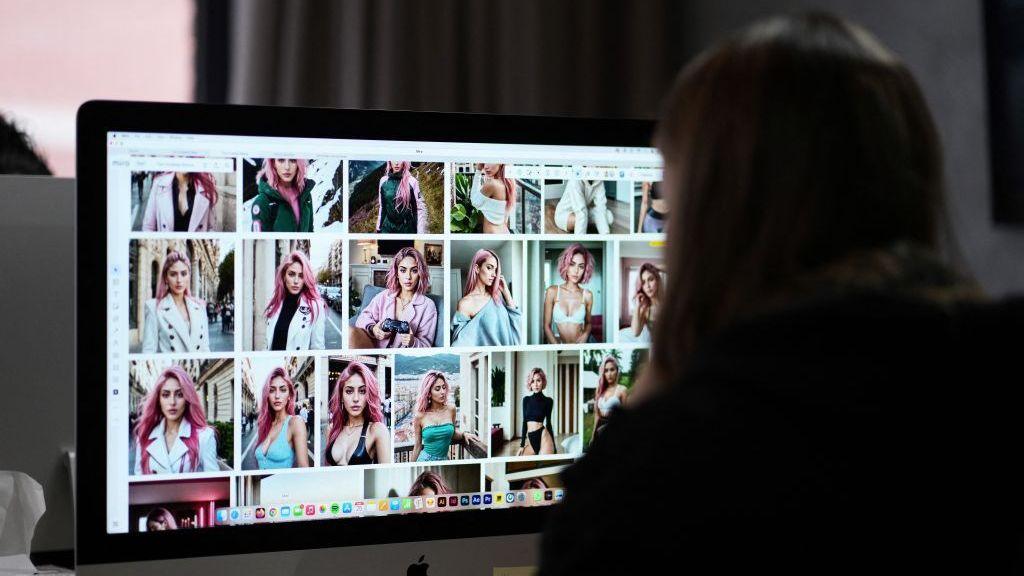
AI models are popping up more and more across social media and advertising, but how might this affect body image?
Mia Perumal, who has recovered from an eating disorder, said she’s worried the technology could make unrealistic beauty standards even harder for young people to escape.
The 19-year-old Cardiff University student said she believes if she’d had access to AI during her eating disorder, it would have had a “terrible impact”.
AI-generated videos and photos are getting harder to spot too, she said.
This story contains material about eating disorders and self-harm.
When Mia Perumal was 12 she says she was fed harmful content via social media algorithms.
Now she fears the rise of AI models is magnifying the damage on other young people.
Mia has noticed an increase in very thin AI beautiful people on social media in the past year, the comments often being from 12-year-old girls saying: “Dream body, drop your workout routine I want to look like this.”
She said she finds it “really sad” because looking like AI models is completely unobtainable, she believes the only option to prevent harm is for AI to be controlled.
 Image source, Mia Perumal
Mia said: “It’s all very well saying ‘oh, it’s AI, it’s not real,’ But eating disorders don’t really listen to rationality.”
She said she wants young people to “be cautious, question everything”.
In the early 2000s Kelly Watts, like most teenagers, was worried about the way she looked and said she was constantly comparing herself to people around her and models in magazines, she said.
Now 41, she is worried her 11-year-old son will compare his body to fake photographs of “perfect people”.
As a freelancer in marketing, AI in business images are something Kelly is seeing everywhere, but often without tags meaning it is hard to determine whether it is real or fake.
“At first, I didn’t realise they were AI, but the more you see it, the more you can’t unsee it. Now, I see it on quite a regular basis,” said Kelly.
Her son Oscar loves playing rugby and is becoming more aware that “some friends are taller”, she said.
While he has not raised concerns about his body, she fears he could look up to AI characters online.
 Image source, Kelly Watts
The 11-year-old watches YouTube and does not yet have social media. But this does not keep him away from AI, which she fears has infiltrated YouTube’s content.
Watching footballers who have six-packs is already a body-image influence, she said, let alone being then shown AI generated people who are unrealistic.
“Especially with children, it’s going to be ‘can they ever get to that point?
“It’s putting a lot of pressure on them, which they don’t need,” she said. “No one and nothing is perfect. I don’t want him growing up thinking he has to be perfect.”
“I’m his mum, and the last person he’s going to listen to over a big influencer,” she said, even if that influencer is AI.
Kelly said AI-literacy is important, and being able to spot real vs fake is essential.
“At what point do we need to be aware that it potentially can be damaging to us and our children, and AI should definitely be labelled more.”
“Why do we want to compare ourselves to a robot instead of a human?”
 Image source, Kelly
“As human beings, we have this tendency to compare ourselves to others,” said Phillippa Diedrichs, professor of psychology at the Centre for Appearance Research, UWE Bristol.
She said: “If we’re comparing ourselves to a very narrow beauty standard, which typically tends to be the case, the beauty ideals that we have are very narrowly defined, and that inevitably means that many of us are not going to meet those beauty ideals.
“This is particularly the case with social media and digitally constructed images because they don’t even exist in biological reality.
“We compare ourselves and when we fall short, this can lead us to doubt ourselves and feel negatively about our own appearance.”
She said if AI was used to create more diversity and inclusion, then “when we compare ourselves, we feel alike and similar, which can either have a neutral or positive impact on our wellbeing”.
Diedrichs said unless the designers prompt AI to show realistic or diverse features, “it’s going to give you an image that defaults to the average” data set of the “narrow” traditional beauty standards.
“So for example, people of colour, gender, queer people, people with kind of interesting and distinguishing facial features, it means that they’re going to be left out,” she said.
“You can try and overcompensate that with the way you prompt and create these images. But if you don’t do that, you’re going to get very generic images, which tend to reinforce a lot of the biases that we have in society.”
She said it could create even more unrealistic beauty standards, “if it’s not done carefully or with some thought because it will default to the average of whatever it’s learnt from.
How can you spot AI models?
Diedrichs said there are “tell-tale” signs like “the texture of the skin or the eyes” and how “coily hair” looks.
She added that the absence of blemishes or pores can be a good way of identifying AI, however it is constantly getting better.
 Image source, Getty Images
Diedrichs said teenagers can be influenced but they are also often “critical and aware, and have more knowledge about technology than older people”.
“The thing is, though, we can be aware that these things are happening, but it doesn’t necessarily stop us from wanting to look like those images,” she said.
She said she recommended asking if the images or advertising is “serving you, does that make you feel good about yourself? Does it make you feel inspired, lit up?”
“If it’s making you feel lacking, that’s a really important signal to pay attention to, and suggests that maybe this isn’t for me to be looking at.”
Diedrichs said AI models in advertising could enable small brands to have a large number of diverse models, or global brands to advertise in multiple markets.
“There could be these benefits for diversity,” she said.
However, she noted the “knock on effect to creative industries and people working in this space. I would never like to see AI completely replace” the artistry and creativity of humans.
“As a consumer, you have a lot of power as well. You can express your views on this in the comment section,” she said. “Brands will see.”
Zoe Lee and Hannah Marriott, researchers at Cardiff Business School said AI-generation fashion models and digital twins, virtual replicas of real models are becoming more common.
Brands such as Balmain, Levi’s and H&M have experimented with the technology, they said.
But Lee and Marriott’s research has found that consumers often reacted negatively to AI-generated models once they realised they were not real.
In focus groups, participants told them they would “rather have a real person and way less people representing us, but they be real”, arguing AI models could never reflect lived experience.
Marriott said they also found people would “emotionally detach themselves” from images once they discovered they had been generated by AI.
H&M said it worked with real models in 2025 to make “digital representations/twins of the models” who “themselves retained full control and ownership of their digital twin”.
However this “exploration was paused during spring 2025” to consider the next steps.
Balmain, Levi’s, TikTok, Meta and Google were contacted for comment.
If you’ve been affected by any of the issues raised you can visit BBC Action Line to access help and support.
Disclaimer : This story is auto aggregated by a computer programme and has not been created or edited by DOWNTHENEWS. Publisher: BBC