I’m one of those rare Mexicans who never cared for soccer.
My family is from the north-central Mexico state of Zacatecas, where baseball is king and even volleyball was more popular in the ranchos of my parents than futbol. The childhood sports idols for my generation of cousins were Dodgers pitcher Fernando Valenzuela and boxing champ Julio César Chávez, not Mexican soccer legends Hugo Sánchez and Jorge Campos. Our dads bought us hats and bats to occupy our summer, not kits and cleats. I don’t even remember any of us ever owning a soccer ball — and I have nearly 100 cousins.
The first World Cup I remember was the 1994 edition hosted by the United States, I remember reading a huge Times special preview section on the affair and collected some of the commemorative pins that McDonald’s sold. But the matches were background noise in our living room during family parties as we splashed around in the swimming pool at our Anaheim home. When the tournament finale happened at the Rose Bowl, my favorite cousins and mutual best friend instead caught a baseball game at Angel Stadium and only knew about Brazil’s victory over Italy because the people above us in the a private suite let us know.
As a sports fan, I paid enough attention to soccer as the decades passed to know who was who and what team was what and which sides kept winning — and that was mostly because I enjoyed EA Sports’ excellent video game version of it. What made playing soccer on consoles so fun — an exponential number of domestic leagues and international tournaments, the fact that every English-language match seemed to have a Scottish color commentator, the seeming aimlessness and formlessness on the pitch broken up by flairs of beauty — made it a slog when watching in real life.
As a reporter, I knew enough about soccer culture to file stories from watch parties across Southern California’s cornucopia of diasporas every World Cup. As a Mexican American, I cared enough about Mexico’s perpetually heartbreaking El Tri squad to watch their runs and sigh about how we’ll always have it harder than most. But I never bothered to tune into other matches even as soccer leagues from across the globe have stormed network, cable and streaming channels in recent years.
I never hated the sport — it just never moved me. But when the final whistle blew on this year’s World Cup finale and three-quarters of the packed house at Chapter One: The Modern Bistro cheered wildly, I realized I was finally, truly a soccer fan.
Over 104 games, a bunch of questionable VAR calls, another heartbreaking downfall by Mexico, a bizarre Tom Cruise pregame monologue in the last match and the brilliant goal by Ferran Torres in extra time that let Spain squeak by Argentina 1-0, I slowly learned and felt why soccer is the world’s most popular sport, why a billion-plus people watched alongside me Sunday afternoon, and why this Cup kept setting viewership records in the United States and beyond until the end.
Who wouldn’t be moved by the heroic performances of underdog countries against the game’s traditional powers, like tiny Cabo Verde and ancient Egypt? Who couldn’t feel the thrill of seeing young stars meet the hype around them and exceed it — Erling Haaland of Norway, Lamine Yamal of Spain, Mexican midfielder Gilberto Mora, to name the most fabulous? Who didn’t want to interact with fan bases that distilled the best of their side’s cultures and traditions and showed it off to everyone and anyone — I’m doing Norway’s Viking Row even as I type.
Who can’t learn from the life lessons soccer offers — and I’m not talking about the obvious geopolitical metaphors? I knew some of them, yet I never really absorbed them until I decided to make Chapter One my gustatory church for the Cup and watch as many games there as possible. I caught so many that I effectively became a walking Manhattan cocktail for the summer, and while my liver won’t forgive me for a while, my heart and soul absolutely have.
The one thing I always admired about domestic leagues — well, except Major League Soccer — is the relegation system, where the bottom teams in one league swap places with the top teams in a lower-ranked league at the end of each season. For national tournaments, the corollary is how poorer countries always have to match up against richer ones for regional faceoffs and qualifiers that culminate in the quadrennial dream that is the World Cup.
That makes soccer a beacon of hope and possibility that few other team sports can offer, especially in an era where top teams try everything possible to keep everyone else out of their riches (which is why relegation will probably never come to MLS). In a world where the haves are grinding down the have nots, soccer is a reminder that anything truly is possible for anyone — you just have to keep at it.
The Chapter One gatherings quickly taught me how the long lulls broken up by spurts of passion that I once found a drag were actually as stirring as a religious experience. It’s impossible not to feel this watching even one game — but a succession of them have the effect of a full conversion.
Cheers and chants turned into prayers. Boos against opponents and bad referee and yells at your side to do better was the Spirit moving you to testify. Text threads among friends became daily missals. When your side scored, it was like the gift of life itself — I’ve never been in a louder environment than when Mexico scored against England, a roar that rivaled a jet engine.
When your side lost, like Mexico eventually, inevitably did, it was a reminder that we all must at some point — but that we shouldn’t dwell on defeat because while eternal glory isn’t guaranteed, it can happen. And that’s why soccer teaches we must continue no matter how bad our team performed, no matter how terrible things get or how hopeless life seems.
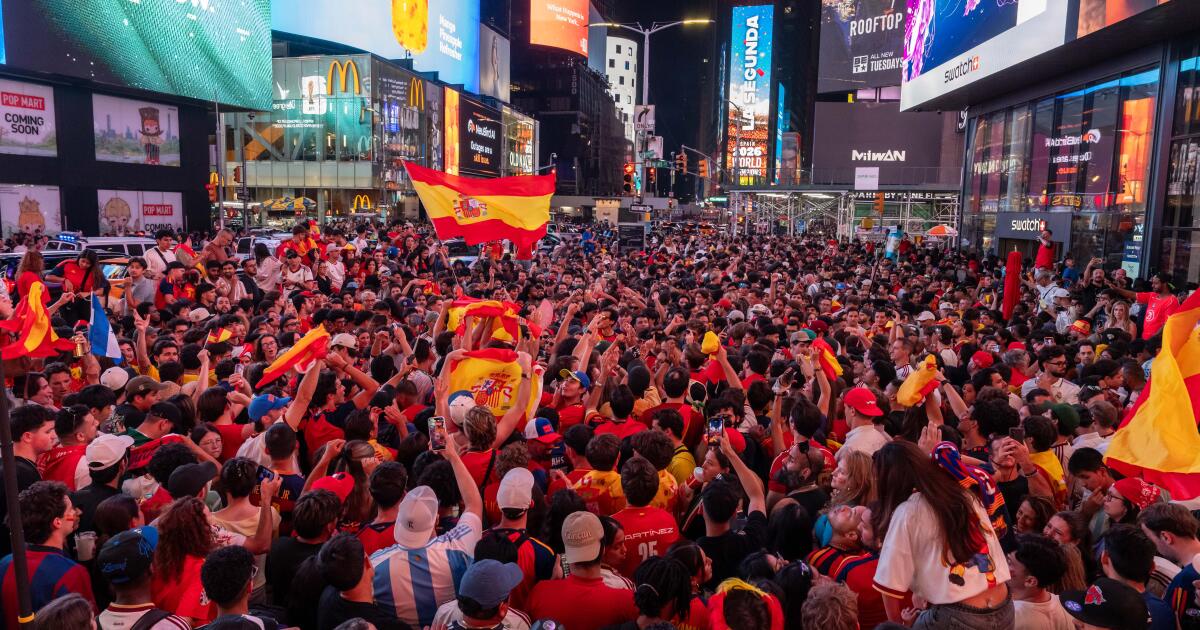
After every Mexico match, downtown Santa Ana became the most wonderful expression of happiness I’ve ever been lucky enough to join — fireworks, conga lines, street takeovers or just standing among thousands of strangers and soaking it all in. It was the revival of a people whom a year early were angrily protesting on those same city blocks if they weren’t sheltering in place because ICE was running roughshod over Southern California.
Only soccer could’ve caused such a joyous revolt. We should all channel some of that magic into our daily lives.
And in the middle of all this emotion, I actually watched what was going on. I saw talented teams like South Korea collapse under pressure and my beloved Mexico valiantly fall against an English squad that was taller, faster and just better — for now. Haaland’s singularity was a testament to how humanity seeks heroes — but Spain’s ultimate triumph via crisp passes and selfless teamwork offered a stirring, convincing collective counterpoint.
Soccer probably won’t supplant my love for baseball, football, basketball and hockey — but I can now mention it in the same breath as them.
International and professional soccer is rife with corruption and avarice and increasingly embraces the worst tendencies of late-stage capitalism. And yet fans suspend their cynicism for a few hours — for a tournament, for a season — because they know that the communion that soccer offers is pure and holy.
It truly is the people’s game. And no amount of Gianni Infantino or mysteriously suspended red cards can ever take that away.
Now that the Cup is over, my mind is racing with what club teams I should start to follow and continue my World Cup experience. I already kind of like Bayern Munich because that was the side I chose in EA Sports FIFA 18 (to show how retrograde my soccer knowledge remains, I still think James Rodriguez, Thomas Müller and Robert Lewandowski play for them), but who will I root for in Premier League? I can’t do Arsenal even though Chapter One is the official Orange County home for Gooner fans because that would be too obvious — maybe Crystal Palace, about which I know nothing other than that was also the name of the Bakersfield music hall owned by country legend Buck Owens?
Zacatecas has never had a successful club team — baseball still rules there, after all — so I think I’ll root for Pumas UNAM to honor all my Mexico City friends who urged me forever to give soccer a true chance. I don’t really know any La Liga squads besides Real Madrid, Atlético Madrid and FC Barcelona, so I have a lot of studying to do there. And between Galaxy and LAFC? Well, time for me to catch a home-and-home El Tráfico and let their support groups court me.
One team I know I’ll now follow: Angel City FC, the L.A.’s women’s soccer side brilliant enough to rebrand itself “Immigrant City Football Club” last summer in the midst of President Trump’s deportation deluge while the city’s other professional sports teams stayed quiet. And I’m already counting down the months before Brazil hosts the Women’s World Cup a year from now and Chapter One becomes my Cheers anew.
Soccer: it’s been a long time coming between you and I. But here I am! Drop those hydration breaks, and you’ve got a fanático for life.
More to Read
Disclaimer : This story is auto aggregated by a computer programme and has not been created or edited by DOWNTHENEWS. Publisher: latimes.com