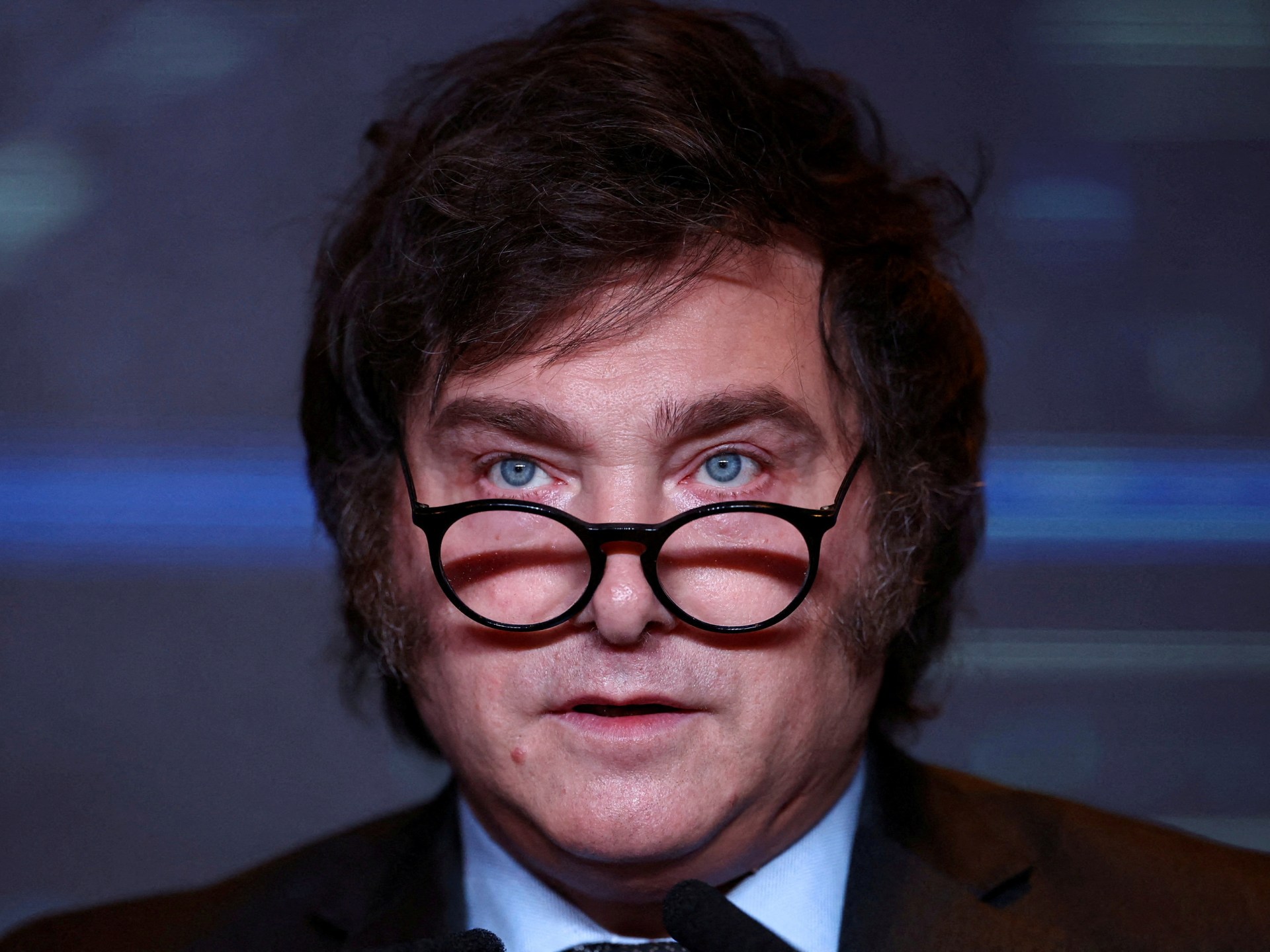
The makings of an economist
Javier Gerardo Milei was born on October 2, 1970, in Buenos Aires. His father, Norberto, was a taxi driver and, eventually, the owner of a transport company. Norberto was also abusive, often beating little Javier, calling him “trash” and telling him he would die of hunger.
“He was attacked and humiliated by his father; he had a really, really difficult life, and the Milei we see now is obviously a consequence of that,” Juan Luis González, author of “El Loco,” a biography of the Argentinian leader, told Al Jazeera.
Only Karina tried to protect him, while Milei’s mother, Alicia, a housewife, was not violent but enabled the abuse by siding with her husband. Once, Karina witnessed Norberto beating her brother so severely that she suffered a panic attack.
“Your sister is like this because of you,” Alicia had told her son. “If she dies, it’s your fault.”
While he would later distance himself from his parents, even refusing to speak with them, Karina remained one of his closest confidants.
At this time, from 1976 until 1983, Argentina was under military rule, following a coup d’etat set on exterminating so-called “terrorists”. Death squads murdered up to 30,000 suspected communist sympathisers during the Dirty War, and many more were tortured. Military rule ended shortly after Britain’s victory in the 1982 Falklands War – fought over contested islands 500km (300 miles) east of Argentina in the South Atlantic – and democracy returned with elections the following year.
As a teenager, Milei sang in a Rolling Stones tribute band and had a brief spell as a semi-professional footballer, playing goalie for the Chacarita Juniors, where he was nicknamed “El Loco” for his fiery temperament.
“He wasn’t afraid of anything,” a teammate recalled to the newspaper La Nacion.
“We trained on fields that were really rough. Rain or shine, we practised anyway. Nothing mattered. And he would do things that made us wonder… why does he do them?”
But young Milei’s interests soon pivoted to economics; he enrolled in university and earned two Master’s degrees. While in graduate school in the 1990s, Milei came across the work of early 20th-century British economist John Maynard Keynes.
Observing how unrestrained capitalism had led to the Great Depression of the 1930s, Keynes argued that governments should intervene to create jobs, offset inflation through taxes, and stimulate the economy during recessions with reduced interest rates. Keynesian ideas, notably, were behind the strong welfare states that emerged in Europe after World War II.
Milei was not a fan of Keynes. The Argentinian was much more attracted to libertarian economists, especially Friedrich Hayek and Milton Friedman. Hayek argued against state intervention, believing it clashed with personal freedom and private property, while Friedman’s star pupils, the so-called “Chicago Boys”, advised Chilean dictator Augusto Pinochet. Their ideology, known as neoliberalism, was the inspiration for Ronald Reagan and Margaret Thatcher. Milei once described the United Kingdom’s first female prime minister as “one of the great leaders of humanity”.
That reverence is not just rhetorical; it reflects Milei’s deep ideological conviction about the market’s role.
“This is precisely what distinguishes Milei from conventional liberalism,” political scientist Juan Bautista Lucca of the National Scientific and Technical Research Council (CONICET) told Al Jazeera.
“For him, the market is not simply efficient; it’s just. This is a moral question.”
Another inspiration was Murray Rothbard, the father of anarcho-capitalism.
Rothbard rejected any form of state authority, believing that taxes and welfare should be abolished. Instead, society should be organised purely around private contracts.
“There would be no monopoly of violence, no state taking the law in its own hands that decides all conflicts,” explained German economist Phillip Bagus, author of the book The Milei Era and a supporter of the president.
“Everything would be private. There would be private streets, private hospitals, schools, universities, healthcare, police. Everything would be based on voluntary cooperation.”
In a 2024 interview with The Economist, Milei revealed that it was reading Rothbard’s books in 2013 that converted him to anarcho-capitalism. However, Milei recognises the difficulties of putting these ideas into practice and considers himself a minarchist: one who slims government duties to purely provide security (law enforcement and defence).
“He is a great communicator of ideas, but his theoretical knowledge is quite weak, contradictory, and dogmatic,” opined Fernández, who first met Milei in 2005 after reviewing and offering feedback on one of his academic papers.
In 2016, Milei made his first television appearance at age 45 on the late-night talk show Loose Animals, where he was asked about Keynes. Milei flew into a rage, ripping into not only socialists but the then-conservative government of Mauricio Macri. From then on, Milei became a regular fixture on Argentinian television, railing against the inefficiencies of government and denouncing what he described as the corrupt ruling “caste” of politicians, journalists, trade unionists and academics.
“The state is the paedophile in the kindergarten, with the children chained up and slathered in Vaseline,” he said on a 2018 television show, equating the state to a predator.
Many of Milei’s early televised appearances were on the channels A24 and América TV, owned by billionaire airport magnate Eduardo Eurnekian. Milei worked for Eurnekian from 2008 until 2021, ultimately becoming the chief economist at the tycoon’s Corporación América.
According to Lucca, Milei’s media spotlight was the deliberate result of a “metapolitical strategy” by these powerful interests: “The idea of the battle for cultural hegemony conducted not through [political] party structure but through the media arena and social networks.”
“That’s why I say from the beginning, he doesn’t follow the classic path of party insider or traditional outsider. He’s an untraditional outsider,” Lucca said.
Milei’s rhetoric towards those he perceived as the enemies of freedom was openly hostile.
“You can’t give leftist turds an inch,” he professed in a television interview that aired in October 2023.
“If you think differently from them, they will kill you. This is the point. You can’t give leftist turds an inch. If you give them an inch, they will use it to destroy you.”
“[This] distinguishes him from the rest of the politicians in Argentina – the Milei you see is the Milei there is,” said González.
“There is no character that he’s playing. He was really, really angry, and in that moment, his anger, his way of insulting all [his opponents] … he fit with the anger that a lot of people in Argentina had with the pandemic, with the economic crisis, with the inflation, or the bad government we had before. Milei was the right man at the right time.”
In 2021, Milei was elected to Congress, initially as a member of a libertarian coalition, but soon founded his own party, La Libertad Avanza (Liberty Advances). As a congressman, Milei theatrically declared that his salary was “money stolen from the people by the state”, and that he would give it away in a monthly raffle broadcast on national television. Within hours of his announcement, 250,000 Argentinians had signed up.
Milei lived up to his promise, giving away his congressional salary each month.
The following year, he announced his run for president.
Disclaimer : This story is auto aggregated by a computer programme and has not been created or edited by DOWNTHENEWS. Publisher: aljazeera.com