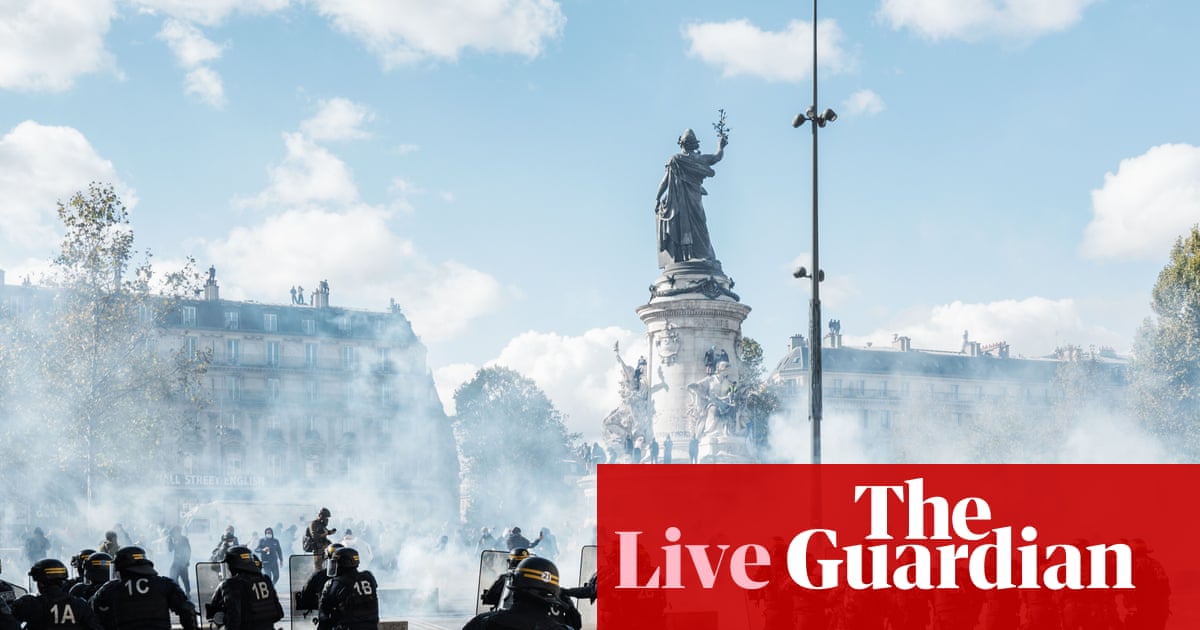
It’s approaching 5pm in Paris, as we await French President Emmanuel Macron’s televised response to large-scale protests and unrest across France on Saturday.
Here’s a summary of today’s events
-
Macron will address the French public on TV at 8pm (7pm BST) after crisis meetings with ministers on Sunday.
-
France’s interior minister Laurent Nunez said “the Republic will not yield” after 1,800 were arrested across the country on Saturday.
-
Protests which had begun about education and schooling conditions in France have broadened to wider cost of living issues.
-
Buildings were set alight, including Limoges City Hall in central France, as other cities suffered widespread vandalism.
-
More than 500 police officers, gendarmes and firefighters were injured.
-
Nunez blamed thousands of “far left” protesters along with criminals who “looted and ransacked” buildings.
-
The numbers of protesters on Saturday have varied, with authorities saying 550,000 took to the streets nationwide, but organisers said it was about 800,000.
-
Paris police said 110,000 took part in a march. Sunday has not seen similar incidents.
-
The cost of damage to shops will run to hundreds of millions of euros, according to the president of a trade body.
-
US president Donald Trump said “France is burning” and blamed immigration in a post on Truth Social.
-
Other protests took place against the cost of living in Spain, Italy and Portugal.
Our Paris correspondent Angelique Chrisafis has this dispatch from France, ahead of Emmanuel Macron’s address to the nation on Sunday night.
The French government was in crisis talks on Sunday after one of the most violent days of unrest in years left public buildings burned, hundreds of shops destroyed and looted and more than 2000 people arrested in cities across the country.
Politicians on the left and far-right called for the resignation of the interior minister, Laurent Nunez after the government appeared to have been caught by surprise by the scale of violence. State buildings were stormed and torched, bus-stops smashed, roads barricaded and shops broken into and destroyed.
The president Emmanuel Macron, who is standing down next spring as the far-right Marine Le Pen polls high for the presidential election, was preparing to address the nation on Sunday night.
He wrote on social media there was “no place for violence” in France.
Police and officials faced challenges of different types on Saturday.
First, tens of thousands of peaceful protestors attended calm marches through major cities including Paris, supporting schoolchildren’s demands for more teachers and repairs to decrepit schools.
Those marches, which came after four weeks of street marches and barricades of schools, were attended by parents, teachers and grandparents as well as students and workers protesting over the high cost of living.
The demonstrators carried banners saying the government was not listening to them and calling for more money for public services.
But separately to those peaceful demonstrations, different groups caught police and officials by surprise with moving gatherings, sporadic burning, barricading streets and clashing with police in different parts of cities including Paris, Bordeaux, Nice and Marseille.
Finally, masked looters took advantage of what French media called the “chaos” on the streets to smash shopfronts and grab goods.
If you’re just catching up on the demonstrations across Europe which turned violent on Saturday, this is why some of them are happening.
Why are people taking to the streets across Europe?
People have been protesting in countries across Europe, including Spain, France and Portugal over their unhappiness at the state of schools and wider cost of living crisis.
In France, the activism has largely been led by high school pupils who have clashed with police in often violent protests over long hours, missing teachers, dilapidated classrooms and an opaque university admissions system. Pupils routinely miss months of teaching due to unfilled staff absences.
Other demonstrators have then joined student marches to voice their unhappiness about rising living costs, including over fuel prices after US bombing caused the effective closure of the strait of Hormuz.
The General Confederation of Labour (CGT), one of France’s largest unions, has backed the protests and called for lower prices, higher pensions and boosted wages.
French president Emmanual Macron is nearing the end of his time in the Élysée Palace after serving two terms.
Over the Pyrenees in Spain activists took to the streets in September over housing prices.
They were triggered by the eviction of a 87-year-old woman from her home after an investment fund hiked her rent by 230%. María del Carmen Abascal died a fortnight later after being admitted to hospital.
Protesters have called for lower rents, an end to evictions and a ban on investment funds buying property.
Similar pleas were made across the Iberian border in Portugal on Saturday, with hundreds gathering in central Lisbon.
Portuguese housing prices rose by 124% between 2015 and 2024, roughly twice as fast as the EU average, according to official data.
Squeezed household budgets were also at the centre of marches in Milan, Italy.
A march on Saturday began peacefully but ended with masked rioters throwing stones, paving blocks and other objects at riot police and setting fire to barricades made from bar tables.
Meanwhile student-protests in Albania against the prime minister, Edi Rama, entered their sixth day on Sunday.
Demonstrators have said they are unhappy with perceived corruption, a lack of jobs and poor education standards.
When did protests start?
The education protests in France began in late September, week after the start of the school year.
However demonstrations have since intensified, reaching the high point on Saturday.
Saturday was also the first day of cost of living protests in Italy, Portugal and Belgium.
In Albania protests have been taking place since the summer, triggered by a luxury coastal development backed by Donald Trump’s son-in-law Jared Kushner.
Have they led to any changes?
In France the government has said it would deploy 3,000 more substitute teachers to deal with shortages, and said it would include students in decision-making for schools.
It also scrapped plans to increase some university registration fees, which it had announced for next year’s budget.
Fuel protests in mid-September led to an announcement by the Elysee that the government would increase petrol subsidies for certain industries.
Spain’s president Pedro Sánchez attempted to pass emergency housing legislation that would have protected tenants in the rental market.
The Socialist party leader’s defeat led him to calling an early election for 29 November, as he told the public he needed a “broader progressive majority” to get the new laws through.
Is there any sense it will end?
Macron will give a televised address on Sunday night after holding a crisis meeting with key ministers.
His interior minister Laurent Nunez appeared to signal the French government are not willing to concede further, as he blamed “far left” protesters and “criminals who looted and ransacked” buildings across France.
The country will go to the polls in April 2027.
If Sanchez wins the Spanish election in November, and is able to pass the emergency housing legislation that was stymied last month, then it could see marches in Spain end.
The US president Donald Trump said “France is burning” and the country has been “shattered” by immigration in a post on Truth Social.
He said: “France is burning! The immigration of people from an entirely different world, people with hatred in their hearts, has shattered that once-great country. Close your borders and take control before it is too late!”
French authorities and police have not linked immigrants to the rioting and have repeatedly attributed some of the violence to “radical far-left groups” and other people who joined to loot.
Trump’s post comes after similar comments made by vice president JD Vance on Saturday.
“Western liberals imported the third world into France and other countries in the name of diversity and compassion. They ignored fundamental questions of assimilation and compatibility. They were told it would lead to this and they didn’t listen,” Vance wrote on X.
“I pray that France, a beautiful country of amazing people, will stop this madness before more of its landmarks burn,” he added.
Elsewhere in Europe, violent protests are also continuing Albania, where thousands have been calling for the prime minister to step down as they rally against poor university conditions, high tuition fees and corruption.
Albanian’s capital saw protests on Sunday for a sixth day in a row as the prime minister, Edi Rama, ruled out resigning, the main demand of the protesters.
Hundreds of protesters gathered again in Tirana on Sunday at noon in front of the education ministry chanting “Rama, resign” in a tense standoff with the police, who later used water cannons and tear gas to hold back the crowds.
Shops and institutions in the centre of the city have secured their doors and windows with metal shutters, while city workers removed paving stones to prevent their use by protesters.
In an over-an-hour long video broadcast earlier in the day, Rama ruled out resigning, stating that the protests are the “work of an outside hand”.
Writer and activist Lura Elezi, 38, told AFP that she is protesting for “a better life, rule of law and against crime and corruption”.
“I love my country, but my government does not respect us – it defies us. Every citizen must take responsibility for their country, taking on the duty to lead, to love, and not to destroy one’s own nation,” she said.
Tirana saw its harshest violence on Saturday when protesters threw rocks, Molotov cocktails, metal objects and pyrotechnic devices at police, and torched cars and litter bins, using them as blazing barricades to stop police advancing.
The morning newspapers after the night before, here’s how the French press covered Saturday’s protests on Sunday morning.
Le Parisien Dimanche captured the scenes in the Capital with protests taking place near the Monument à la République.
Left leaning newspaper Libération went with “Giving a voice to students”, referring to the genesis of the protests.
The financial Sunday newspaper La Tribune Dimanche’s front page was headlined “Six months until the Presidential election: Chaos”, again showing the scenes near the Monument à la République.
The centre-right newspaper Le Figaro referred to a “a month of blockades and destruction”.
Meanwhile France’s widest-read paid national daily newspaper Le Monde details how Macron “lost the youth”, referring to the protests.
French President Emmanuel Macron will hold a crisis meeting with ministers on Sunday before he addresses the public, Agence France Presse reports.
Macron will sit down with members of his cabinet on Sunday, the Elysee has said, ahead of his televised speech to the French public this evening.
It was to come as France counts the cost of Saturday’s protests, which saw clashes, arson and widespread looting.
Ministers have blamed “ultra-left” groups for the violence, which erupted six months before the French go to the polls to elect Macron’s successor.
Interior minister Laurent Nunez said thousands of “far-left” protesters had been joined by “criminals who looted and ransacked” buildings across France.
A dispatch here from Sam Jones, our reporter in Madrid, as protests have spread to Italy and Portugal
The angry protests that have convulsed Spain and France in recent weeks have spilled over to Italy and Portugal, with rioters clashing with police and setting property on fire in Milan, and a tent encampment springing up in Lisbon over the weekend.
A march in central Milan on Saturday to protest against rising living costs began peacefully but ended with masked rioters throwing stones, paving blocks and other objects at riot police and setting fire to barricades made from bar tables.
Police used water cannon and teargas to disperse the crowds, and images of the aftermath showed a severely damaged carabinieri car.
At least two police officers were injured and about 50 demonstrators, including many minors, were detained, the LaPresse news agency reported.
Italy’s prime minister, Giorgia Meloni, said that while demonstrating was a right, “setting our cities ablaze is not”. In a social media post, she said “hooligans” had exploited the protests “to sow chaos, attack those responsible for ensuring security and to hold entire cities hostage”.
Read more
Emmanuel Macron will give a televised address to the French public this evening on the protests and unrest on Saturday.
The French President will speak at 8pm French time (6pm GMT), after more than 1,800 people were arrested on Saturday in connection with violence that spread from protests against the cost of living.
Paris police said about 110,000 people took part in a protest march on Saturday against the cost of living and school conditions.
Numbers have differed for those nationwide, with authorities saying it was about 550,000 but organisers claiming it was higher at about 800,000.
One person died of a heart attack, Paris police said. French media reported a protester suffered a medical emergency in the street during the march.
Thirteen police and gendarmerie officers and two firefighters were injured, the statement said, according to Associated Press.
The mayors of France’s three largest cities, Paris, Marseille and Lyon have requested a meeting with the prime minister, Sébastien Lecornu, in the coming days.
Around Paris’ Place de la République on Sunday morning, dislodged cobblestones, shattered storefronts and broken glass marked the aftermath of the events.
Looting and damage were reported around the square and in some other tourist and shopping areas in the city centre.
Police said groups numbering from several hundred to more than 1,000 people formed unauthorised marches across central Paris on Saturday.
“By late afternoon, a new phase began with the arrival of large numbers of people whose sole aim was to steal and loot, taking advantage of the unrest,” police said.
Protests in France caused damage worth hundreds of millions of euros, according to the head of a trade body representing shop owners.
About 1,500 shops and retailers were damaged in the demonstrations according to Alexandre Bompard, president of the Retail and Trade Federation.
He told LCI television the cost to the establishments will run to “several hundreds of millions of euros”.
More than 1,800 people have been arrested in France over protests on Saturday, the country’s interior minister Laurent Nunez has said.
Nunez, in a post on X, said “the Republic will not yield” as more than 500 police officers, gendarmes and firefighters have been injured in the demonstrations.
“The material damage is considerable,” Nunez added, pointing to damaged shops.
He blamed thousands of “far-left” protesters along with “criminals who looted and ransacked” buildings across France.
“The Republic will yield nothing to those who seek to impose disorder and violence,” he said.
In the post he said
Protesting is a fundamental right.
Causing disorder through violence and in a coordinated manner is not.
Attacking our law enforcement officers, targeting our institutions, damaging public buildings, breaking into prefectures or town halls, and looting businesses – none of this can be justified.
Following the events of 17 October – which, in some cities, continued late into the night-I wish to express my sincere gratitude and full support to the police officers, gendarmes, and firefighters who intervened under extreme conditions all across France.
By midday – and as early as the morning in Marseille – thousands of far-left individuals, intent on attacking public buildings and confronting our law enforcement, began committing acts of violence.
They were subsequently joined by criminals who looted and ransacked numerous businesses in several French cities, including Paris, Marseille, Lyon, Bordeaux, Rennes, Strasbourg, Grenoble, Nice, Limoges, and many others.
As of now, 1,800 people have been arrested, and investigations are already under way to identify the perpetrators so that they may be held accountable before the justice system.
At this stage, more than 500 police officers, gendarmes, and firefighters have been injured amid this violence.
Sadly, this casualty count is only provisional. The material damage is substantial, affecting, among others, hundreds of business owners.
The Republic will not yield to those who seek to impose disorder and violence.
It’s important to note that protests have also been taking place across Europe.
In Italy rioters clashed with police, looted stores and set property on fire in central Milan on Saturday.
The demonstration escalated after a march against wars and rising living costs began peacefully.
However masked protesters threw stones, paving blocks and other objects at riot police and set fire to barricades made from bar tables. Images of the aftermath showed a severely damaged carabinieri car.
Police used water cannons and teargas to disperse the crowds.
At least two police officers were injured and about 50 demonstrators, including many minors, were detained, the LaPresse news agency reported.
Meanwhile more peaceful protests took place in Portugal, with activists making calls for action to stop rising housing and living costs.
Hundreds of people gathered at Rossio Square in its capital, Lisbon, after a march that had seen thousands take to the streets across the country.
Reports from Agence France-Presse said the group in Lisbon vowed to stay overnight as they gathered around a statue of King Pedro IV in the square.
“The Portuguese social class that pays taxes, that which keeps this country going, is under attack and is losing its rights, notably its right to housing,” said Elena Costa, a 46-year-old social assistant.
Here’s a selection of photographs from the protests on Saturday and their aftermath, including the City Hall in Limoges.
The prefect on Sunday said the blaze in the 143-year-old building had been contained.
In case you are still catching up with the news from yesterday, my colleagues Kim Willsher and William Christou have this report.
More than 1,200 people were arrested in France on Saturday after protesters supporting high school students clashed with police, with some demonstrations later spiralling out of control as buildings were set ablaze and shops looted.
Police fired teargas in confrontations with protesters, as demonstrations across France were boosted by other groups angry about high prices and the fraying of a social welfare system. While hundreds of thousands protested peacefully in street marches in scores of cities, violent fringe groups targeted public buildings, luxury boutiques and supermarkets and attacked police vehicles and officers.
Late on Saturday, prime minister Sébastien Lecornu said 1,200 people had been arrested and 150 police hurt.
Interior minister Laurent Nuñez said the official demonstration had been hijacked by casseurs – “opportunistic delinquents who had seen a chance to pillage and loot … we will find them and deal with them firmly”.
Read more…
Police in Paris arrested a “record figure” of 855 people during the protests on Saturday.
Agence France-Presse reported the number detained was the highest ever for a single event.
The figure forms part of the 1,200 arrested across France, as prime minister Sébastien Lecornu said 150 police had been hurt in clashes.
Meanwhile Deputy Mayor of Paris Lamia El Aaraje said the capital had been hit by “a level of violence that I believe we had never seen before”.
France is recovering after its worst protests in years saw buildings attacked and set ablaze across the country.
More than 1,200 people were arrested in the demonstrations on Saturday, which began with protests from students over the cost of living.
However violent fringe groups came out in support of the students, which saw events spiralling out of control.
Whole streets in Paris “have been devastated”, the city’s mayor, Emmanuel Gregoire, said.
Meanwhile in Limoges, central France, the town hall was “largely lost” to a fire set by masked protesters, the top regional official told the AFP news agency.
Authorities in France are now waiting to see if protests will go into another day. The protests began last month at schools in the poor northern suburbs of Paris, where anger over teacher absences and shabby facilities quickly morphed into a nationwide movement against inequality, weak public spending and falling standards.
We will be following events in France and bringing you any reaction as it comes in.
Disclaimer : This story is auto aggregated by a computer programme and has not been created or edited by DOWNTHENEWS. Publisher: theguardian.com