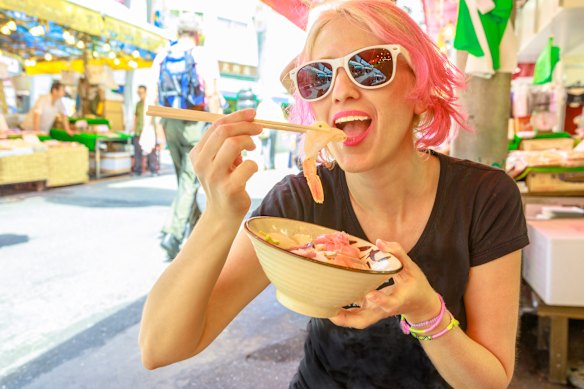
I went back to Japan after 20 years, expecting to be disappointed. That’s what happens, isn’t it? You return to a place that shaped you and find it smaller than the memory you carried of it.
But it wasn’t like that.
In the years between my first life there at 22 and this return, everything had expanded. I changed countries – continents, even! – got married, had two kids and filled the calendar with work until there wasn’t much calendar left. Then came an ADHD diagnosis and burnout – that mid-life signal that something has gone wrong. My life started to feel like 20 tabs left open before the whole system stalls.
My reason for going back to Japan wasn’t one I could articulate. More of a pull. A writing retreat popped up on my Instagram feed, offering a tinge of excitement, and a suspicion that something I’d once known was still there, waiting. Halfway through the trip, I found it.
With my retreat friends, we’d been searching for a soba restaurant with raving local reviews – and if you know Japanese culture, you know they are not generous with praise. The directions led us through narrow streets, past stone walls softened by moss, to what felt less like a food establishment and more like someone’s private garden.
We were asked to wait under a bonsai tree. Slippers appeared in front of us without a word. Inside, tatami floors, and the sudden awareness of our own size – our noise, our Western bodies, our presence taking up a lot more space than comfortable. Tea arrived. Then sake. Then soba and tempura, arranged with such care that made you hesitate before picking up your chopsticks.
Yet, it was nothing extravagant. Just a simple bowl of noodles over clear broth, served with a bow and a timid smile.
At the next table, a woman – Western, maybe in her late 40s – started crying. Quietly, then with a stormy release that made everyone look away, tactfully. When the waitress came over, the woman stood and embraced her through the sobs.
“Thank you. It just all feels so kind,” she said. “More healing than weeks of therapy.”
The petite waitress held her tight for what felt like minutes. We all went quiet. You could have dismissed it as jet lag or a difficult year catching up with someone travelling alone. But in a sense, I felt it too.
There’s a phrase I first encountered during a tea ceremony led by a young Japanese woman who had rediscovered the tradition after years away studying in the US: ichi-go ichi-e. One time, one meeting. This moment will not happen again — which is precisely why it deserves your full presence.
You feel this everywhere in Japan.
In the way a cashier bows after handing you change on a tray. In the way a convenience store meal is wrapped as if it were a gift. In the choreography of people moving around each other without friction or the low-level aggression that hums beneath public life in many Western cities.
Sociologists call it omoiyari – empathy expressed not in words but in the anticipation of what someone needs before they ask. It’s small acts of kindness that accumulate to create social connection, cohesion and belonging.
Japan has become a magnet. In 2025, a record 42.7 million tourists visited Japan, including more than 1 million Australians. The result has been crowded streets, waitlists for ryokans and the clogged soft-power machinery of a country that somehow became the world’s comfort object. You could put it down to the food, the aesthetics, the safety, the sheer orderedness of it all.
But I think it’s something else. I think we are arriving depleted, from cultures that have optimised everything except the quality of ordinary moments. We have outsourced care to apps, wellness routines and productivity systems. We’ve lost the sense that the small things – a bowl of tea, a pair of slippers, a cute bento box – are worth doing beautifully because the person receiving them is worth it.
It reminds me of Perfect Days, Wim Wenders’ 2023 film about a Tokyo toilet cleaner named Hirayama – who tends to a modernist toilet cubicle with the same devotion he lives his life. The film was a sensation in the West partly because it was beautiful, and partly because it showed us that the ordinary moment, when met with attention, is enough.
My first time there, in my 20s, I was a blonde girl, obviously foreign. To an average Japanese eye, I could, apparently, pass for either Britney Spears or Anna Kournikova. It sounds strange, but being visibly other gave me relief.
Returning now – older, a body shaped by motherhood and time – I felt something similar. This time, though, it was less like an escape, more like permission. To just be a person, having tea.
Japan is still the same. The soba restaurant has probably been there for decades. But we got more stretched and disconnected. We’re going to Japan to remember what it feels like to be treated as if our presence matters.
Japan has its own pressures, its own rigidities. But it offers a glimpse of another way to be.
Alex Reszelska is a writer and Oxford-educated Japanologist, living with her family on the South Coast of NSW.
The Opinion newsletter is a weekly wrap of views that will challenge, champion and inform your own. Sign up here.
 Alex Reszelska is a writer and Oxford-educated Japanologist, living with her
family on the South Coast of NSW.
From our partners
Disclaimer : This story is auto aggregated by a computer programme and has not been created or edited by DOWNTHENEWS. Publisher: www.smh.com.au