Opinion
In this series, My Happy Place, our writers reflect on the holiday destinations in Australia and around the world that they cherish the most.
It was the first place I ever lived in Australia. It remains the place that is Australia to me. Why is Bondi more famous? Manly is surely better.
When I first arrived permanently in Australia, I lived in Manly and I worked there too, teaching English to Japanese surfers and bedazzled Europeans. Later I worked in the city; work that was shuffled off like unwanted snakeskin at the end of each day thanks to the sheer glory of commuting home by ferry and disembarking back into a never-ending seaside holiday.
I’m far from the only person to equate beaches with holidays, of course. Who works on a beach? Beaches are about downtime, sunbathing, swims, simple snacks and toe-squishing sunset walks. They might be the only travel destination everyone agrees upon: who doesn’t like a beach?
But for someone who, before then, had lived mostly in a chilly landlocked city (Geneva), a grey landlocked city (Chengdu) and a grey rainy one (Edinburgh), Manly had an especially fevered effect on me.
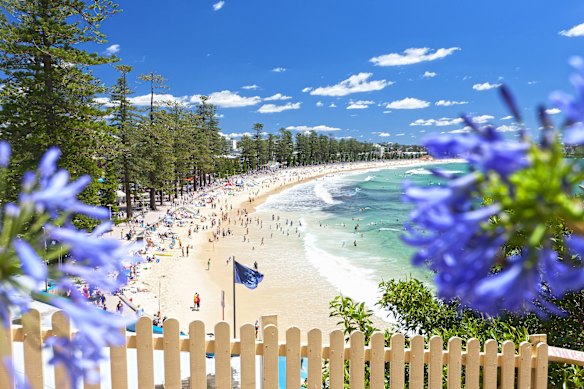
How could I not like Manly, spectacularly wedged on a peninsula between harbour and ocean? It was an explosion of sun and colour. Lifesavers wore yellow and red. Heritage buildings were pink. Ferries green. Everything smelled of beer, sunscreen and gum trees.
Sign up for the Traveller Deals newsletter
Get exclusive travel deals delivered straight to your inbox. Sign up now.
Cloudless skies and blue seas made walking to the bank or post office (as we had to do in those days) feel like a special excursion. To me, living in Manly was a perennial summer among toned surfers, bouncy Brazilians and lizard-skinned retirees. The Norfolk pines looked like Lego trees. Lorikeets screeched blue murder. Seagulls swooped.
I did abandon Manly for other suburbs, because inner-city life was the lure for a while. But I never stopped visiting for a regular dose of sea and sand. Eventually, I returned to live just along the Middle Harbour, only a seven-minute drive from my favourite place.
Now Manly is a 40-minute brisk walk, direct via suburban streets across humpy hills pretty with frangipani and jacarandas. Or a longer coastal journey on the Manly Scenic Walkway, one of the world’s best urban hikes.
Anywhere else and this splendid trail would have entrance fees, turnstiles and crowds, and be famous on Instagram. Instead, I can be halfway along it and imagine I’m lost in the bush if it weren’t for the skyscrapers glittering in the distance.
No week goes by when I’m not in Manly, if I’m at home at all. It remains my slice of otherness, as if it has nothing to do with real life. I dodge joggers along the waterfront, watch the jiggle of volleyball players, talk to old folk on benches, spot English-language students who now, disconcertingly, look improbably young.
True, Manly can seem like a tourist trap to casual visitors, with its ice-cream parlours and surf-wear boutiques. During the school holidays, ferries disgorge kids whose ceaseless shrieks outdo the lorikeets.
Barely-clothed day-trippers wobble along the Corso. Asian visitors nibble cautiously at fish and chips, as well they might. Look at cherished cultural emblems from an outsider’s viewpoint and you often have to admit they’re odd and unappetising.
But Manly is much more than its Corso and two strips of waterfront frequented by day-trippers and tourists. It has a dozen plump beaches, some so well hidden in tiny coves they’re known only to local residents. It has parcels of almost-original landscapes, and giant ferns hidden in gullies.
The Old Quarantine Station provides curious insights into Sydney’s immigration history and features abandoned sandstone ruins behind white picket fences. On North Head you’ll find Indigenous rock carvings, World War II gun emplacements, and a view straight down the world’s most magnificent harbour that deserves to be accompanied by a brass-band fanfare.
Is Manly my happy place from nostalgia alone? Well, I was young when I first arrived, but don’t beaches always make you feel young? They seduce you into light-heartedness. They seem pure and simple and carefree. The ever-swooshing surf washes your problems away against the perspective of eternal time.
I don’t often think of my young self when I’m in Manly. Another great thing about beachy places is that they encourage living in the moment. If anything I think ahead more. One day, I hope to be a leathery old bloke sitting under a Norfolk pine, wrinkled as a basset hound, unabashed in my Speedos and grinning at my good fortune.
Although I’m Australian now, I was a foreigner once. Maybe it takes an outsider to remind Australians of their good luck, and how special this place and many other Australian beachside suburbs are.
Whether you stay for a day or a decade, if you aren’t happy in Manly, you can’t be happy anywhere.
 Brian Johnston seemed destined to become a travel writer: he is an Irishman born in Nigeria and raised in Switzerland, who has lived in Britain and China and now calls Australia home.
From our partners
Disclaimer : This story is auto aggregated by a computer programme and has not been created or edited by DOWNTHENEWS. Publisher: www.smh.com.au