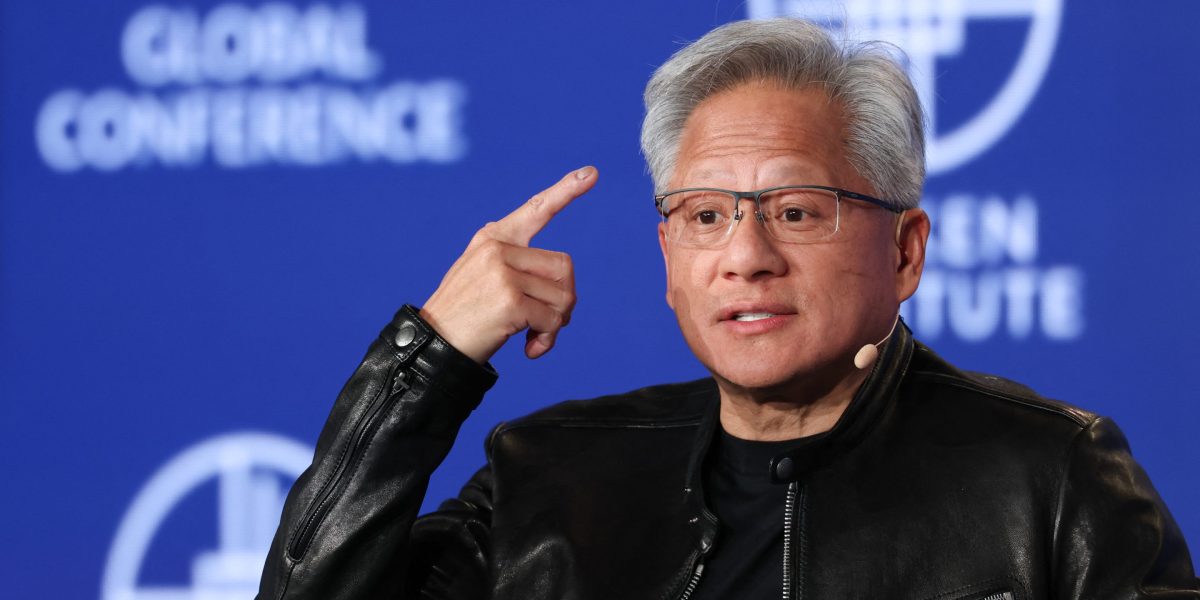
Nvidia CEO Jensen Huang may have studied engineering, but he says it won’t matter what your child studies in the future.
Huang said even in a world dominated by AI journalism, the arts, and design are still going to matter. Therefore, parents shouldn’t worry about pushing their kids into AI-focused careers.
“I think that it won’t matter. All the things that used to matter are still things that are going to matter in the future,” he told Singapore’s Channel NewsAsia Monday.
He noted that even with advanced AI, storytelling will be just as important, and young people should instead focus on how technology can enhance their area of study.
“The only one thing that you have to do is to make sure that you ask yourself: ‘How can AI help elevate my learning, my craft, you know, my purpose,’” he told the broadcaster.
Why is China eliminating arts degrees?
Huang’s advice comes as China has taken the opposite stance, eliminating degrees that authorities claim are no longer justified in the AI era. One of the most prestigious schools in China for media and the arts, the Communication University of China in Beijing, last year cut five undergraduate degrees as it recalibrates its offerings for a new era.
Several arts degrees were cut including photography, comics, visual communication design, new media art, and fashion design. They will no longer be offered as standalone programs, but will be integrated into broader, technology-infused disciplines, according to Sixth Tone, a China state media outlet.
The university’s top official, Liao Xiangzhong, said these changes were made because advances in technology have made it so that offering these degrees as standalone programs no longer makes sense. For example, photography can’t be offered as a standalone degree because “today everyone can be a self-media creator and recorder,” Liao said. Instead, its curriculum was rolled into the “film and television photography and production” degree.
Translation, another degree that was cut at the university, “has already been largely replaced by AI,” he added.
“Setting up a four-year major for translation in a specific language is a huge waste of national resources,” Liao said, according to the outlet.
At the same time, the university added three degrees, “intelligent imaging art,” “intelligent audiovisual engineering,” and “intelligent engineering and creative design.”
Apart from the Communication University of China, other universities across China are cutting degrees in the arts as the government aims to cut down on oversaturated fields and graduate more students with high-tech skills.
Other colleges like Jilin University in northeastern China as well as East China Normal University and Nanchang University in the east have cut arts majors like drama, film literature, broadcasting, and animation.
What did Jensen Huang study?
Before Huang turned a company focused primarily on gaming graphics cards into one of the most valuable companies in the world and the $5.2 trillion go-to AI chip provider for Google, Amazon, and Meta, he studied electrical engineering as an undergraduate at Oregon State University. Soon after, he pursued a master’s degree in electrical engineering from Stanford. He graduated from college two years early, at age 20, after he skipped multiple grades and also graduated early from high school. A year after finishing his master’s degree in 1992, he started Nvidia.
Huang has previously said if he were to repeat his studies, he probably would’ve pursued “more of the physical sciences than the software sciences.”
Other top tech leaders also share Huang’s view of the future of education. Jack Clark, a billionaire cofounder of Anthropic who majored in English literature and creative writing said during a conference last month his education on “history and a lot about the kind of stories that we tell ourselves about the future,” was essential to his work on AI at Anthropic.
Another Anthropic cofounder, Daniela Amodei, who studied literature at the University of California, Santa Cruz, said in an interview with ABC News earlier this year, while AI models have incredible STEM knowledge, young people should focus on areas where the technology still needs improvement such as communication skills and critical thinking.
“I actually think studying the humanities is going to be more important than ever,” she said.
Disclaimer : This story is auto aggregated by a computer programme and has not been created or edited by DOWNTHENEWS. Publisher: fortune.com