Here’s what we covered today
We’re pausing our live coverage of the US midterms for today, with Americans set to begin heading to the polls from 11pm tonight AEDT (7am US Eastern time) in elections that could have major ramifications for Donald Trump’s presidency.
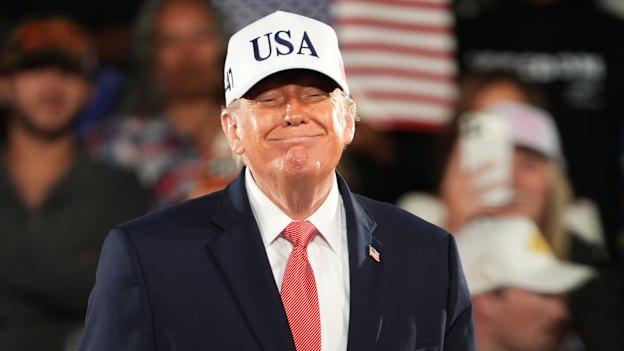
- Trump wrapped up the Republicans’ election campaign with a speech in Washington.
- The speech focused heavily on his remaking of the capital and, in particular, the Lincoln Reflecting Pool – the site of the botched renovation. He did not mention the election for the first 20 minutes.
- A Reuters/Ipsos poll on Monday showed Trump’s approval rating near a record low, but signs that the battle for Congress between Democrats and Republicans could be tightening.
- Other polling suggested the Democrats could sweep both houses of Congress in a blue wave.
- In his speech, Trump noted falling oil prices and pledged energy costs would come down “a lot further” once the war against Iran ended.
- Hours later, US officials confirmed to the Wall Street Journal that the military had carried out limited strikes on Iranian targets in the Strait of Hormuz, with Iran’s state-run Islamic Republic News Agency reporting five blasts on Qeshm Island.
- The Supreme Court rejected a push for California to set aside thousands of mail-in ballots from people that the Trump administration claims are non-citizens.
- Attorney-General Todd Blanche encouraged people to report any potential non-citizens voting, sparking fears of unrest or even vigilantism at the polls.
- Polls will start to close at 6pm Eastern time (10am tomorrow AEDT), with Texas and most Midwest states closing at 9pm Eastern (1pm tomorrow AEDT) and Alaska closing at midnight Eastern (4pm tomorrow AEDT).
‘I find him to be a moral void’: Christians lose faith in Trump
Many US Christians have turned their backs on Donald Trump, according to the London Telegraph, put off by factors ranging from the decision to go to war with Iran to outbursts against Pope Leo and a social media post with an AI-generated picture of the president as Jesus.
“I find him [Donald Trump] to be a moral void”, an American pastor told the paper recently. “I don’t think there is a moral centre to him or a moral frame. He’s just a transactional person who tries to get the most he can out of people.“
The pastor was one of several American voters who spoke to the Telegraph ahead of the midterms.
In the 2024 presidential elections, 80 per cent of white evangelicals voted for Trump, who describes himself as a non-denominational Christian. But support for Trump in these circles has dropped, it suggests. While 78 per cent of white evangelical Protestants were plumping for him in January 2025, for instance, only 58 per cent backed him in October 2026.
The Telegraph also spoke with a healthcare worker from Alabama who voted for Trump in 2024 but had now become disillusioned. “The president’s involvement in Iran has played a key role in that,” Jason Mullis said. “I believed and hoped he was sincere about keeping us out of conflicts.”
Alaska’s ‘real’ Dan Sullivan lashes ‘Decoy Dan’ opponent
In Alaska, scene of one of the midterms’ bitterest Senate battles, Republican senator Dan Sullivan used an election-eve address to attack his Democratic rival, Mary Peltola, over her alleged involvement in installing a candidate with the same name on the state ballot.
Speaking to supporters, Sullivan repeated allegations made by the New York Times, which last week exposed Peltola’s alleged effort to siphon votes away from him. He stopped short of accusing Peltola of illegal behaviour, but said he’d already met a handful of people who accidentally voted for the wrong Dan Sullivan.
Introduced as “the real Dan Sullivan”, the senator said Democrats see Alaska as key to taking control of the Senate. “It’s not just about Alaska,” he said. “We are the firewall for freedom for America right now.”
Peltola has denied involvement in an alleged effort to back Dan Sullivan Jnr, a retired teacher, who himself has denied co-ordinating his independent candidacy with Peltola’s campaign.
Read more from Michael Koziol about the ‘Decoy Dan’ affair
With AP
What can $677 million buy at the midterms? Elon Musk is about to find out
Elon Musk has spent more than any other donor in a single midterm election cycle, according to The New York Times, shelling out a cool half a billion or so US dollars, or $677 million. The only person who has ever spent more during an election cycle is Michael Bloomberg, the billionaire former mayor of New York, who ran for president in 2020.
Of Musk’s publicly disclosed donations for 2025-26, some $300 million went into his own super PAC (or Political Action Committee); it, for example, forked out $67 million on a state judicial race in Wisconsin last year that Musk’s favoured candidate lost, reports the Times.
Almost all of another chunk – $240 million – went into a Senate leadership fund to support Republican nominee Ken Paxton’s campaign in Texas. “If Mr Paxton wins in Texas, of course, he will have Mr Musk to thank,” the Times suggests.
“Should he lose, though, Mr Musk’s spending will have been for naught.”
(Paxton is pitched against Democrat James Talarico, a seminarian and former school teacher who told supporters last week: “We’re going to shock the nation and shock the world when we beat the billionaires and take back Texas”.)
The funding disclosure records run only up to mid-October, the Times notes, so they don’t include any funds which Musk might have donated in the past three weeks.
How likely is a ‘mirage’?
“Red mirage” is the term credited to data scientist Josh Mendelsohn in 2020 to describe the phenomenon of results appearing to favour Republicans at the start before shifting in the other direction.
Today, observers refer to both blue and red mirages.
Here’s why a mirage can happen: Election officials in the US report cumulative vote totals in real time as they count ballots, and the leading candidate can change throughout the night. Those lead changes produce “mirages” – the illusion that a candidate is winning based on an unrepresentative sample of votes.
While sudden changes in reported vote totals have often fuelled conspiracy theories in recent years, they’re not new and are not evidence of vote tampering.
US confirms fresh Iran strikes
The US has conducted defensive strikes on some Iranian targets in the Strait of Hormuz, an American official has said following earlier Iranian state television reports of explosions on Qeshm Island.
The official, who wasn’t authorised to comment publicly and spoke on condition of anonymity, said that “Iranians using surface-to-air missiles against US assets” had been targeted.
The strikes, which appeared limited rather than a full return to hostilities, came on the eve of the midterm elections. President Donald Trump had previously said the US wouldn’t launch strikes on Iran before the elections.
The unpopular Iran war and the resulting impact on US petrol prices and other parts of the economy have been a vulnerability for Republicans as they try to keep control of Congress.
Earlier, Vice President JD Vance told reporters he had spoken with Trump about talks with Iran and said that “the president and I both feel pretty good about the prospects for potentially coming to a negotiated settlement”.
AP
Opinion: Trump has risen to the top on a wave of cynicism. It’s starting to crash
Since the beginning of the US midterm campaigns, which reach their climax today, Donald Trump has held three rallies in my home state of South Carolina.
Republicans haven’t had to worry about South Carolina elections for a long time. We last elected a Democrat to statewide office in 2006. We most recently sent a Democrat to the Senate in 1998.
But 2026 is redrawing the political map and the US president’s rally schedule makes it clear how far it has shifted.
Republicans may well still hold some ground in today’s midterms. But they are playing defence all the way to the horn.
Read former Biden-Harris White House staffer Cory Alpert’s column here.
Some key midterms numbers to watch
As with any election, the midterms are a numbers game. Here are some of the fundamentals.
- 218 seats are needed for a party to control the lower house, the House of Representatives, where all 435 seats go up for grabs every two years; and 218 happens to be the number of seats currently held by Republicans – so, a wafer-thin majority.
- 214 seats are held by the Democrats. Two are vacant after a couple of earlier resignations. The one independent is Californian Kevin Kiley, who was elected as a Republican but changed in March. So, Democrats need a net gain of four seats to gain control of the House.
- Meanwhile, 35 of the 100 Senate seats are up for election. That includes special elections for the two places vacated by J.D. Vance in Ohio and Marco Rubio in Florida when they resigned as senators to become vice president and secretary of state, respectively, and which have since been filled by temporary appointments.
- 53 Senate seats are held by Republicans.
- 45 Senate seats are held by Democrats with whom two independents caucus: Bernie Sanders from Vermont and Angus King from Maine.
- 51 seats is what the Democrats would need to control the Senate, also known as a 51-Democrat, or 51D, result.
- Contrast this with a 50-Republican result: in a 50-50 tie, the vice president casts the deciding vote; in this case, that would be Vance, which means the Republicans would remain in control.
One pressing question: How will Trump respond to the results?
How Trump responds to the results – especially if Republicans lose control of Congress– could become one of the election’s biggest stories.
In the early hours of November 4, 2020, before vote counting had finished in several states, Trump declared victory and called for counting to stop.
He ultimately lost to Democrat Joe Biden, but continued to falsely claim the election had been stolen, helping fuel the January 6, 2021 attack on the US Capitol by a mob of his supporters who were seeking to stop certification of Biden’s win by Congress.
Trump still falsely claims he won the 2020 election and has cast doubt on the integrity of these midterms, raising the prospect of Republican challenges if the party loses one or both chambers.
This year, the Trump administration has pressed states for voter data and launched investigations into non-citizen voting, which election experts and studies have found little evidence to support.
Reuters
Reports of explosions on Iran’s Qeshm Island
There are reports of explosions in Iran.
The country’s state run Islamic Republic News Agency reported five blasts on Qeshm Island in the Strait of Hormuz.
A correspondent for the agency heard the explosions in quick succession, the agency reported, while residents spotted planes in the skies above the island.
Meanwhile, The Wall Street Journal is reporting that the US was responsible for the strikes, citing US officials.
US midterms will have ‘big economic consequences’ for Australia: Chalmers
The outcome of the US midterm elections will have significant consequences for Australia’s economy, the treasurer has warned.
As Americans head to the polls, Jim Chalmers said the implications of the result would flow on to countries around the world, including Australia.
“There are potentially big economic consequences of these midterms, particularly when it comes to any implications for the war in the Middle East,” he told ABC Radio today.
“Americans are dealing with a lot of the same issues that we are, whether it be inflation or these other pressures on people. The difference between us and the Americans is that they have a say when in when the war ends, and we don’t.
Disclaimer : This story is auto aggregated by a computer programme and has not been created or edited by DOWNTHENEWS. Publisher: www.smh.com.au