Back in April, as rumors swirled that the Saudi Arabian Public Investment Fund (PIF) was set to withdraw funding from LIV Golf, Bryson DeChambeau pledged his fealty to the future of a league that wasn’t guaranteed to have one.
“As long as LIV is here, I would figure out a way for it to make sense,” DeChambeau told the social media account Flushing It days before the PIF officially withdrew funding.
A few months later, as LIV’s season ended early and the prospects of LIV 2.0 remained murky, DeChambeau again assumed his role as LIV’s biggest advocate.
“I think there’s a lot of potential moving forward. It’s been an interesting ride, that’s for sure,” DeChambeau said. “Everything that we’ve gone through and the tough moments that we’ve had. But it’s made us stronger. … As much as we’re transitioning from LIV 1.0 to 2.0, I have great thoughts about what could happen next year. I wish I could be more up front about it.”
Ever the showman looking to draw attention, DeChambeau then spoke about LIV in the past tense even as he supposedly looked to a future with the league post-Saudi exit.
“If there’s one thing that I could say, it’s we did something different in the game of golf, and I’m proud of that,” DeChambeau said.
That was the last time DeChambeau spoke publicly about LIV’s future. Since then, the league has filed for Chapter 11 bankruptcy, secured an initial targeted investment for LIV 2.0 from BC Partners Global, and seen numerous players, including Jon Rahm and Tyrrell Hatton, exit the league. The list of players who have said “thanks but no thanks” to LIV 2.0 is much longer than the one of players who have signed back up. You can count those on one hand: Ben Campbell, Cameron Tringale, Richard Bland and Brendan Steele. In the other column, Rahm, Hatton, Ian Poulter, David Puig, Adrian Meronk, Tom McKibbin, Louis Oosthuizen and Abraham Ancer are among those who have confirmed that they are departing LIV Golf.
But we don’t yet have the full picture, which is why Sunday is a marquee date for LIV Golf and its future prospects.
The restructuring support agreement (RSA) between BC Partners and LIV Golf that was filed with the courts moved back the deadline for players to commit to LIV 2.0 to Oct. 25. But the RSA also gave BC Partners full autonomy to decide whether LIV has earned enough player commitments to do business. LIV’s lawyers have said they will know by the end of October whether LIV 2.0 is a go or if they are closing up shop, but Sunday’s commitment deadline is expected to be a “soft” deadline as BC Partners and LIV Golf try to secure enough talent to get LIV 2.0 off the ground.
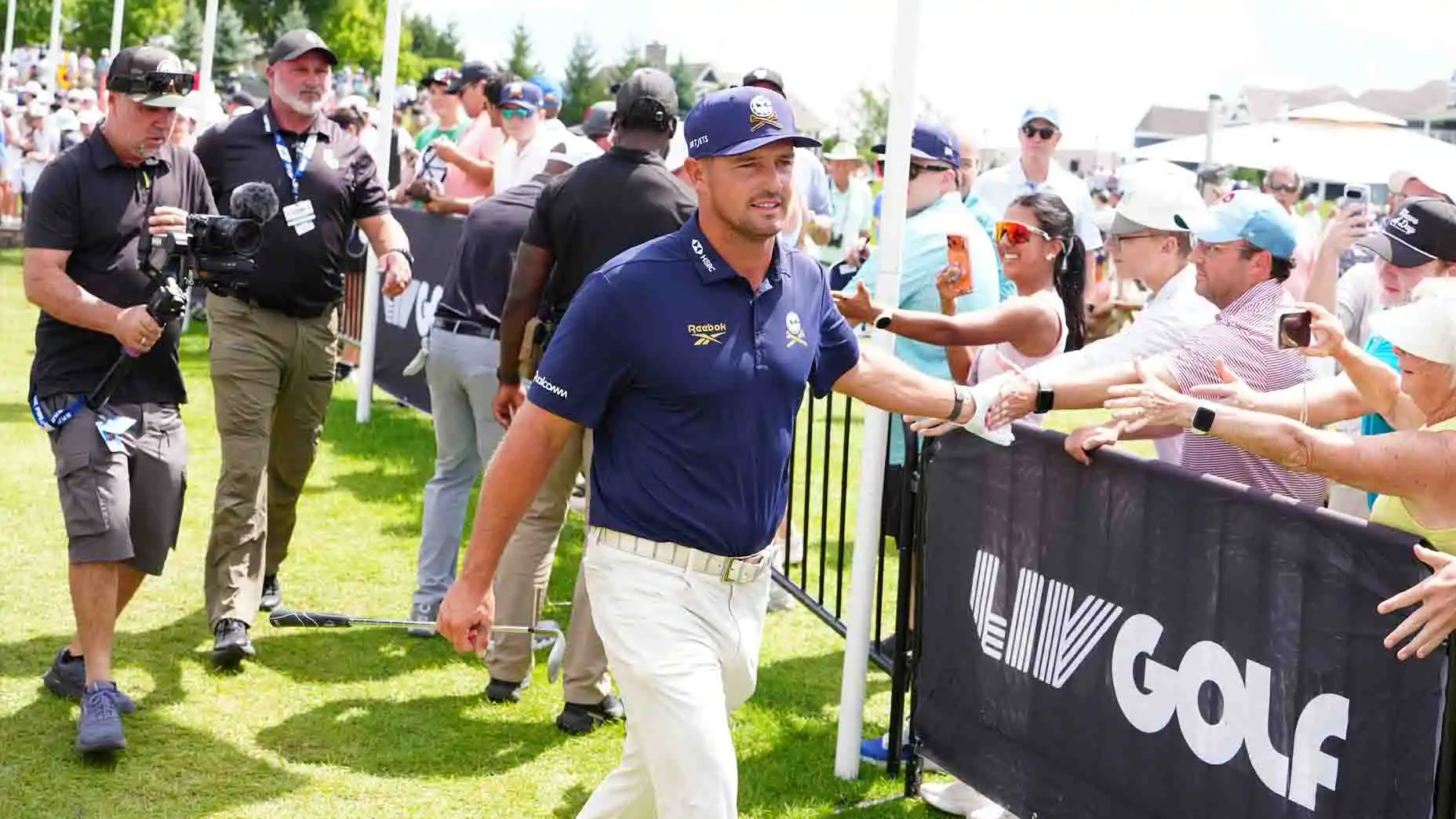
That starts and ends with DeChambeau, who by all accounts has been working behind the scenes to help get LIV 2.0 up and running. LIV Golf CEO Scott O’Neil has said that DeChambeau is even more “pro-LIV” than he is. Everything we’ve seen and heard from DeChambeau over the past four years would suggest that’s true. While Phil Mickelson got LIV off the ground and Dustin Johnson helped give it legitimacy at the outset, it’s DeChambeau who has been its biggest cheerleader and supporter. The league and his growing YouTube audience gave him popularity he couldn’t find on the PGA Tour. That was on display at the 2024 U.S. Open, where he was the Pinehurst crowd favorite in a battle with Rory McIlroy. LIV Golf has been good to Bryson DeChambeau.
But now, as the LIV 2.0 deadline arrives, we’re going to get the answer to the question that will determine the league’s fate. What really matters to Bryson DeChambeau?
With the mass exodus of talent, LIV 2.0, if it comes to fruition, would include DeChambeau and a roster of players of far lower wattage and world ranking than the one the PIF-backed operation put together with billions of dollars in a soft-power exercise at its inception. It would be the DeChambeau show for 10 tournaments a year, and he could spend the rest of his time building his YouTube channel and trying to stay sharp for the majors despite a lack of major tour. That would make him the star attraction for 10 weeks a year — the sun a league revolves around — and give him time to focus on new challenges and new subscribers most of the year.
If that’s what Bryson DeChambeau wants, then he’ll continue being the frontman for Crushers GC, with whatever teammates he can cobble together, and then show up at four tournaments that really matter and see if he can render the idea of “competitive reps” meaningless. But if the two-time major champion who loved and idolized Arnold Palmer truly cares, as he says, about the game’s trajectory, its growth and his own legacy, then he’ll follow Rahm and others out the door and see what his competitive future holds post-LIV. He’ll come hat in hand to the established tours — though also with the knowledge of what he brings to their business — be willing to pay a penalty, and then rejoin the ecosystem.
“The reality is I’m so focused on what I can do for the game that somebody saying something online or to me personally in my face is not going to distract me from the mission that I have,” DeChambeau said in LIV Golf Korea. “I hope people can understand that, that my goal is bigger than just winning every tournament every single week. Do I want to win every week? 100 percent. Do I care about the game sometimes more than my own life? Yeah. Because I see what it can do for people’s lives. That’s ultimately why I care so much and I’m so passionate and I want the best for everybody.”
Pro golf’s civil war is all but over. In time and with a penalty, defectors will be allowed back. Rory McIlroy, Justin Rose and others have already said they are willing to put the past in the past. Most pros benefited from LIV’s arrival and the fracture of pro golf across both tours, but with the PIF gone and LIV facing a mass exodus of talent, the game is slowly coming back together.
When Palmer passed away, former PGA Tour commissioner Tim Finchem summed up Palmer’s impact on the sport with a few sentences in a lengthy remembrance.
“More than his words, Arnold’s actions spoke to his unequivocal love of golf and belief that no individual can be or should be bigger than the game. Arnold totally gave of himself to support golf and its growth,” Finchem said in a statement.
Bryson DeChambeau has told us that he believes the same. He wanted to follow in Palmer’s footsteps and leave the game better than he found it. What seems to most golf fans to be best for the game in the current moment is for all the best players — DeChambeau among them — to play together as often as possible. There’s one way for that to happen. We’re going to find out if that’s what matters to Bryson DeChambeau, too.
Disclaimer : This story is auto aggregated by a computer programme and has not been created or edited by DOWNTHENEWS. Publisher: golf.com