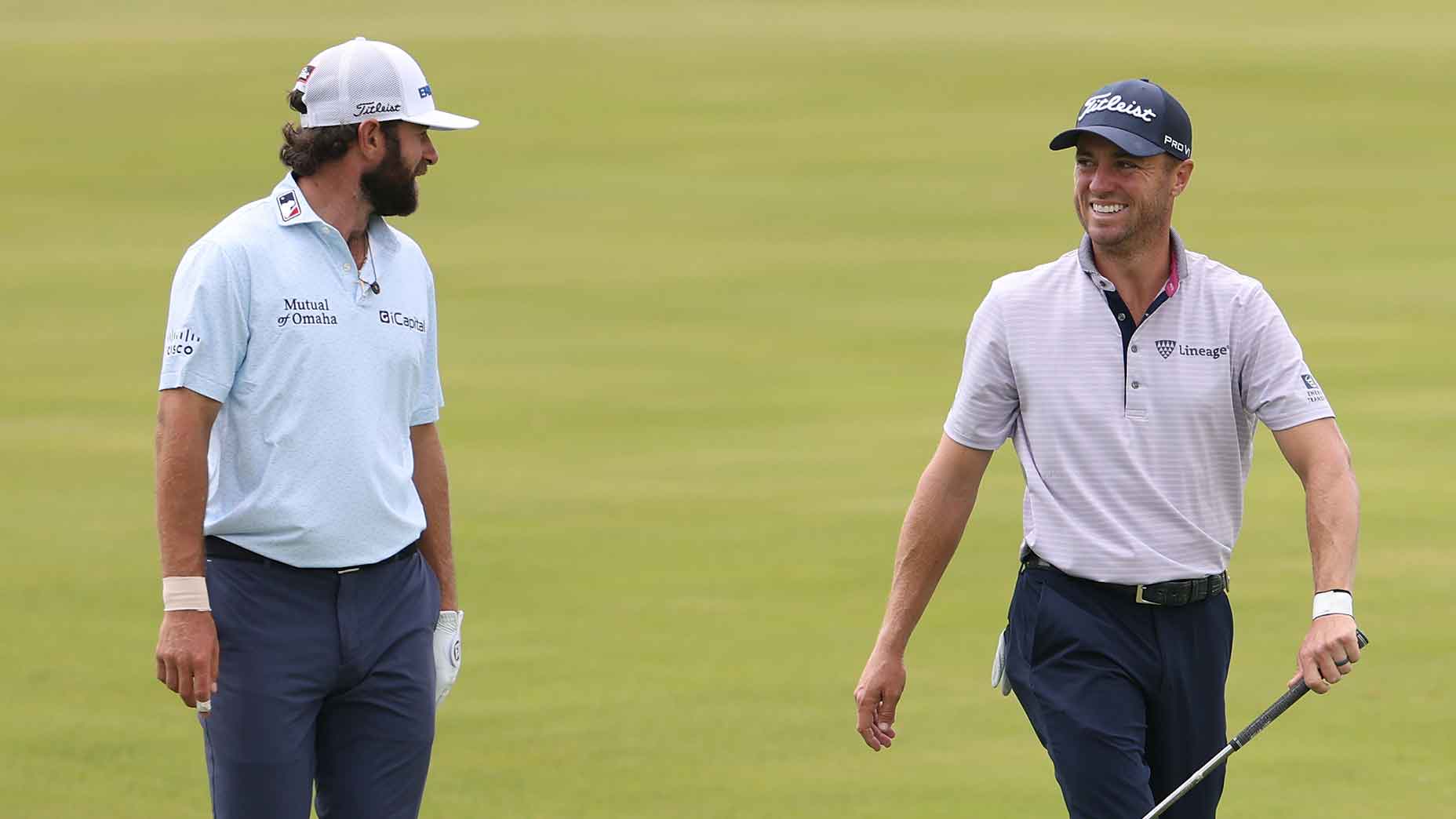
NEWTOWN SQUARE, Pa. — It was about this time five years ago that pro golf’s five families, as they’re known — the four major-owning governing bodies and the PGA Tour — started acting like the cousins they really are. They agreed upon something with near-absolute unison: that LIV Golf and the audacious investments from Saudi Arabia were a threat to the status quo.
“Some money is better than other money,” then-PGA of America CEO Seth Waugh said at Kiawah Island at the 2021 PGA Championship. From wherever PGA Tour commissioner Jay Monahan was watching, he had to be nodding along. And if he wasn’t, his actions and those of his cousins soon fell in line. It took years for the R&A and USGA to offer specific LIV exemptions into their championships. The World Golf Ranking board — comprised largely of representatives from these bodies — didn’t sanction LIV’s events until the beginning of this year. Fred Ridley, on behalf of the Masters, said the actions of 2022, when LIV launched with bigger purses than the sport has ever seen, “diminished the virtues of the game.” An anti-trust lawsuit filed by LIV players alleged that Augusta National members threatened to disinvite LIV pros from the Masters.
Each brand protected its own protocols and regulations, which was entirely their right. But in almost every instance, any stiff-arming of LIV, if only temporary, was helpful to their cousin, the PGA Tour. Those defenses softened over time — particularly as the Tour decided to accept Saudi money, too — but with recent news that the Saudi PIF will no longer fund LIV into the future, the threat it presents to pro golf’s status quo has quickly dropped down the priority list.
But it didn’t take long to replace it. Reentering the fore: the contentious golf-ball rollback.
In simple terms, the USGA and R&A have determined that distances pro golfers can hit the ball these days is untenable for the sport in the long term. It impacts how tournaments are staged, how the boundaries of courses are manipulated, how the difficulty of setups struggle to stand up against the most gifted hitters. In 2023, the USGA and R&A decreed that, under specific, modernized testing conditions, balls, starting in 2028, should be able to fly a maximum distance of 317 yards.
Problem is, the families have been fighting, if quietly in the background, ever since. And frankly, there are more families than previously thought.
Rather than five controlling bodies, the issue of the rollback — much less than the issue of LIV — underlines how there are at least six, maybe seven true families in the sport. The professional golfers, though not collectively unionized, are one. They are the talent of this entertainment product, who often operate strictly via groupthink. (And the PGA Tour cannot reasonably do anything without their support.) There also are the equipment manufacturers, or OEMs, like Callaway, TaylorMade and Titleist, who are competitors but agree the rollback would hurt their business.
The OEMs love the status quo, but a curious story has arisen this week, during this first major in the lessened-LIV era. Cameron Young, one of the best players on the planet, has reportedly been using a Titleist ball that would conform to those future standards set forth by the USGA and R&A. How noble of him to lead the way! And more than a year ahead of the deadline! Young has been using the ball — a prototype Pro V1x Double Dot — for a while, too, after testing it for the first time in 2024. He is one of the longest players in the world and is apparently seeing no difference in the distance he averages off the tee, which should prompt a rational question:
Why change anything if the change to combat distance that’s oh-so important is ultimately negligible?
There are a few plausible reasons. The way Young hits a golf ball might be impacted to a lesser degree by these changes than how, say, Scottie Scheffler hits a ball. Young may be an anomaly (a handful of other Tour players are using the ball, too). It’s possible the suggested testing standards of the USGA aren’t perfect yet. It’s also plausible that the story would arrive purposefully on Tuesday evening because there was never a better time, mere hours before PGA of America executives were scheduled for a press conference. We know what the USGA and R&A think. The PGA of America, we needed to hear from.
“We need to understand more,” the new PGA CEO, Terry Clark, said Wednesday. “It’s up to those governing bodies to really say how does it impact [the game] and what’s the next step.”
In other words, as non-committal as Family 4 can get. Fred Ridley, a month ago at the Masters, reiterated his support for the USGA and called the modern game “much more one-dimensional.” But Brian Rolapp, two months ago at the Players Championship, coyly acted like the PGA Tour hadn’t made up its mind (even though his predecessor vehemently opposed it).
“I’ve spoken with players,” Rolapp said at Sawgrass. “I’ve spoken with, obviously, the governing bodies; I’ve spoken with golf ball manufacturers; I’ve spoken to fans; I’ve spoken to everybody. What’s clear to me, everybody has an opinion, and those opinions are clearly not consistent…”
What should be a matter of transparent science is suddenly a battle waged across carefully worded press conferences. There were two on Wednesday, one from Young and another from Clark, neither of which were particularly revealing. There will be multiple in June from USGA CEO Mike Whan, who has proven forcible on the topic. Another couple will follow in July and August from R&A chief Mark Darbon, across the pond. Mixed in throughout those months will be Rolapp’s press conference at the Travelers Championship and any number of Q&A sessions for his players, a majority of whom are against the rollback and are not-so coincidentally sponsored by the manufacturers.
LIV Golf vs. the Status Quo feels simple by comparison.
Disclaimer : This story is auto aggregated by a computer programme and has not been created or edited by DOWNTHENEWS. Publisher: golf.com