
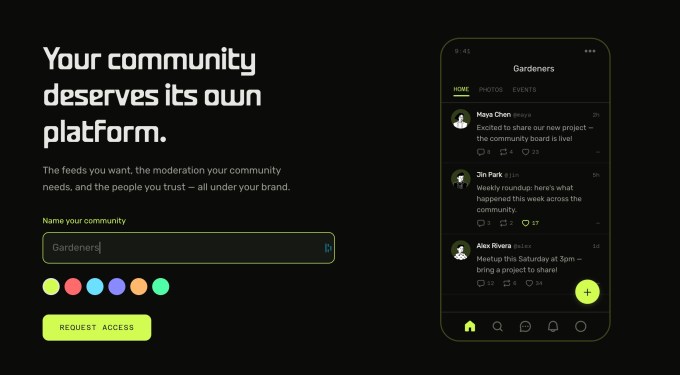
A new project called Acorn has launched a way for organizations and creators to build their own online communities as an alternative to centralized social media platforms like Instagram, X, and Threads. It uses the same underlying technology that powers the decentralized social media app Bluesky, allowing communities to build their own homepages, create starter packs for new members, and customize feeds and moderation tools.
Acorn’s platform hails from Blacksky, a company building its own decentralized social media toolkit around the AT Protocol. The AT protocol was developed by Bluesky’s team and is used by it and other open social apps, like Flashes, Spark, Skylight, Surf, Streamplace, Leaflet, and more.
To date, Blacksky’s focus has been on building tools to provide a safer online space for members of the Black Twitter community to move to — an effort that has so far included forking Bluesky, building custom moderation services, creating its own implementation of the AT Protocol, and other technical feats.
With Acorn, Blacksky is providing access to these same tools to other communities that want to build their own spaces on the open social web.
This could allow organizations and creators to establish communities they control, rather than ceding that control to tech giants, leaving them at the mercy of inscrutable algorithms and ever-changing policies. For instance, X recently announced it was shutting down its own Communities feature, leaving users scrambling to move their groups elsewhere.
At launch, Acorn includes a set of tools to help communities onboard new members, customize their feeds, configure and run moderation services, and track community growth through analytics, among other things.
As on Bluesky, where users can create “Starter Packs” with a list of suggested follows for newcomers looking to grow their network, Acorn allows communities to create starter packs of their own. It also provides reputation systems that help communities recognize and manage members, using things like custom badges and awards, along with tools for policing bots and trolls.

Communities can also define the moderation policies that matter most to them, then access custom tools to manage the reporting flow and other actions, like taking down or banning accounts, or removing posts.

Community creators can build their own feeds focused on topics that matter to their members, and can create different tabs for important items, like announcements, events, or resources, for instance.

As the community grows, built-in analytics help creators track member growth, feed activity, and engagement patterns, so they can understand their overall community health.

Communities can deploy Acorn’s tools on their own domain, and pricing is customized to their needs. Some communities want to use all the tools, which can even include running their own PDS (Personal Data Server), a part of the AT Protocol’s infrastructure. Others may want just a customized version of Blacksky’s community client build for their needs.
The average customer price is roughly $100 to $150 per month, but longer-term, Acorn will move to a tiered SaaS (software-as-a-service) model that will scale with community size and the level of tooling required.
Already, Acorn is being used by the AT Protocol-based communities Latinsky and Medsky, and by a filmmaker community called The Invite. It’s in active discussions with other media companies and nonprofits. Those interested in using its software can join the waitlist from its website.
Acorn’s toolkit has also arrived at a time when social media services are being more heavily regulated in global markets, where some have even banned the services from being used by minors. At the same time, many people have become distrustful of the platforms created by the tech giants, which ultimately focus on generating profits from their massive advertising businesses first, and serving the end users second.
In addition, a wave of automated bans across Facebook and Instagram has wiped out some users’ social media accounts and Facebook Groups, leaving them with no recourse and no way to reach a human for an appeal. While the impacted users are a small percentage of Meta’s overall user base of billions, these people are more likely to consider an alternative platform when and if they choose to return to social media, making them good potential customers for services like Acorn to target.
When you purchase through links in our articles, we may earn a small commission. This doesn’t affect our editorial independence.
Disclaimer : This story is auto aggregated by a computer programme and has not been created or edited by DOWNTHENEWS. Publisher: techcrunch.com



