
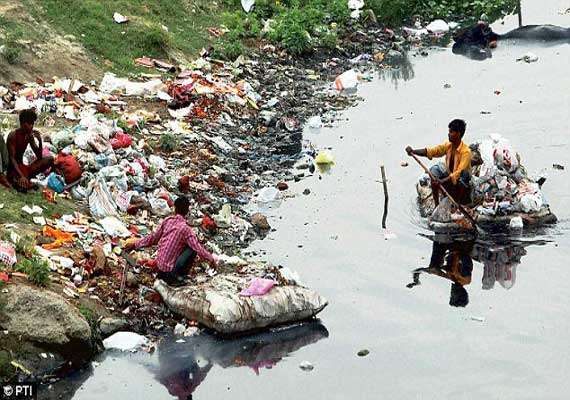
Mathura (UP) : The deteriorating condition of the Yamuna river is fast emerging as a key political issue in Mathura ahead of the 2027 Uttar Pradesh assembly elections, with opposition parties sharpening their attack and the ruling BJP citing ongoing clean-up measures. Recent February 2026 data from the State Pollution Control Board has flagged alarming pollution levels at key sites such as Kesi Ghat, Vishram Ghat and Gokul Barrage.
K P Singh of the Biodiversity Research and Development Society, who analysed the samples using official data, said, “While basic parameters such as temperature and pH remain within acceptable limits, several critical pollution indicators are far beyond safe standards.”
He said high levels of turbidity, Biological Oxygen Demand (BOD) and Chemical Oxygen Demand (COD) across all three sites reflect “significant organic pollution in the river”.
According to the analysis, Vishram Ghat recorded the highest turbidity and bacterial contamination, making it the most polluted site, while Gokul Barrage showed relatively better dissolved oxygen but the highest organic load. Kesi Ghat exhibited moderately high pollution levels.
The report also found extremely high concentrations of total and fecal coliform bacteria at all locations, indicating severe sewage contamination.
Experts said such conditions make the water unsafe for human consumption and even risky for bathing without proper treatment, while posing a threat to aquatic biodiversity, allowing only pollution-tolerant species to survive.
The findings further noted that the water quality has remained in Category ‘D’ – fit only for aquatic life – in December 2025, January 2026 and February 2026.
The report attributed the decline to untreated sewage discharge, increased human activity along the ghats and inadequate wastewater management systems.
Environmental activist and first petitioner in the Yamuna Action Plan, Gopeshwar Nath Chaturvedi, blamed the “lacklustre attitude” of executing agencies despite multiple court orders and policies.
“One can see the toxic form on the other side of the Gokul Barrage on the Yamuna River,” Chaturvedi said.
He added, “Industries like brass polishing and Todiya work use highly toxic chemicals like cyanide as a cleaning agent. The untreated water is then freely disposed of in the river.”
“Sewage treatment plants are designed to treat sewage and not chemicals,” he said, adding, “Treatment of chemical-laden river water with chlorine and alum, for drinking, is a futile practice, given both chlorine and alum’s inability to treat chemicals.”
Chaturvedi also demanded strict enforcement, saying no overflow should be allowed from sewage treatment plants where drains are connected to pumping stations.
Pollution Control Board official Pankaj Yadav said, “While the Yamuna water is fit for aquatic life, it is unfit for drinking without treatment. The foam on the other side of the Gokul barrage is primarily caused by detergents from domestic use. When water falls from a height, it forms foam. The formation depends on the temperature difference. Therefore, it is more visible in the winter.”
He added that the department has organised a special drive to shut down ‘todiya’ units.
The issue has now taken a political turn, with opposition parties preparing to raise it prominently in the assembly elections.
Congress leader Pradeep Mathur said, “Unfortunately, the sacred river is now a pool of sewage, due to rampant corruption. Total coliform and fecal coliform bacteria numbers are dangerously high. The river remains clean till the HathniKund Barrage only. It is almost dead for the next 35 km as the Haryana government does not release water, and it is so polluted thereafter that it cannot recover from there, there is no fresh water left in it.”
He added that despite BJP governments at the Centre and in Uttar Pradesh, Haryana and Delhi, coordinated efforts were lacking and questioned the silence of saints.
“Are they happy with the state of the river,” he asked, adding that “this is going to be a major issue in next year’s Vidhan Sabha elections.”
Rashtriya Lok Dal leader Ashok Agrawal said, “Vishram Ghat, a key religious centre on the river, is identified as the most polluted place. Lakhs of Devotees from across the world visit Vishram Ghat and take a ceremonial sip of water and bathe in the Yamuna. This is hurting their religious sentiments.”
“We expect a Sanatani government to at least take care of religious heritage,” he added.
Sanjay Chaturvedi ‘Alpine’, a sewayat at the Shri Yamuna temple at Vishram Ghat, said the deteriorating water quality has begun affecting even religious practices.
“The river water is so polluted that it is no longer used to give a bath to Gopal Ji and Yamuna Maharani. We use well water instead,” he told PTI.
He added that a perfume bath is now given daily to Yamuna Ji at the temple, and river water is no longer stored in a jhari (long-necked vessel) for offering to the deity. “It damages the silver vessel and the water gets infested with worms,” he said.
Responding to the concerns, Mathura MP Hema Malini said, “It’s not just a river, it’s a heritage,” adding that the government is working on an action plan.
“Projects worth 460 crores are already completed, and projects worth around 493 crores have been sanctioned and are ongoing under the Namami Gange project. I have raised the issue in my meetings with Prime Minister Modi and Uttar Pradesh Chief Minister Yogi Adityanath, and they have assured speedy action in the matter,” she said.
Her representative Janardhan Sharma said the funds are being used to tap drains in Mathura, Vrindavan, Chhata and Kosi, along with construction of sewage treatment plants and renovation of infrastructure.
BJP leader and Mathura MLA Srikant Sharma said, “The river’s condition has improved significantly since the BJP government came to power in 2017. We decided to tap the nalas and construct a large treatment plant at Masani. Following encouraging results from the treatment plant, we began working on tapping all remaining nalas. 19 nalas out of 23 in Mathura and 11 nalas out of 13 in Vrindavan are tapped now. The work of remaining nalas is expected to finish soon.”
“The results of these efforts will be visible soon,” he added.
Meanwhile, Mukul Agrawal of Indian Oil’s Mathura Refinery said the facility has upgraded infrastructure to control pollution.
“The refinery uses a Sour Water Stripper Unit to strip off H2S and NH3 gasses, allowing stripped water to be reused, reducing fresh water consumption,” he said, adding that effluent treatment systems including reverse osmosis are in place.
With scientific findings pointing to severe pollution and political parties trading charges, the Yamuna’s condition – intertwined with faith, ecology and public health – is set to remain a contentious and emotive issue in Mathura in the run-up to the 2027 assembly elections.
Disclaimer : This story is auto aggregated by a computer programme and has not been created or edited by DOWNTHENEWS. Publisher: deccanchronicle.com









