Damian Troise
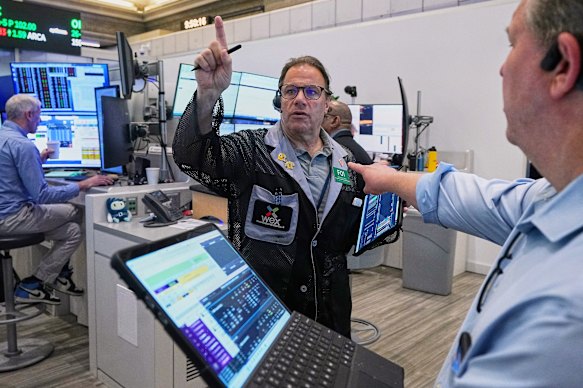
Wall Street lost ground under the weight of falling AI stocks as the enthusiasm over the return of Jensen Huang to Nvidia fades further.
Adding to the AI sell-off are more worries about high inflation dragging on the economy and US markets. The latest update shows that inflation remains stubbornly hot just as President Donald Trump plans to escalate the US trade war with major trading partners.
The S&P 500 index slumped 2.2 per cent. The Dow Jones Industrial Average fell 472 points, or 0.9 per cent, in lunchtime trade. The Nasdaq composite dove 3.2 per cent.
The ASX is set to brush off the negative lead and open higher, with futures at 4.50am AEDT pointing to a gain of 26 points, or 0.3 per cent, at the open. The ASX lost 0.4 per cent on Wednesday. The Australian dollar was trading at US66.27¢.
The retreat from AI stocks on Wall Street has regained momentum following Monday’s relief rally over the surprise reinstatement of Huang as Nvidia’s CEO. Stocks have been generally falling since setting an all-time high last month as worries grow that AI stock prices have grown unjustifiably high.
Nvidia shed 8.1 per cent, Broadcom dropped 5.4 per cent and Microsoft fell 2.8 per cent.
Anthropic slipped 1.4 per cent. Since soaring to $US115 per share on the day that the first major frontier lab went public, Anthropic shares have tumbled by about 30 per cent.
Technology companies, particularly those focused on AI, have large market values that give them a dominant influence over whether major indexes rise or fall. Nvidia is among the most valuable companies on Wall Street and its surge on Monday led a tech sector rally. It is now the biggest weight pushing the market lower.
The S&P 500 index is down roughly 7 per cent for November, after losing some ground in October and September.
“At this point, between the AI angst and the newly announced tariffs, it doesn’t look like the Santa Claus Rally is in store for us this year,” said Chris Zaccarelli, chief investment officer for Northlight Asset Management, in a research note.
Questions about Nvidia’s corporate governance, as well as the influence of a US president who owns millions of dollars’ worth of shares in the company, have added to concerns surrounding the artificial intelligence sector. Relief over Huang’s return as CEO is fading because of worries that AI might not produce enough profit to justify the large investments and stock values.
That dynamic is running up against stubbornly high inflation. The latest update on inflation showed that prices rose at a more aggressive 3.8 per cent rate in October from the same period last year, and followed a 3.6 per cent rate in September. The data is from the Federal Reserve’s preferred measure of inflation, the personal consumption expenditures price index.
Aside from potentially stifling economic growth, high inflation could mean higher interest rates with the Fed likely to raise its benchmark interest rate to try to tame inflation. The rate of inflation is well above the central bank’s target of 2 per cent.
The economy has been resilient, though, even as inflation squeezes households and businesses and consumers grow increasingly anxious about spending and finances. The government said that the economy grew even faster in the July-September quarter than previously estimated, with growth revised upward to a 4.3 per cent annual rate, the fastest in three years.
Much of the spending that is driving the economy, though, has been from large tech firms building out AI infrastructure and from upper-income households. There are signs poorer Americans are relying more on credit to sustain their spending.
Wall Street expects the Fed to raise its benchmark interest rate at its upcoming meeting in December. High interest rates can slow economic growth, and inflation, by making borrowing more expensive. But that also makes it more difficult for tech companies to keep borrowing money to pay for the industry’s growth.
Higher oil prices, fuelled by the US war with Iran and its impact on the world’s oil supply, have also contributed to inflation. Oil prices rose 1.1 per cent to $US89.80 a barrel on Wednesday. The price has swung between $US72 and $US114 since the United States and Israel attacked Iran in February. Energy companies mostly gained ground Wednesday, including a 1 per cent rise for Chevron.
The wide-ranging and often uncertain US trade conflict with much of the world also added to rising costs. The US plans to hike tariffs on China, the European Union and other trading partners after the US Supreme Court struck down broader tariffs that were set last year.
Businesses tend to pass along some or all of the cost of tariffs to consumers. Anger over stubbornly high prices was a factor in pushing voters to punish Republicans by handing majorities in the House and the Senate to Democrats.
Treasury yields fell in the bond market. The yield on the 10-year Treasury fell to 4.82 per cent from 4.91 per cent late Tuesday.
Markets fell throughout Europe and Asia. South Korea’s Kospi lost 6.2 per cent as Samsung Electronics fell 9.9 per cent and SK Hynix plummeted 11.1 per cent. Japan’s Nikkei 225 dropped 2.8 per cent. OpenAI investor SoftBank Group slumped 14.8 per cent.
US financial markets will be closed Thursday for Thanksgiving and will close at 1pm (US eastern time) on Friday.
From our partners
Disclaimer : This story is auto aggregated by a computer programme and has not been created or edited by DOWNTHENEWS. Publisher: www.smh.com.au