Staff writers
Updated ,first published
The Australian sharemarket has extended early losses after higher oil prices and growing inflation concerns sent a shiver through the bond market over the weekend.
The S&P/ASX 200 was down 123.6 points, or 1.4 per cent, to 8507.20 in early afternoon trade, with ten of 11 industry sectors in negative territory. Energy is the only sector in the green on the back of surging crude prices.
Mining stocks slumped as the war continues to weigh on the global economic outlook. BHP fell 2.4 per cent, Fortescue lost 2.6 per cent and Rio Tinto dropped 2.8 per cent. Gold miners fell as inflation concerns sent the price of the safe haven lower. Northern Star lost 4.4 per cent and Evolution Mining fell 5.7 per cent.
Financial stocks are mixed with Commonwealth Bank adding 0.3 per cent while Westpac was flat. National Australia Bank lost 0.8 per cent and ANZ Bank shed 0.2 per cent in early afternoon trade.
Energy stocks advanced after oil prices rose again as the US and Iran remained far apart on a deal to end weeks of war and reopen the crucial Strait of Hormuz. Brent advanced above $US110 a barrel, after adding almost 8 per cent last week, while West Texas Intermediate rose above $US107.
President Donald Trump made clear his patience is wearing thin, posting on social media on Sunday that: “For Iran, the Clock is Ticking, and they better get moving, FAST, or there won’t be anything left of them. TIME IS OF THE ESSENCE!“. Woodside Energy rose 2.5 per cent and Santos added 2.4 per cent. Ampol advanced 2.1 per cent while fellow refiner Viva Energy jumped 2.9 per cent.
Agribusiness company Elders tumbled 22.9 per cent as it posted a rise in profit to $39.65 million but warned of ongoing uncertainty due to the Middle East conflict, saying elevated diesel prices remain “a risk” to the company, with “elevated fuel and fertiliser prices creating challenges for its supply chain” in the first half.
Technology stocks are mixed, with WiseTech up 0.4 per cent, Xero down 1.6 per cent, NEXTDC falling 2 per cent and Technology One 0.3 per cent lower.
The Australian dollar was trading lower at US71.23¢ at 1.19pm AEST.
On Friday on Wall Street, the S&P 500 fell 1.2 per cent from its all-time high set the day before. The Dow Jones dropped 537 points, or 1.1 per cent, and the Nasdaq composite sank 1.5 per cent from its own record.
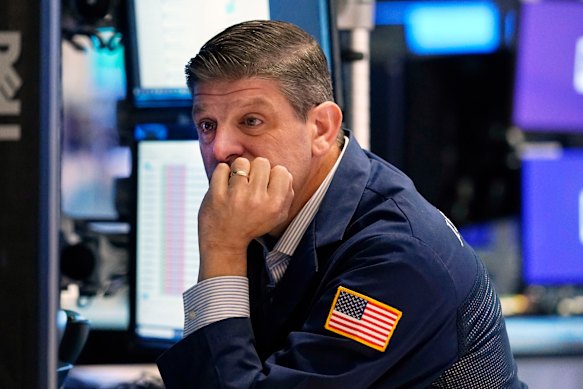
Technology stocks tumbled in a sharp turnaround from their meteoric rises for much of the year, which had carried markets worldwide to records but also raised criticism that they had gone too far.
Nvidia, the stock that quickly became the face of the AI revolution, dropped 4.4 per cent and was the heaviest weight on the S&P 500. It had come into the day with a gain of more than 26 per cent for the year so far.
“To us, it looks like markets have pushed into overbought territory,” according to Brian Jacobsen, chief economic strategist at Annex Wealth Management. He said the strong corporate profits and durable US economy that launched US stocks to records remain intact, but “the path is unlikely to be smooth. Periods like this call for discipline more than hope.”
Many big US companies have been saying their customers have been able to keep spending on their products and services despite having to pay higher prices for gasoline. But US households have also been telling surveys they’re feeling discouraged about the economy and the pressures building on them because of the war and tariffs.
The worries were most clear on Friday in the bond market, where Treasury yields climbed. The yield on the 10-year Treasury rose to 4.59 per cent from 4.47 per cent late on Thursday. That’s a notable move for the bond market, and it’s well above its 3.97 per cent level from before the war.
Yields have been climbing since the war on worries about higher inflation and how it may tie the Federal Reserve’s hands when it comes to short-term interest rates. Not only have traders abandoned virtually all expectations that the Fed will resume its cuts to interest rates this year, they’ve been building some bets that it may even hike rates in 2026, according to data from CME Group.
A couple of reports on the US economy that came in better than expected also helped to lift yields. One said US industrial production improved by more last month than economists expected, while another said manufacturing in New York state is expanding at a faster rate.
With AP, Bloomberg
The Market Recap newsletter is a wrap of the day’s trading. Get it each weekday afternoon.
From our partners
Disclaimer : This story is auto aggregated by a computer programme and has not been created or edited by DOWNTHENEWS. Publisher: www.smh.com.au