Staff writers
Updated ,first published
The Australian sharemarket advanced in early trade on Tuesday, led by tech stocks after an AI-fuelled rally on Wall Street, as oil prices and bond yields eased amid hopes for diplomatic progress in the Iran war.
The S&P/ASX 200 was up 12.70 points, or 0.2 per cent, at 8744.60 shortly after 11am AEST, with seven of its 11 sectors in the green. The benchmark index closed flat on Monday. The Australian dollar was steady at US71.19¢.
Tech stocks led the early gains on the ASX, after America’s tech-focussed Nasdaq composite leaped 2.3 per cent to a record overnight, with chip stocks and other companies in the artificial-intelligence industry leading the way. America’s AI chip giant Nvidia climbed 2.3 per cent and Advanced Micro Devices rallied 9.9 per cent.
Leaders of the industry have recently warned a slowdown is needed in the industry’s development for the safety of humanity. Yet even if the industry leans into more measures for safety, some analysts say it will still be hungry for chips to power it all.
Of the local tech names, software giants WiseTech Global and Xero climbed 3.6 per cent and 3.2 per cent, respectively. AI data centre operator NextDC jumped 4.4 per cent, and digital networks operator Megaport rose 3.6 per cent. Family tracking app Life 360 jumped 4 per cent.
The mining heavyweights were also higher in early trade, albeit at a more moderate pace. Iron ore and copper giants BHP and Rio Tinto were up 0.3 per cent and 0.2 per cent, respectively, and gold producers Northern Star and Evolution Mining rose 0.9 per cent and 0.6 per cent.
The ASX’s gains came after the price for a barrel of Brent oil fell 3.4 per cent to $US100.34. While that’s still much higher than its roughly $US72 price from earlier this year, it’s down from the nearly $US110 it touched last week.
Oil prices have been swinging up and down as some crude from the Middle East is able to sail through the Strait of Hormuz to get to customers, though nowhere near as much as the industry would like because of the war with Iran.
Satellite data showed that Saudi Arabia’s observed oil loadings from inside the Persian Gulf jumped over the weekend, with the highest number of ships seen at the nation’s main Persian Gulf port since June. The images indicate that the kingdom is successfully redirecting its exports back toward the Gulf following the shutdown of its vital East-West pipeline due to drone attacks.
Meanwhile, US president Donald Trump told Fox News he would “probably” be open to meeting his Iranian counterpart, Masoud Pezeshkian, on the sidelines of the UN General Assembly in New York this week. Trump will also hold a summit with Chinese President Xi Jinping. China is the world’s top importer of oil, and provides Tehran with an economic lifeline as its biggest buyer. The US is seeking to step up pressure on Tehran’s trading partners.
While beneficial for the wider market, the falling oil price weighed down energy stocks. Oil and gas major Woodside fell 1.5 per cent, Santos dropped 0.8 per cent, and refiner Ampol shed 0.3 per cent. Coal producers Yancoal and Whitehaven both lost 1 per cent. Coal tends to benefit from higher oil prices as it’s a fossil fuel alternative.
Amid the renewed risk-on sentiment in the market, defensive sectors such as utilities and consumer staples struggled on Tuesday morning. Origin Energy slumped 3.3 per cent and AGL dropped 1.2 per cent. Supermarket chains Woolworths and Coles both fell 0.6 per cent. Discretionary consumer stocks, however, blossomed, with Wesfarmers up 0.4 per cent, pokies maker Aristocrat down 1.1 per cent and furniture seller Harvey Norman up 1 per cent.
The financial sector was mixed, with Commonwealth Bank edging up 0.1 per cent but National Australia Bank (down 0.3 per cent), Westpac (down 0.1 per cent) and ANZ Bank (down 0.2 per cent) all lower.
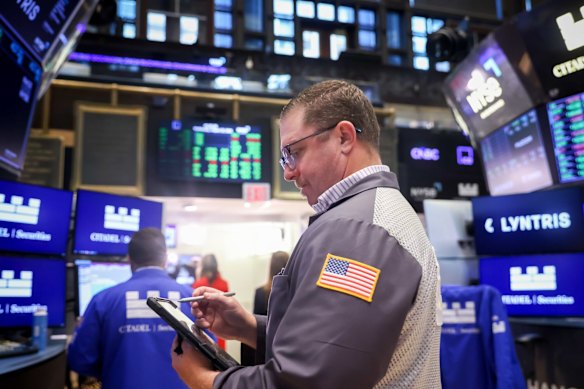
Overnight on Wall Street, the S&P 500 jumped 1.5 per cent and pulled within 0.4 per cent of its record set last month. The Dow Jones Industrial Average added 0.7 per cent, and the Nasdaq composite leaped 2.3 per cent.
The pullback in oil prices helped lower the pressure coming from the bond market. The yield on the 10-year US Treasury eased to 4.95 per cent from 5.01 per cent late on Friday after crossing above the 5 per cent threshold last week for the first time since 2023. Australia’s 10-year bond yields slipped 1 basis point to 5.26 per cent.
Yields have been on the rise because of worries about inflation, big debt loads for governments worldwide and other factors. That hurts the economy because high yields make it more expensive not only for the government to borrow money to pay its bills but also for households and businesses.
Worries remain about how much oil is available for customers worldwide. But ING commodities strategists Ewa Manthey and Warren Patterson wrote in a commentary on Monday that profit-taking by investors after the recent jump in oil prices, together with hopes for discussions at this week’s UN General Assembly and at a meeting between China’s and America’s leaders, helped improve optimism.
US Treasury Secretary Scott Bessent told reporters following talks on Sunday with Chinese Vice Premier He Lifeng that the US had “a very successful engagement” with the Chinese side.
In Beijing, China’s Foreign Ministry on Monday confirmed that Xi Jinping will pay a state visit to the US between September 23 and 25. Experts and policymakers believe trade, tariffs and AI safety are likely among the topics to be on the agenda.
Stocks enmeshed in the cryptocurrency industry, meanwhile, rallied overnight after bitcoin’s price rose above $US86,000 and returned to where it was in January. Coinbase Global climbed 3.5 per cent, and Robinhood Markets rose 2.9 per cent.
Skydance-owned Paramount fell 2.9 per cent as it reached a settlement in lawsuits brought by 12 state attorneys general and the Writers Guild trade union challenging its $US110 billion ($154 billion) acquisition of Warner Bros Discovery, which jumped 10.8 per cent.
The parties worked through the weekend to reach the deal, which includes protections designed to limit the market power and ensure the editorial independence of the media giant, which will control two of Hollywood’s biggest studios, two major subscription streaming services and dozens of TV channels ranging from CBS to HBO.
Paramount has promised to release 30 movies a year at the combined studios, a move designed to placate cinema owners and Hollywood talent who believed the merger would reduce film output. Under the terms of the deal, half of those films must be produced by the new company.
Stock indexes around the world also climbed thanks to the easing of oil prices and bond yields. Indexes gained 0.9 per cent in France, 1.2 per cent in Hong Kong and 1.6 per cent in South Korea.
with AP, Bloomberg
The Market Recap newsletter is a wrap of the day’s trading. Get it each weekday afternoon.
From our partners
Disclaimer : This story is auto aggregated by a computer programme and has not been created or edited by DOWNTHENEWS. Publisher: www.smh.com.au