Staff writers
Updated ,first published
The Australian sharemarket went higher after a lukewarm start on Wednesday, even as tensions escalated in the Middle East after US forces struck Iran and Wall Street was sent reeling by another reversal for high-flying artificial-intelligence stocks. Oil prices climbed.
Consumer-related stocks extended their recent gains, pushing the wider market higher. Sigma Healthcare shares slumped after the owner of the Chemist Warehouse chain confirmed it was in talks to buy UK chemist chain Boots, which has put itself up for sale for £7.5 billion ($14.3 billion).
The S&P/ASX 200 was up 64 points, or 0.7 per cent, at 8668.20 shortly after 11am AEST, with seven of its 11 industry sectors in the green. The ASX fell by 0.2 per cent on Tuesday after recovering from a sharp sell-off in early trade. The Australian dollar was trading at US70.26¢.
US forces launched fresh strikes against Iran overnight in what US Central Command said were “self-defence strikes” following the downing of an American helicopter. Iran will leave no attack or threat unanswered, Foreign Minister Abbas Araghchi said on X in response.
The latest hostilities imperil negotiations for a more lasting accord between the warring parties. Trump has repeatedly said that peace talks are on track, after a flare-up earlier in the week saw Israel and Iran exchange attacks.
Energy stocks were mixed in early trade as oil prices rebounded after the strikes. Brent crude rose as much as 1.3 per cent to trade near $US93 a barrel, while West Texas Intermediate was near $US89. Local oil and gas giant Woodside dropped 0.9 per cent, but Santos edged up 0.1 per cent. Refiners Ampol and Viva Energy were down 0.3 per cent and up 0.4 per cent, respectively.
With uncertainty continuing, investors flocked to defensive consumer staples, pushing supermarket chains Woolworths and Coles up 1.3 per cent and 2.1 per cent respectively, while bottle shop owner Endeavour gained 2.4 per cent.
But discretionary retailers also advanced, with Wesfarmers up 1.3 per cent as it held its strategy day, in which it flagged plans to use AI to drive sales and earnings growth. JB Hi-Fi gained 1.8 per cent and Harvey Norman rose 2.1 per cent.
Consumer-related property trusts also benefited, with shopping centre landlords Scentre (up 1.5 per cent), Vicinity (up 2.2 per cent) and Stockland (up 2.9 per cent) all advancing. Warehouse and data centre owner Goodman Group added 0.9 per cent.
Meanwhile, gold producers weighed down the mining sector in early trade as gold prices softened amid investor fears about prolonged higher energy costs pushing up inflation and thus leading to higher interest rates. Bullion fell as much 2.2 per cent, and is now almost 20 per cent cheaper than before the Iran war broke out.
Northern Star Resources was down 1.6 per cent. Evolution Mining dropped 2.1 per cent and Newmont lost 2.3 per cent. The mining heavyweights were mixed, with BHP up 0.7 per cent and Rio Tinto up 0.3 per cent, while Fortescue slipped 0.4 per cent.
But it was tech stocks that were among the biggest losers in early trade, reflecting another sell-down of their peers overnight in the US. Xero, Australia’s biggest software maker, shed 1.1 per cent, while WiseTech Global and Technology One were down 2.3 per cent and 1.8 per cent, respectively. AI data centre operator Next DC fell 2.3 per cent.
Shares of Sigma Healthcare slumped 4.3 per cent after the owner of the Chemist Warehouse chain confirmed reports out of the UK that it’s “engaged in preliminary discussions” regarding a potential takeover of British chemist chain Boots, with a reported asking price of more than $14 billion.
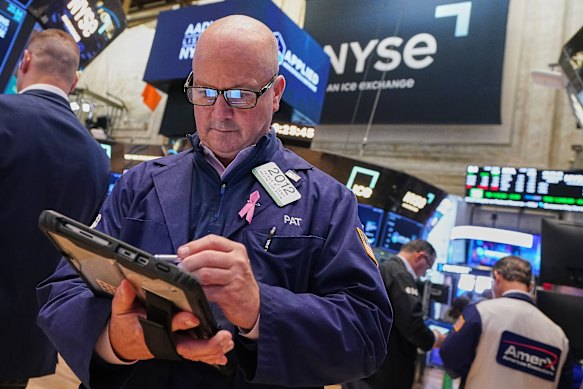
On Wall Street overnight, the S&P 500 fell 0.3 per cent after careening between an initial gain of 1 per cent and a midday loss of 2.3 per cent, pulling further from its all-time high set a week ago. After similar yo-yo moves, the Dow Jones Industrial Average added 86 points, or 0.2 per cent, and the Nasdaq composite dropped 1 per cent.
“My head was spinning all day,” said Mary Ann Bartels, chief investment strategist at Sanctuary Wealth, which has been telling clients to buy the dip on tech stocks. “At one point when the Nasdaq 100 slid 4 per cent, I couldn’t even figure out why. It could be deleveraging after a big run. Middle East tensions? Rate-hike fears? Inflation worries? All of the above? No one really knows.”
Indexes swung lower after companies selling computer chips, memory and other building blocks of the AI boom broke from early gains to losses. Micron Technology went from a jump of 4 per cent to a plummet of 10 per cent, for example, before finishing with a drop of 1.4 per cent. That’s a day after it soared 9.9 per cent and two days after it plunged 13.3 per cent.
The computer memory company’s stock has already tripled so far this year, raising criticism that it’s gone too far, too fast. Following last week’s industry-wide selloff, the question is whether AI stocks broadly are heading for a long downturn or just needed a shake-out to get rid of excessive optimism.
Marvell Technology dropped 7.6 per cent, and Advanced Micro Devices sank 3 per cent after both AI winners also erased early-morning gains.
All the while, several big-name AI companies are racing to list their stocks on a US exchange and sell them at high prices. OpenAI, the maker of ChatGPT, said Monday it was the latest to file confidential paperwork with US regulators top open the door for an initial public offering. SpaceX’s IPO could happen later this week.
High oil prices caused by the war with Iran have created a painful acceleration of inflation for US shoppers. They have also pushed bond yields higher worldwide, raising the pressure on stock prices. The latest monthly updates on US inflation will arrive later in the week, with one on consumer prices coming Wednesday and one on wholesale prices coming Thursday.
“Fears of another hot inflation print this week on the back of escalating Middle East tensions has revived fears that the threat of rate hikes may eat into Corporate America’s profit margins, and thus, stock prices,” said John Cunnison, chief investment officer at Baker Boyer Bank.
Inflation is high enough, and the US job market looks strong enough, that traders on Wall Street largely expect the Federal Reserve will have to raise its main interest rate at least once by the end of this year. Higher interest rates would keep a lid on inflation, but they would also threaten to slow the economy and undercut prices for stocks and all kinds of other investments.
The average long-term US mortgage rate recently hit its highest level in nine months, and high costs to borrow money could discourage the building of AI data centres that are fuelling the US economy.
In other international markets, indexes dipped in Europe following bigger moves in Asia. South Korea’s Kospi jumped 8.2 per cent and nearly recovered Monday’s plunge of 8.3 per cent. It’s been beholden to the performance of big tech stocks like SK Hynix and Samsung Electronics.
with AP, Bloomberg
The Market Recap newsletter is a wrap of the day’s trading. Get it each weekday afternoon.
From our partners
Disclaimer : This story is auto aggregated by a computer programme and has not been created or edited by DOWNTHENEWS. Publisher: www.smh.com.au