
“I used to be very scared to speak in English because I thought I would make mistakes and everyone would laugh at me, so I stayed quiet even when I knew the answer,” says Neha (name changed), a 12-year-old student from the Need Base India Girls Home in Bengaluru.
“I could understand everything the teacher was saying, but when it was my turn to answer, I would stay silent. I was too afraid of being judged or laughed at if I got it wrong,” says Sheela (name changed), also 12, from the same home.
“I liked English, but I never knew how to speak properly. I would get nervous and stop halfway,” adds Asha (name changed), 13.
In classrooms like these, English is not absent. It is present in textbooks, written in notebooks, and tested in examinations. For many children in care homes and government schools, especially in places like the Need Base India Girls Home in Bengaluru, it remains something they can read and understand, but rarely speak with ease.
What is missing is not learning. It is confidence.
And it is mostly this gap between understanding and expression that goes unnoticed in classrooms, but not by a student who walked into them with a very different question in mind.
A teenager who stepped into unfamiliar classrooms
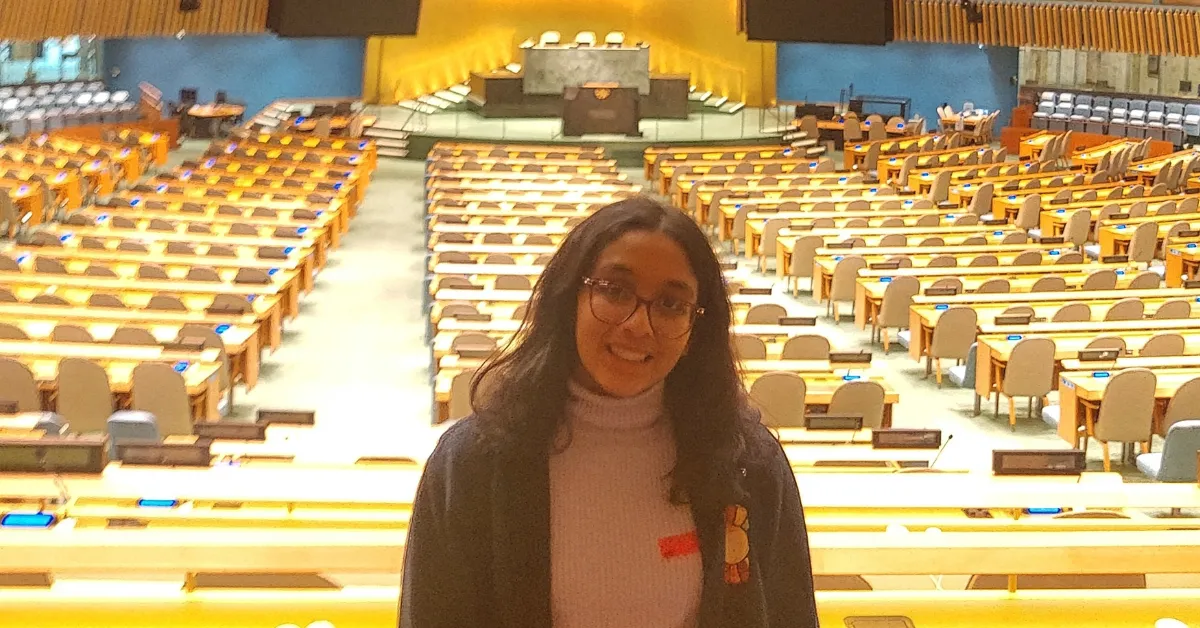
Roshni Gupta is now 17 and studying in Class 11 at Mallya Aditi International School in Bengaluru. But when she first entered classrooms like those at the Need Base India Girls Home and nearby government schools in Rajajinagar, she was only 14, a Class 9 student trying to understand something she could not ignore.
She was raised in Bengaluru, where she grew up in a learning environment that encouraged speaking up, questioning, and discussion as part of everyday education. In contrast, what she observed in several government schools and orphanages, including Greater Hope Children’s Orphanage, was very different.
The children were not disengaged. In fact, they were interested and responsive. They answered confidently in their own languages, participated actively in familiar topics, and showed genuine eagerness in learning. But when English entered the conversation, the energy in the room changed.
The voices lost their earlier confidence. Hands went down. Eyes turned to notebooks instead of teachers.
“It was not that they lacked understanding. They just were not used to speaking without fear,” the young girl shares with The Better India.
In May 2023, she began visiting more deliberately, moving between schools and homes in Srirampura, government schools in Rajajinagar, and other learning spaces in Bengaluru. She was not there to teach, but to understand.
One moment stayed with her.
“I asked a student to explain something she had written,” she recalls. “Everything was correct, but she could not speak it in English. That is when I realised the issue was not knowledge. It was an expression.”
By August, at just 14 years old and in Class 9, she decided to act on what she had seen. ‘Project Vidya’ was born.
When English becomes a conversation instead of a fear
Project Vidya began with a basic idea, but one that required a complete shift in how English was being taught in many of the classrooms she had visited. The focus was not on grammar drills or memorisation. It was spoken English, communication, confidence, and the ability to express thoughts without hesitation.
The initiative now works with children from Classes 4 to 9 across institutions, including the Need Base India Girls Home, government schools in Bengaluru, Hyderabad and Delhi, as well as chapters in Rwanda, Kenya, Lesotho, and the United Arab Emirates.
Each workshop brings together around 30 to 40 students and is built around interaction rather than instruction.
/filters:format(webp)/english-betterindia/media/media_files/2026/06/01/roshni-gupta-project-vidya-2026-06-01-19-17-30.png)
A session might begin with something as simple as introductions. But instead of writing answers in a notebook, children are asked to speak, respond, and engage. Videos are used to introduce ideas, followed by prompts that slowly draw students into conversation.
“We wanted to take away the fear of speaking, not by correcting every mistake, but by making it feel natural and comfortable,” she explains.
One of the most engaging activities involves creativity. Children are given paper, colours and craft materials, and asked to create origami or drawings. They then introduce their creations in English as if they were characters in a story. Laughter replaces hesitation, and speaking becomes part of play.
The approach is influenced by Lev Vygotsky’s sociocultural theory, which suggests that learning happens best through interaction, collaboration, and guided participation rather than silent repetition.
For older students, sessions also introduce digital literacy through tools like Canva and basic computer skills. Some workshops include financial literacy concepts such as saving, planning, and basic money awareness.
Books that moved from apartments into classrooms
Alongside workshops, the initiative slowly began building another layer of impact through book donations.
In Bengaluru, community-driven collection drives were organised in residential apartments. The team placed boxes in building lobbies, shared messages with residents, and, as days passed, began to receive contributions.
Over time, around 300 to 400 books were collected. These included storybooks, English textbooks, dictionaries, and reading material. They were distributed to orphanages in Srirampura, Greater Hope Children Orphanage, and partner schools where access to reading material is often limited.
For many children, these were not just books. They were the first time reading became something beyond a classroom exercise. “I like reading storybooks because I understand new words slowly,” says Sheela. “It is easier when I read by myself.”
In some homes, books are shared in groups. In others, they form small libraries where children pick them up during free time, reading not because they are asked to, but because they want to.
A growing network led entirely by young people
From its beginnings in Bengaluru, the initiative has grown into a youth-led network spanning five countries, including India, the United Arab Emirates, Rwanda, Kenya and Lesotho. The organisation is entirely run by young volunteers between the ages of 13 and 25, with around 40 active members.
Each region operates through its own chapter, led by a chapter head and supported by small teams working on teaching, curriculum development, outreach, and coordination.
In India, active chapters are based in Bengaluru, Hyderabad and Delhi. Internationally, teams operate in Rwanda and the UAE, while partnerships extend to Kenya and Lesotho.
The structure is intentionally flexible. The founder selects volunteers through applications and interviews, via LinkedIn and personal networks, emphasising commitment rather than prior experience.
/filters:format(webp)/english-betterindia/media/media_files/2026/06/01/roshni-gupta-project-vidya-2026-06-01-19-19-15.png)
Mentorship that helped guide direction
Behind this growing structure is mentorship from the 1M1B Foundation (One Million for One Billion), a youth-led organisation that guides young changemakers through leadership training, mentorship and opportunities aligned with the United Nations Sustainable Development Goals.
The teenager first came into contact with the programme when it was introduced at her school in 2023, and since then, she has been mentored by senior mentor Chhavi Kumar.
“I have worked with Roshni since the early stages of Project Vidya. What stood out was how clearly she thinks, how she organises her ideas, and how she actually puts them into action,” says Chhavi.
Her role, she explains, was to guide rather than instruct.
“She learnt to identify a problem, build a solution around it, and then carry it forward with consistent effort. That kind of consistency is rare at her age,” the mentor adds.
What change looks like in everyday moments
Since its launch in 2023, Project Vidya has conducted 48 workshops across five countries, directly reaching approximately 1,680 students. Advocacy sessions aligned with United Nations Sustainable Development Goal 4 have engaged over 400 participants.
Through book donation drives, nearly 5,000 children have been indirectly impacted across schools and homes, including the Need Base India Girls Home in Srirampura and Greater Hope Children’s Orphanage.
A scholarship initiative supported through Impact Guru raised around 42,000 rupees, helping 25 students with one year of educational support, as decided in consultation with school and home authorities.
But the most visible impact is not captured in numbers. It is seen in hesitation turning into participation.
“I try speaking now, even if I make mistakes. Earlier, I would not even try at all. Now I feel like I can at least attempt to say what I want,” says Neha. “I can speak a little English now. I don’t feel as scared in class anymore, and I try to answer when the teacher asks questions,” adds Asha.
At the Need Base India Girls Home in Srirampura, caregivers and educators have noticed a slow shift. Children who once avoided speaking are now attempting answers, asking questions, and engaging more freely during sessions.
/filters:format(webp)/english-betterindia/media/media_files/2026/06/01/roshni-gupta-project-vidya-2026-06-01-19-21-06.png)
For Roshni, now balancing Class 11 academics with leading a multi-country initiative, Project Vidya is still growing. She hopes it will grow into a larger youth-led movement that reimagines how communication skills are taught, not as a subject to be tested, but as a life skill to be lived.
“I want children to feel that their voice matters,” she says. “Not only in English, but in any language, in any space.” In classrooms across Bengaluru and beyond, that change is already visible in small ways. And sometimes, that is how change begins.
All pictures courtesy Roshni Gupta.
Disclaimer : This story is auto aggregated by a computer programme and has not been created or edited by DOWNTHENEWS. Publisher: thebetterindia.com



