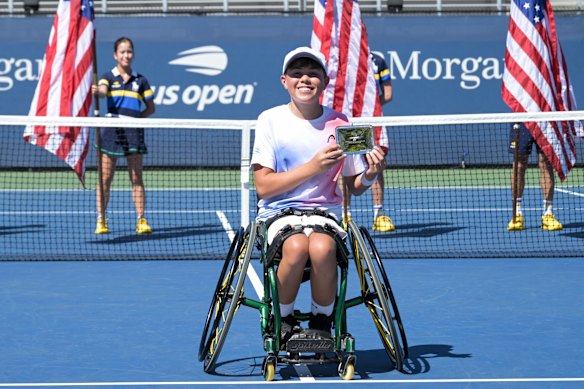
Tennis-mad Sonny Rennison was told he wouldn’t be able to walk any more, but just made tennis history in New York.
My four-year-old son gazed up at me from my lap, brown eyes shimmering as his trademark smile faded from his cherubic face. I bit my lip, holding back my tears as I repeated the words the doctor used to explain that our sport-obsessed son couldn’t walk any more. The first droplet rolled down his cheek as he choked out the most important question of all: But how will I play tennis?
Sonny always wanted to play with a ball. At age two, he’d study the older kids at the basketball hoop, mimicking them until he mastered dribbling. At three, he always got a hole-in-one at mini-golf. By four, he had discovered tennis, his grin wide as he stepped on court for his first lesson.
Two months later, he woke with a severe limp.
As a toddler, I’d developed my own limp, which was initially dismissed by doctors. My mother sought a second opinion, which led to multiple surgeries to -correct a non-existent hip joint, and by age 36, after years of immobility, I had a total hip replacement.
Terrified my babies would inherit my imperfect bones, I fought for Sonny and his older sister to have every test and X-ray, but they were caught in the net of misdiagnosis anyway, just like me all those years before. When we finally found the correct orthopaedic paediatrician, I knew from the subtle drop of his shoulders the moment Sonny’s bones lit up the monitor that I wasn’t just the paranoid mother every other medical professional had suggested I was.
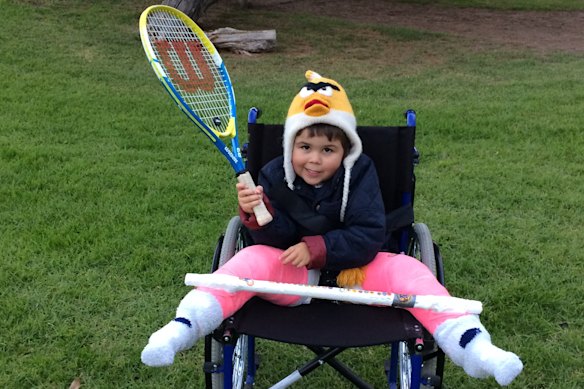
That day, we were told Sonny had a rare bone condition called Perthes disease. The blood supply to his hip was disrupted, leaving the ball joint to waste away. Any impact, from running to simply standing, would destroy the hip further. Surgeries, procedures and treatments were listed, all familiar to me from my own childhood, along with the news that it could be something worse. Something that attacks every joint. Something called multiple epiphyseal dysplasia. Spoiler alert. It was.
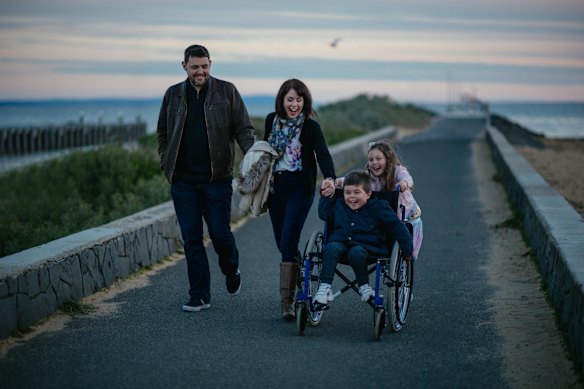
In the weeks following Sonny’s diagnosis, our world shrank, and with our families based overseas, we were swallowed up by loneliness. Unable to lift Sonny into his car seat because of my own physical limitations, I hoisted him into the stroller he’d long outgrown to walk my daughter to school, battling scorching heat one day, torrential rain the next, held hostage by Melbourne’s unpredictable weather.
I cancelled playdates, as hosting his friends became too difficult. They’d perch next to him, twitching like wind-up toys, desperate to burn off their four-year-old energy, as I drank tea with their mothers, suppressing the howl embedded in my throat while forcing a smile through conversations I could barely follow. I spent hours on the phone, unprepared for the difficulties – and expense – of accessing wheelchairs, equipment and funding. At the end of each day, I hovered in front of the clock, waiting for my husband to return from work. He was the only other person who understood this new pain.
Four months after Sonny’s diagnosis and first surgery, armed with no more than an “Aldi-special” wheelchair, we found Access for All Abilities Play, the government organisation connecting Victorians with disabilities to local sports. Through them, we met Rob Hilbig, a young, enthusiastic coach with wheelchair tennis experience based at a nearby club.
We wheeled Sonny onto the court, positioned him in front of the net, and locked the brakes. His feet dangled from the giant chair but as he gripped his racquet tight, that familiar grin returned to his face. He smashed every forehand and backhand Rob fed him, laughing as each ball whizzed past his new coach’s head. My husband and I locked eyes. We knew nothing about wheelchairs, and even less about wheelchair sports, but we knew this moment was special, and a spark of hope ignited.
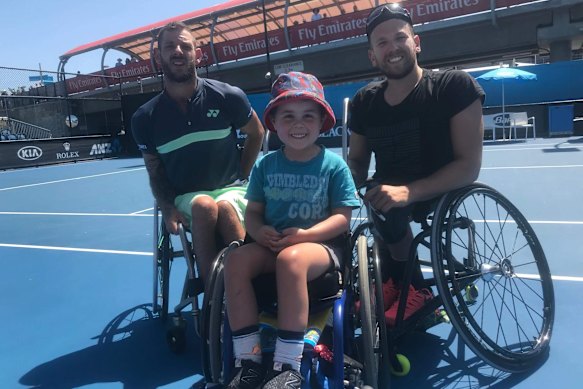
The following January, we watched Dylan Alcott and Heath Davidson on the practice courts at the Australian Open. Ignoring Sonny’s self-conscious pleas for us to make no fuss as the crowd swarmed for signatures and selfies, I blurted out, “My son plays wheelchair tennis!” The two stars peered over the barrier that was hiding Sonny from view, and instructed everyone to make space for him to join them, unlatching a door to a world we could never have predicted 12 months prior.
That evening, Tennis Australia’s national development wheelchair coach, Greg “Crumpy” Crump, invited us to watch more matches at Melbourne Park, offering the opportunity for Sonny to do a coin-toss before a match, then, post-tournament, to try the special sports wheelchairs on site. They were enormous, and after he tumbled out of one following an epic serve, we strapped him in with a makeshift velcro seatbelt.
The next week, Crumpy presented him with a beautiful, Sonny-sized chair, and then, the greatest gift of all – an introduction to the wheelchair juniors community, where we met kids like him, and parents who understood our reality, without any explanation.
At nine, Sonny entered his first tournament. The rain was relentless, hammering the clubhouse roof, so when indoor courts were finally secured, matches ran late. At 8pm, Sonny’s usual bedtime, he played his first competitive match against a junior who was twice his size. The joy never left Sonny’s face, even as the scores went against him. He was officially on the world rankings board – at No. 58 after that match – the youngest player in the ITF junior boys division, and counting down until he could do it all again.
Known for his contagious smile – on and off the court – it’s easy to assume nothing gets to Sonny, but so much has gone on behind that grin. The tearful nights after school because he couldn’t play soccer with his mates. The days he wore a plastic Star Wars mask at shopping centres, hiding from stares when his legs were plastered thigh-to-ankle in “broomstick” casts. The throbbing pain that still keeps him bedridden for days. But, always, he persists.
By 12, Sonny had climbed the world rankings, reaching 16th at the end of 2024. His goal was to represent Australia at the BNP Paribas World Team Cup – the wheelchair tennis equivalent of the Davis and Billie Jean King cups. Finally, the long-awaited call came. Through the speakerphone, Crumpy’s words filled the room: “Matey, how’d you like to come to Turkey?”
Thirty hours, three flights, eight wheelchairs, four kids, five parents, and two coaches later, the team touched down in Antalya. On court, competition between the countries was rigorous and fierce. Off court, there was singing, wheelchair conga-lines and blossoming friendships with players from Brazil to Belgium.
Between Sonny’s surgeries – twice on his ankles, which hadn’t formed properly, and major spinal fusion that my daughter, Evie-Rose, required – was a whirlwind of travel that included visiting the UK, Belgium and Japan. Our family was divided as my husband and I took turns travelling – one of us worked courtside while the other stayed home with Evie-Rose.
In 2022, when Sonny was 10, the US Open became the first grand slam to debut a junior wheelchair tournament, with the top eight boys and girls qualifying. This was followed by the French Open in 2024, and the Australian Open in 2025, which both take the top four male and female players.
This year, at 14, Sonny reached No. 8, and with nails bitten to the quick, we watched tournament results from across the world shuffle the rankings until the US Open qualifying deadline arrived. Then the email landed, with an invitation to his first grand slam.
Crumpy, Sonny and I departed Melbourne for New York, my fingers constantly crossed that his wheelchair would arrive in one unbroken piece. With our accreditation hooked around our necks, a US Open Cadillac delivered us to Flushing Meadows. The door Dylan Alcott and Heath Davidson had unlatched in Melbourne at that pivotal Australian Open now swung wide open. Beside the famous Arthur Ashe Stadium, as cheers erupted for the Elena Rybakina-Qinwen Zheng women’s singles quarter-final, Sonny launched his US Open campaign with a straight-sets victory, securing a place in the semi-final.
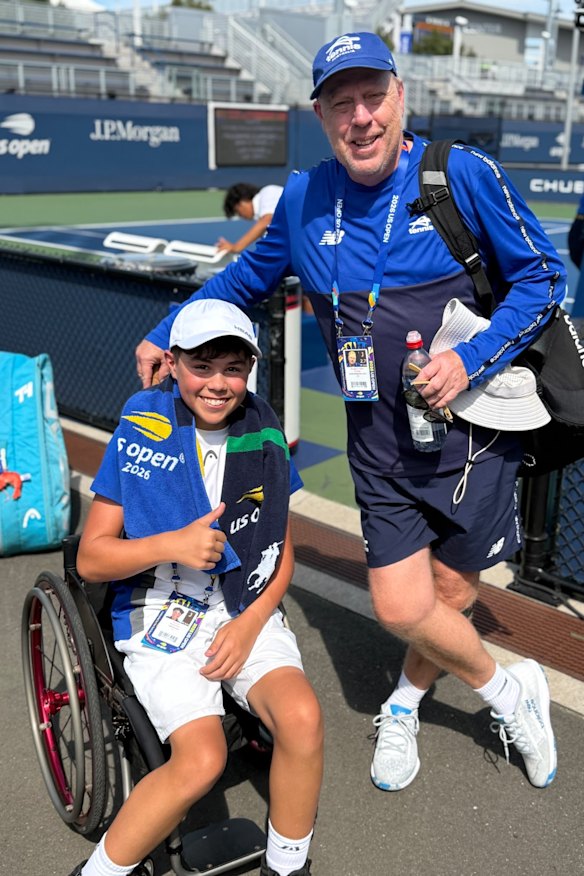
The next day, waiting courtside, was Heath, beaming with pride. Sonny took the first set 6-2, but the second was tough. Down 4-0, he fought back, winning six consecutive games to become the first Australian to reach a grand slam boys’ wheelchair singles final. He slapped hands with Crumpy, reached for me, then stretched across the barrier to wrap his arms around Heath, burying his face into his neck.
On the day of the final, ready to battle against the No. 1 seed, Matthew Knoesen, Sonny wheeled onto court, his name and stats flashing up on giant monitors. I took my seat between Crumpy and Heath on the bleachers, the autumn sun beating down. The rest of the Australian team surrounded the court as the crowds grew, while back home in the dark early hours, Sonny’s dad and sister watched, their faces lit by the television screen.
People have asked if I cried as the final point landed, but my heart unknotted, swelling with a joy I never expected to feel again after that fateful day in the hospital when Sonny was diagnosed. His opponent took the match – 6-0, 6-2 – but I applauded far above my head all the same.
Meanwhile, Sonny, always the sportsman, raced around the net to embrace his friend, with that grin we all adore stretched high into his cheeks.
Read more from Good Weekend magazine:
Get the best of Good Weekend delivered to your inbox every Saturday morning. Sign up for our newsletter.
Disclaimer : This story is auto aggregated by a computer programme and has not been created or edited by DOWNTHENEWS. Publisher: www.smh.com.au