
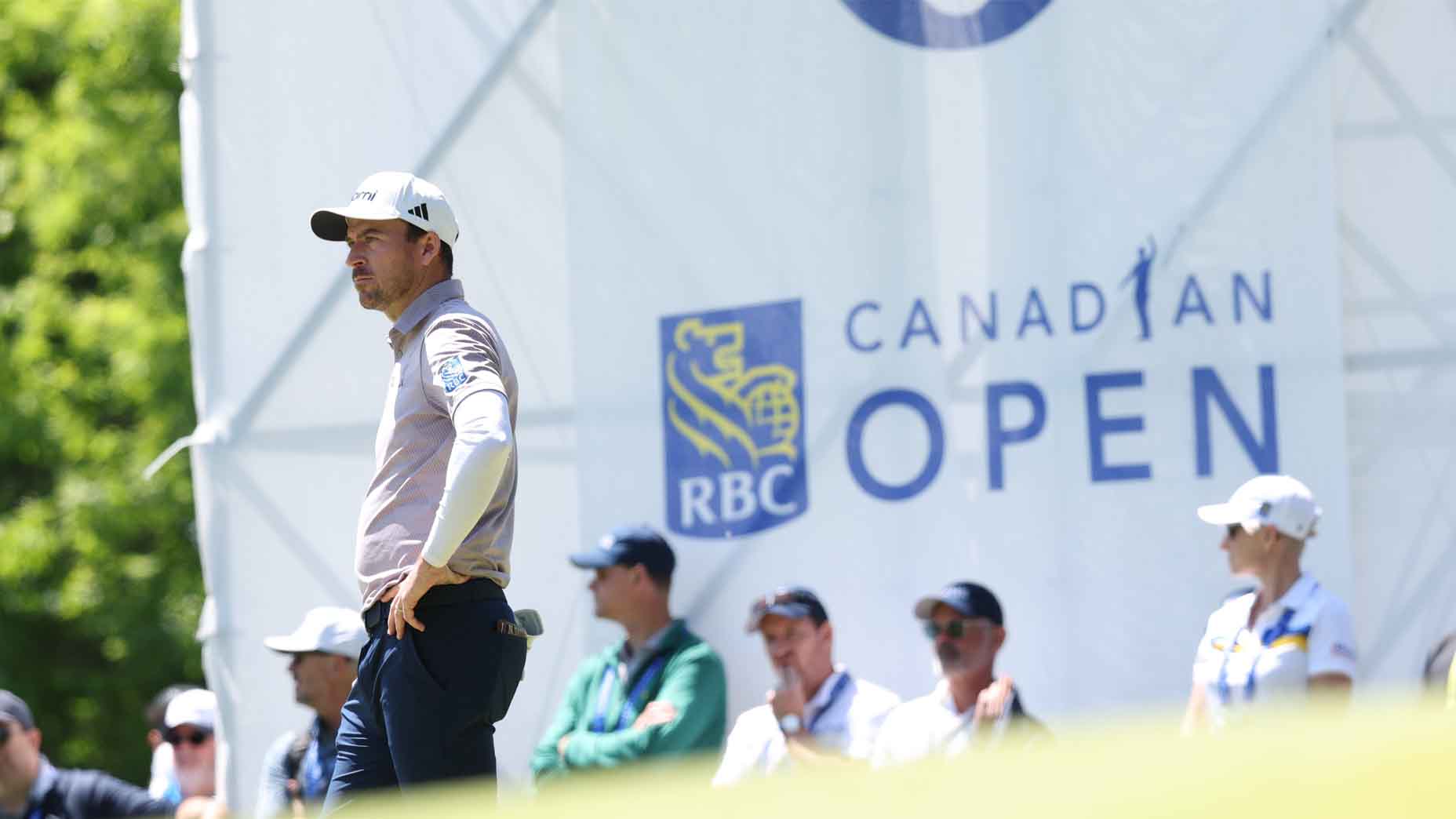
Nick Taylor’s career highlight to this point came at the 2023 Canadian Open when he dropped a 72-foot eagle putt to beat Tommy Fleetwood and win his national open in a playoff. Barring a major championship win, that will likely be the top line of Taylor’s career obituary whenever he hangs up his golf spikes. Taylor understandably holds his national open in high regard, as Rory McIlroy does with the Irish Open, Adam Scott with the Australian Open and so on.
But as new PGA Tour CEO Brian Rolapp and the Future Competition Committee work to reshape the PGA Tour’s schedule and competitive structure, the Canadian Open, among many other Tour staples, finds itself wondering what the future will look like. Unlike the Rocket Mortgage, which will cease to exist after this summer’s edition, the RBC Canadian Open will have a place in the PGA Tour’s future schedule — it’s just unclear what place that will be and what the event will look like once the PGA Tour enacts those changes.
Last week at the Memorial in Dublin, Ohio, Rolapp spoke briefly with a group of reporters to discuss how the new schedule is shaping up and when it might be implemented. While the proposal is still being discussed, the plan is for the PGA Tour to adopt a two-track system, with the top players on one track and golfers on the lower track competing to move up. Details have not yet been made public, but Rolapp has said the system would see Track 1 host roughly 20 events, including the four majors, with a field size of around 120 players and purses of $20 million. While nothing is decided, players on Track 1 will likely be discouraged or prohibited from playing in Track 2 events.
“At the end of the day, sports is about how good the athletes are and what the competitive consequences are,” Rolapp told reporters at the Memorial, per ESPN’s Mark Schlabach. “I think we have lost a lot of that with the smaller fields, no-cut events. The competitive meritocracy that makes this sport great and unique is what we’ve gotten away from [and is what] we’re getting back to.”
As Rolapp and the FCC work to remake the schedule, the Canadian Open and those who make it an annual stop are left wondering what the future holds for the event and others like it. Will it be a Track 1 or Track 2 event? Will it still be considered an “Open” if it’s a Track 1 event with a set field? And regardless of the track it’s on, how will players who make it a staple of their schedules deal with potentially being unable to tee it up because of the track they reside on?
“That would certainly suck,” Taylor said on Wednesday, bluntly, ahead of this year’s RBC Canadian Open. “I talked to a lot of guys that are on the PAC, a lot of people with the Tour, I think the goal in mind is to have the best product possible. That’s the scenario that I’ve asked and questioned, and what happens in that scenario or in that case. I guess time will tell. I wouldn’t love that certainly. I know there’s a lot of guys that maybe have their local events that that might be a possibility as well. So I guess we’ll cross that bridge when we come to it, but I think it would probably obviously lose the Open name because nobody can essentially earn their way into it or play into it. So it’s unique for us, being a National Open. If you can’t play in it, that’s going to be a big bummer. But again, I think the goal is to make the best product possible.”
Fellow Canadian Corey Conners is hopeful the PGA Tour’s new schedule will have a place for the Canadian Open where it can continue to grow as a popular and meaningful stop — one that he and other Canadians will be able to still play annually.
“I’m really passionate about this event,” Conners said. “I care a lot about this event. The Open factor, you know, it’s always been nice to have 21 Canadians, give some young Canadian players an opportunity to play at such an elite event. So definitely I think there’s going to be some changes. Nothing’s been quite decided, but I’m optimistic that the Canadian Open’s going to continue to thrive and hopefully it can continue to be a big part of the PGA Tour and I can continue trying to chase down the trophy.”
The Canadian Open isn’t the only PGA Tour stop dealing with uncertainty, although that comes in different shapes and sizes depending on the event. In March, the Cognizant Classic, formerly called the Honda Classic, dealt with a wave of WDs prior to the tournament. With the event slotted behind the Genesis Invitational and in front of the Arnold Palmer Invitational and Players Championship, it has gone from a popular Tour stop that used to see Tiger Woods, Sergio Garcia, Rory McIlroy, Rickie Fowler and others attend, to one that gets just a handful of the top 50 players in the world. It was a hint at what might be around the corner for the event in The Palm Beaches.
“It’s tough with any tournament on the PGA Tour schedule, outside of Signature Events, due to a multitude of reasons,” Florida native Billy Horschel, who is a regular at the Cognizant, said in March. “We had this issue before the Signature Events were around. We’ve always had this issue. A decade ago, this event was unbelievable with the field, but where it fell in the schedule was really good for a lot of the guys that lived here. … This field has sort of been up and down the last couple years. When you’ve got so many events on the PGA Tour schedule and you’ve got guys trying to figure out where they’re going to fit, it’s tough to fill a field.
“It’s not just Cognizant. A whole bunch of tournaments are struggling.”
The Cognizant will reportedly have a similar spot in the 2027 bridge-year schedule, sitting between the Genesis and Cadillac Championship and Players Championship as the Arnold Palmer Invitational shifts to later in March. But with the new Tour structure slated to arrive in 2028, Rolapp’s plan to highlight scarcity and up the competitive structure will leave many events grappling with a new reality, or, in the case of the Rocket Mortgage, perhaps see them fade away as the world of the PGA Tour haves and have-nots becomes more crystallized.
The RBC Canadian Open has a long and rich history. It was Arnold Palmer’s first Tour win in 1955 and the site of one of Tiger Woods’ greatest shots. Its list of winners includes Woods, Palmer, McIlroy, Dustin Johnson, Sam Snead, Jim Furyk, Lee Trevino, Jason Day and others.
When Taylor’s 72-foot eagle putt dropped to become the first Canadian in 69 years to win his national open, he etched his name into that history. It’s a history that will continue. But the PGA Tour’s grand restructuring has players and tournaments wondering what their new reality will look like when it finally comes to pass.
Disclaimer : This story is auto aggregated by a computer programme and has not been created or edited by DOWNTHENEWS. Publisher: golf.com



