
More than 160,000 schoolchildren, students and trade unionists have marched in cities across France as protests over high school education continued into a third week and many demonstrators denounced policing tactics.
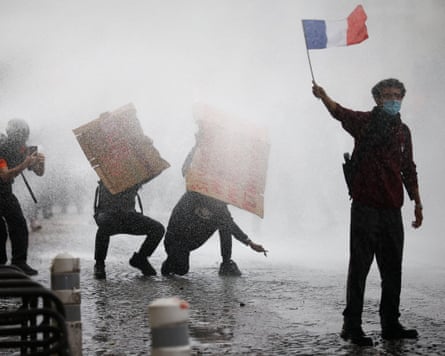
Riot police fired teargas at the end of Tuesday’s marches in Nantes and near the Montparnasse area of Paris, but most of the demonstrations over teacher shortages, overcrowded classes and crumbling school buildings held in cities including Lyon, Lille and Marseille were peaceful.
The Swedish climate activist Greta Thunberg joined an early morning protest outside the Lycée Paul Éluard in the Paris suburb of Saint-Denis.
“Young people are not being included in the conversation,” said Thunberg, 23, who became famous as a teenager through school strikes demanding action on the climate crisis.
As lawyers in their robes formed a human chain to protect pupils after accusations of police brutality, Thunberg said: “Our future is being stolen from us and, as we have seen here, schools are not getting the investment they need.”
Students outside the high school said Thunberg had encouraged them to continue with peaceful demonstrations.
The protests – backed by trade unionists, some teachers and radical leftwing opposition politicians – have shaken a government caught between calls for urgent public investment and pressure to reduce France’s ballooning deficit and debt.
France’s interior ministry said 161,500 people had turned out across the country on Tuesday, while similar marches drew more than 260,000 last Tuesday and 75,000 on Thursday.
“They’re not listening to us, so we’re going to them,” the university students’ union UE – many of whose members are also demonstrating in solidarity, with an estimated 90% of France’s universities disrupted on Tuesday – posted on social media. High schools in Paris, Marseille and elsewhere were again blockaded.
French authorities hope the protests, some of which have resulted in violent clashes with riot police, will peter out during the two-week half-term school holiday that starts this weekend.
Louis Létoublon of the student organisation Les Lycéens! said the protest movement had begun in deprived areas outside Paris where families were unable to afford holidays, so the autumn school vacation would not dampen anger.
“We are continuing the blockades. We are not budging,” Naouel, a high school student in Brest, told Agence France-Presse.
Mariolino, a 16-year-old in Nantes, said: “Those who think the anger will disappear with the holidays just don’t get it.”
France is braced for more nationwide protests on Saturday, which could be joined by people angry at rising fuel and energy prices as well as the cost of living.
Jérôme Rodrigues, a high-profile member of the gilets jaunes (yellow vests) protest movement in 2018 and 2019, was present at the Paris march on Tuesday, and there was speculation that gilets jaunes could return to the streets on Saturday.
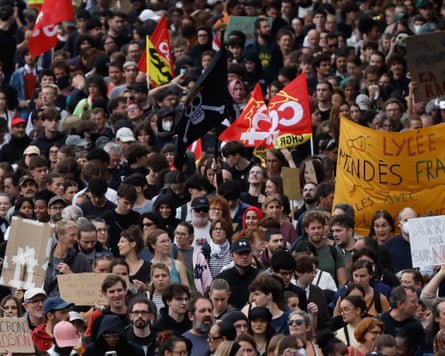
“There is a lot of anger,” Rodrigues told journalists. He said people felt the government had not answered their concerns, offering only “crumbs” – whether on fuel prices or demands for more funding for schools.
Sophie Binet, the head of the leftwing CGT union, said: “Our youth is determined …While there is no answer to demands, the mobilisation will continue.”
The education minister, Édouard Geffray, who has said 3,000 substitute teachers are being deployed in schools facing the most severe staff shortages, said on Tuesday that 214 of the country’s 3,700 high schools were completely closed.
French media have reported, however, that at least some classes have been cancelled or disrupted in many more schools, and some lycées – for pupils mostly aged between 15 and 18 – have switched wholly or partly to online learning.
The country’s president, Emmanuel Macron, called for restraint on Monday, saying the issues “deserve time, consultations, discussion and respect”, as government figures showed more than 6,800 people – mainly minors – had been detained during the protests.
About 1,500 people are being prosecuted, the justice ministry has said, while 24 allegations of police brutality against demonstrators are under investigation. More than 200 teenagers, 100 school staff and 700 police officers have been injured.
One young protester lost a hand from a police stun grenade, prompting the government to ban their use during the protests, while another lost the use of an eye and a third many of his teeth from a teargas canister fired at close range.
Rights groups and students have accused the police of a disproportionate use of force.
The interior minister, Laurent Nuñez, defended the policing. “When demonstrations take place peacefully, there is no police intervention,” he said.
Six months from a crucial presidential election to replace Macron, rival politicians are jockeying to exploit the protests.
The far-right frontrunner, Marine Le Pen, has highlighted the damage to schools and called for parents to foot repair bills, while her radical-left opponent, Jean-Luc Mélenchon, has praised the protesters as “incredible” and denounced police brutality.
Disclaimer : This story is auto aggregated by a computer programme and has not been created or edited by DOWNTHENEWS. Publisher: theguardian.com