
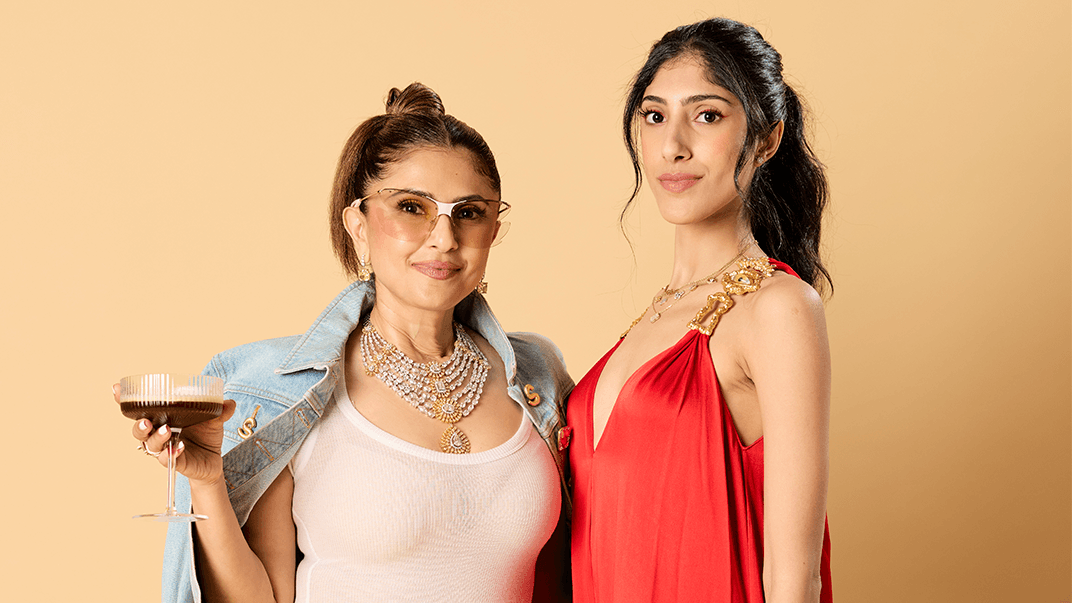
The evening’s jewellery partner, GoluBhai Badalia Diamond, brought its own three-generation history into the room. Known for its focus on high-quality stones and careful selection, the brand sat naturally within the evening’s wider conversation around legacy. Across the room, fine jewellery appeared in sharply different combinations: gold medallions over black necklines, antique pearls with linen, solitary diamonds against paillettes and sapphires worn with navy embroidered saris. Elsewhere, emerald necklaces were worn with green gowns. Across the evening, inherited and fine jewellery was no longer confined to expected weddingwear pairings. It moved through black evening looks, embroidered saris, linen separates and gowns with much greater range.
For Jaya Raheja, legacy came into focus through a piece she still wears: her grandmother’s diamond solitaire pendant, given to her at her wedding. Her answers elsewhere made clear that her own bridal instincts still tilt traditional. “For me, a wedding is always going to be red,” she said, describing her ideal look as “a traditional red lehenga or a sari.” When asked about jewellery, she was equally certain. “Emerald for me,” she said, adding that she prefers a single statement piece. Her response gave the evening one of its clearest ideas: inheritance still matters, but so does the edit each person brings to it.
That tension between recognisable bridal codes and more individual styling choices returned elsewhere in the room. Makeup artist Shradha Luthra described her bridal approach as “minimal magic”, adding that brides now want to look like themselves, just “a little more enhanced”. She also pointed to the return of red this season, a shift that echoed Raheja and suggested that older bridal references are being revisited with a different sensibility rather than simply repeated.
Other guests spoke about legacy through adaptation as much as inheritance. Filmmaker Himanshu Patel described the modern Indian wedding in one word as “reinvention”, arguing for “a modern touch” to old traditions. His answer widened the conversation beyond objects. Legacy, in this version, depends not only on what is handed down, but on how people continue to use it, wear it and revise it.
By the end of the evening, Mumbai offered a view of wedding style that treated legacy as something living rather than static. It could be found in diamond pendants passed down through family, in red bridal dressing returning to favour, in heritage jewels worn with newer silhouettes and in the confidence to approach all of it with a more personal point of view.
Disclaimer : This story is auto aggregated by a computer programme and has not been created or edited by DOWNTHENEWS. Publisher: vogue.in








