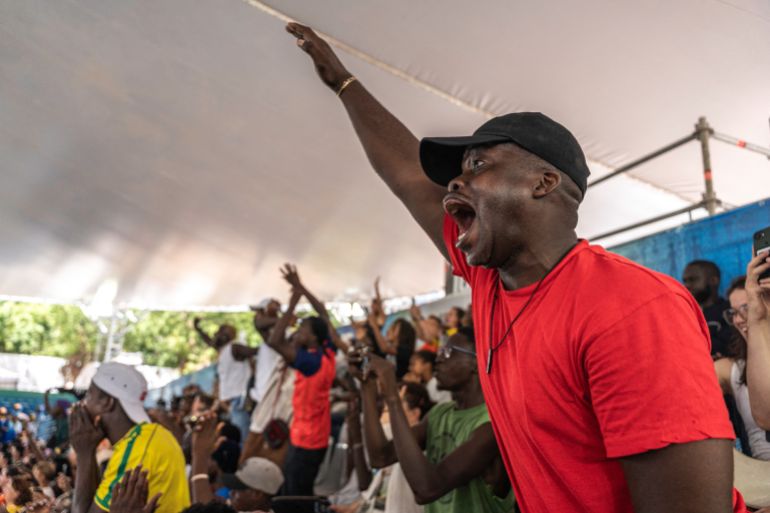
Dakar, Senegal – At the last event of the Dakar Youth Olympics, sneakers shrieked across the floor as breakdancers faced off.
Baggy trousers carried national flags. B-boys and B-girls dropped into six-step footwork, spun through windmills and defied gravity in sudden freezes. Arms became legs, legs became arms, each move a challenge, each response a little more daring.
The competition on Friday, the last in the two-week games, was less about brute strength or speed than invention, creativity, balance and nerve. Each of the teenaged breakers was part gymnast, part basketballer, part boxer all at once, and they brought a fitting energy to the end of a Youth Olympics held on the world’s youngest continent.
Before Senegal became the first African country to host an Olympic event, France’s development agency lent the already heavily indebted West African country 80 million euros ($88m) for sporting facilities for the games. It came as young people across the region are increasingly questioning the former colonial power’s lingering influence.
At Dakar’s railway station, I watched French police helping secure the event. Above them stood a statue of two bronze soldiers – one African, the other French. The African one, named Demba, represents the colonial troops who fought and died for France during World War I. The French one, named Dupont, rests an arm on his shoulder, a gesture of fraternity that others see as colonial paternalism.
Beneath their gaze, politics and history still cast shadows over the games.
At the first swimming medal ceremony I attended, Russia’s 17-year-old Serafima Fokina stood on the podium, gold around her neck, singing her national anthem. Some spectators rose. Others remained seated.
Advertisement
For Russian athletes and their supporters, it was a moment of enormous symbolism: The Russian flag and anthem were back at an Olympic event for the first time since the country’s suspension after its full-scale invasion of Ukraine in 2022.
Israel competed too despite its genocidal war on Gaza. A Senegalese man was arrested over a video opposing its participation that authorities described as threatening.
The International Olympic Committee (IOC) insists on political neutrality, a principle it considers fundamental to the Olympic spirit.
“Youth athletes should not be held accountable for the actions of their governments,” the IOC said, arguing that sport offers them access to hope.
But neutrality is a delicate ideal in a world divided by war, and the flags they carried can never be separated from the conflicts beyond the podiums.
For Palestinian swimmer Alma Shaat, representing her country carried a different weight. She had a message for the children of Gaza.
“Any little girl in Palestine right now, specifically Gaza, I would tell her … to continue following her dreams,” she told me. “She’s not doing it only for herself, but she’s doing it for the people in Gaza and in Palestine.”
Senegal outperform France as China tops medal table
China ended up topping the medals table with 18 golds. Japan were second on 11 golds and Russia third with eight.
Eighty Senegalese athletes had travelled not to France or the United States but to China to train before the fames, part of China’s soft diplomacy. For Senegal it paid off – they finished sixth, five golds to their name, ahead of France.
At her final news conference of the games, International Olympic Committee President Kirsty Coventry fought back tears. The Zimbabwean, who is the first African and first woman to lead the IOC, had helped bring the games to Dakar.
“I am so proud. I’m so grateful,” she said.
Yet it did not all go smoothly. At the Olympic village, the real test of unity came with the heat as athletes stayed in university dormitories without air-conditioning.
Outside the arenas, not everyone could get in. Events sold out. Transport was costly. But neighbourhood sports offered another way to join the celebrations in a city where children play football in the streets, and wrestlers train on the beach.
And sometimes divisions appeared to matter more than national pride.
I overheard a French-speaking Swiss journalist dismiss the prospect of covering a medal won by a German-speaking Swiss athlete. He also complained about the timing of events and the Olympic quota system, which limited participation to one athlete per country per event while giving greater representation to African nations.
Advertisement
But his complaints seemed strangely out of touch with the joyful spirit of the athletes, who were busy rewriting the rules. They had taken hold of the microphones and the cameras themselves. Each became a broadcaster, telling their stories through Instagram and TikTok, reaching audiences well beyond the television networks.
Back at the breakdancing finals, China’s Holy Rain faced Saturn of Chinese Taipei – two teenagers, one from mainland China, the other from Taiwan, dancing out their rivalry.
Amid the roar of the crowd, one spectator leaned towards another and shouted into his ear: “Imagine if their leaders could do the same.”
In the end, Japan’s Hiyo beat Ukraine’s 14-year-old Nikastar for the gold and Spain’s Mini Ali took bronze against Morocco’s Nawel.
Beneath their flags, rivals battled to the sound of hip-hop, then embraced. The flags remained. So did the divisions they represented. But for a few beats, neither seemed to matter.
Disclaimer : This story is auto aggregated by a computer programme and has not been created or edited by DOWNTHENEWS. Publisher: aljazeera.com