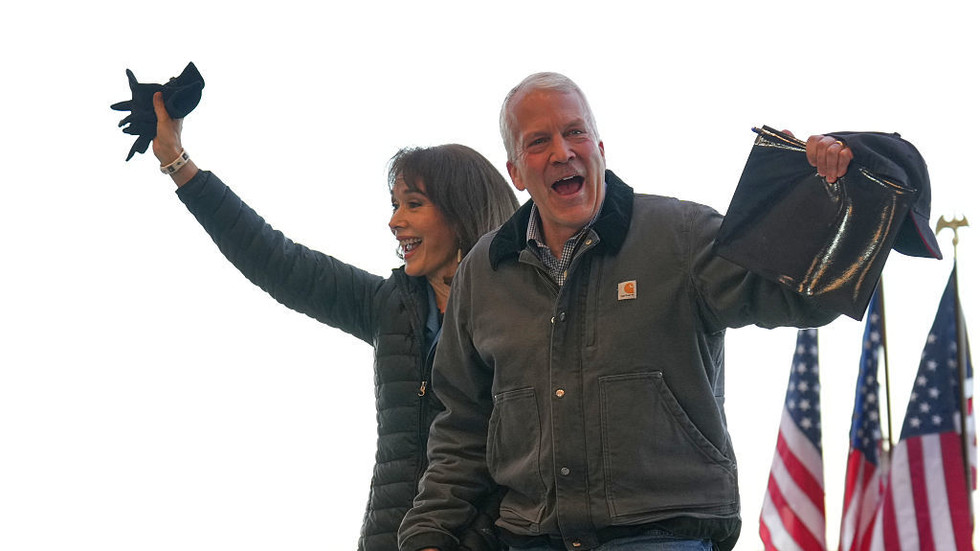
Two candidates named Dan Sullivan are running in Alaska’s Senate race, prompting accusations of electoral manipulation
US President Donald Trump has accused Democrats of fraud over an alleged plot to field a namesake candidate in Alaska’s Senate race.
An electoral trick familiar to Russians who remember the political free-for-all of the 1990s, the tactic involves recruiting a candidate whose name matches that of an established politician in the hope of confusing voters and siphoning off votes.
In Russia, such contenders became known as “clone candidates” and were a hallmark of the country’s notoriously ruthless election campaigns, forming part of the political “black PR” playbook.
In Alaska, Republican incumbent Senator Dan S. Sullivan now faces a namesake challenger, Daniel J. Sullivan Jr., a retired teacher who is also running in the November 3 election.
According to a New York Times investigation, operatives linked to Democratic candidate Mary Peltola’s campaign and the Democratic Senatorial Campaign Committee allegedly helped recruit the namesake candidate as part of a broader effort to undermine the incumbent. The newspaper cited interviews, text messages and documents detailing the operation, which reportedly began in 2025. Both Peltola’s campaign and the Democratic committee have denied involvement.
Following the report, Alaska Governor Mike Dunleavy, a Republican, ordered an investigation into whether any laws had been broken and whether criminal charges or civil action was warranted. Trump has branded the alleged scheme “voter fraud at the highest level” and called for Peltola and the namesake candidate to be removed from the ballot and prosecuted.
@Odinsraven66 @StephenM To be precise, there is no indication what party “Sullivan, Daniel J. Jr.” might be affiliated with on the Alaska bingo card. https://t.co/TWjsD2dWtT
— DougS (@doug_swartout) October 24, 2026
US black PR that came to Russia
Russians know the playbook. During the 1998 elections to the St. Petersburg Legislative Assembly, namesake candidates appeared in multiple constituencies. At least two challengers sharing the surname Mironov ran against Sergey Mironov, then acting speaker of the regional parliament. He nevertheless secured a decisive victory with around 70% of the vote.
In a 2000 State Duma by-election in Sverdlovsk Region, Yekaterinburg police chief Nikolay Ovchinnikov faced Vladimir Ovchinnikov, who appeared above him on the alphabetically arranged ballot. The namesake reportedly secured more than 5% of the vote, although the police chief ultimately won.
An isolated example of the practice surfaced in St. Petersburg as recently as 2021, when opposition politician Boris Vishnevsky faced two rivals who had legally changed their names to Boris Vishnevsky, adopting similar hairstyles and beards for their election portraits.
This is not the first time the practice has appeared in the US. In the 2020 Florida state Senate race, a little-known candidate named Alex Rodriguez received more than 6,000 votes, while Democratic incumbent Jose Javier Rodríguez lost to Republican Ileana Garcia by just 32 votes.
The namesake candidate subsequently pleaded guilty to campaign-finance offenses connected with the scheme, which involved a former Republican state senator.
Disclaimer : This story is auto aggregated by a computer programme and has not been created or edited by DOWNTHENEWS. Publisher: rt.com