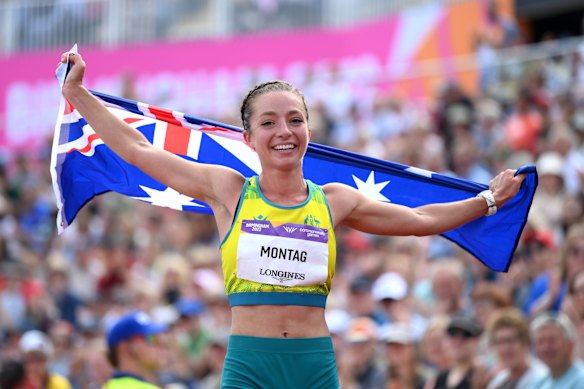

When she won Commonwealth gold four years ago, Jemima Montag had her grandmother walking with her. She wore a bracelet made of a necklace that had belonged to her grandmother, who was a holocaust survivor.
Exhausted after her victory, race walker Montag was still indefatigable in talking about her grandmother’s sacrifice. The bracelet was a tinkling reminder that whatever aches she felt, it was nothing compared with what her grandmother had endured.
Montag’s sport gave her a voice. She proudly used it to honour her family and her Jewish heritage.
A year later, as she walked to silver at the world athletics championships in Budapest, she again spoke of the memory of her grandmother’s long journey from the Nazi death camp of Auschwitz-Birkenau to a life in Australia, and how it drove her on.
A year after that, Montag’s voice went silent. Where she had been proud to be vocal about her heritage, suddenly she was scared.
The world changed only weeks after that silver medal, when Hamas terrorists killed about 1200 Jews in Israel on October 7.
“I was super careful and chose to my hide Jewish identity ahead of the Paris Olympics. The October 7 attacks were less than a year earlier,” Montag said.
“I was so in the public eye before that and event is so public, on a public road when spectators are so close to you and can reach out to you. I was previously so vocal about my grandmother being a holocaust survivor and wearing the necklace and I felt I owed it to her.
“But after October 7, before Paris, I really felt like I had no choice to hide that side of myself in the lead-up. So I would deflect about it in interviews. That was a great shame and I feel sad for that, but to my mind I didn’t have a choice.
“I saw what was happening in the community around the world and felt it was what I had to do.”
She has released herself of that fear now.
December 15 last year was the best and worst day of Montag’s life. In Melbourne’s Botanical Gardens she married her long-term partner Dan Friedman in a Jewish ceremony. Almost at the same time as they were exchanging vows, 15 people were shot and killed, and more injured, at a Hanukkah celebration in Bondi.
“That was really, really hard on the day and for the weeks after to think that at the very moment we were standing under the Chuppah that that was happening in Sydney. I had a hard time disentangling the two and understanding the duality of the human experience, that two things can be true at once,” she said.
“I had had to learn that over the years and it was mirrored on the wedding a day, that a day of overwhelming joy was also a horror for the people of our community.”
Montag, a medical student (her husband is now also a sports doctor), contributed a chapter to a book called Ruptured that considers the experiences of Australian Jewish women since October 7.
“I think things are different now. I think after Bondi there has been a difference in attitudes. A lot of Australians have woken up and non-Jewish friends were able to distinguish the politics from the religion and the culture,” she said.
“My family feel like we are culturally Jewish, we are not religious or political. At our wedding it was about 50-50 Jewish and non-Jewish. I didn’t go to a Jewish school, athletics obviously is not very Jewish, so we had about a 50-50 split of Jewish and non-Jewish friends at the wedding. So to have all of those guests experience such a beautiful cultural ceremony and wake up the next day to something like that on a public beach and park and the TV footage of it in a country like Australia I think was profound.
“I do feel somehow comfortable again speaking about it because I feel like there’s been a shift in the Australian conversation. And maybe I have grown up a bit in the last two years.”
She has also struggled with the perception of Jewish people being entwined with the actions of the Israeli government in Gaza and Iran.
“It’s very hard for people because the symbols are the same. The same symbol of the Jewish people [Star of David] is also on the flag of Israel. They are the same. I can see why it’s super confusing for people. I can see why it is a confusing time for people to separate being Jewish [from the Israeli government].
“I do not have enough knowledge to comment in the political space. I am an athlete and a medical student. My family are in medicine and science, we are not political.”
There is also a tinge of disappointment that she could have had the chance to walk for gold in front of family in the streets of country Victoria, but will instead race in Glasgow at a Games that Victoria is paying for.
Instead of a road race the athletes will walk lap after interminable lap of Glasgow’s small Scotstoun Stadium for a 10,000-metre (not the normal 20-kilometre) race. The team sizes from countries are also reduced, and with them the sizeof the fields in some events.
Montag declares that not only is she confident of a medal, she is confident Australia will win all medals in both the men’s and women’s walks.
“I will say it now, I think we will do a clean sweep of both podiums,” she said.
It is not as bold a prediction as you might think. Even Montag quickly adds some context.
In her event there will be only six women, and three of them will be Australian.
In the men’s event there are only five walkers, and three of those are Australian. Australia literally start the men’s race already on the podium.
Get around our Commonwealth Games coverage
Follow our coverage of the Commonwealth Games with live blogs covering every moment of the action from 6pm AEST daily, beginning Friday, July 24.
News, results and expert analysis from the weekend of sport are sent every Monday. Sign up for our Sport newsletter.
 Michael Gleeson is an award-winning senior sports writer specialising in AFL and athletics.Connect via X or email.
From our partners
Disclaimer : This story is auto aggregated by a computer programme and has not been created or edited by DOWNTHENEWS. Publisher: www.smh.com.au